
The systemd init/service manager is now up to version 201. With systemd 201 comes new features and improvements…
Read more at Phoronix
Last week’s article discussed some of the broad differences between the ODroid-U2 machine and other ARM offerings. While ARM CPUs offer wonderful computing power per watt, in this article we’ll dig into just how fast the ODroid-U2 can perform various tasks. I’ll throw in some benchmarks from large desktop machines so you can get an idea of whether the ODroid-U2 might be fast enough to perform your given workload.
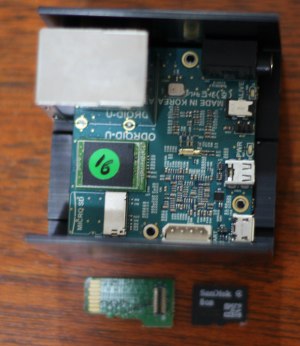 Benchmarks are always a difficult topic. Apart from them being hard to perform well, it is difficult even working out what tests are going to be relevant to users. If you are looking to use the ODroid as a network server, you are likely to be interested in operations like cryptographic digests and signature generation and verification. As the ODroid can use a special eMMC card, you are also likely to be interested in how well that performs relative to a normal microSD card.
The openssl package includes a benchmark that uses a single core of the CPU and performs various speed tests. You can run this test with your installed openssl using “openssl speed” and in a bunch of minutes you will have figures for various tasks on various sizes of data. To make sure I was comparing things fairly close, I compiled openssl-1.0.1e on both the desktop and ODroid-U2. Unfortunately I was using different versions of gcc on both platforms.
ODroid-U2: gcc (Ubuntu/Linaro 4.6.3-1ubuntu5) 4.6.3
Fedora-18: gcc (GCC) 4.7.2 20121109 (Red Hat 4.7.2-8)
Luckily, compiling openssl is itself a good benchmark. It took about 4 times longer to compile on the ODroid-U2 machine than an Intel 2600K (both running at normal specifications, ie, no overclock). I used nice make -j 4 on both machines, so I was only using 4 cores on the 2600K and not taking any advantage of hyperthreading.
ODroid-U2
real    3m59.897s
user    5m52.300s
sys     0m32.840s
Fedora-18/Intel 2600K
real    0m59.684s
user    1m6.102s
sys     0m12.216s
So now on to the openssl benchmark results. For digests, sha256, md5, and sha1 are about 3, 5, and 6 times faster on the Intel 2600K chip than the ODroid. For encryption, aes-256 is about twice as fast on the Intel 2600K. The larger standouts are RSA sign and verify which range at about 16-18 times faster on the Intel 2600K. For such a low power draw chip the aes-256 is surprisingly fast on the ODroid.
The Mail400 GPU on the ODroid when tested using the glmark22012.08 gives an overall score of 78. The first tests for build, texture, and shading all run in the ballpark of 100 Frames Per Second (FPS). The phong shading drops back to 75 FPS.
I bought the 16Gb eMMC card with my ODroid. For benchmarking I have created a roughly 8.5Gb partition starting at address 1153,2288. I created a fresh ext4 filesystem with default parameters, and ran bonnie++ skipping the byte at a time tests. The setup is shown below:
# fdisk -l mmcblk0 | grep mmcblk0p3
/dev/mmcblk0p3        11532288    30777343     9622528   83  Linux
# mkfs.ext4 /dev/mmcblk0p3
# mount /dev/mmcblk0p3 /home/ben/tmp
# chown ben:ben /home/ben/tmp
# su -l ben
$ cd /home/ben/tmp
$ /usr/sbin/bonnie++ -f -m odroid-emmc -d `pwd`
On the eMMC card, sequential output is around 16Mb/s and drops to 12Mb/s on rewrite. Sequential input is at 61Mb/s with around 1300 seeks/s. As for file operations, around 10,000 files can be created and deleted per second. To compare, I used a SanDisk SDSDQU-016G Mobile Ultra microSDHC (Class 10) microSD card, creating a 9Gb partition on it and again using ext4 as the filesystem. Sequential output dropped to around 50-55% of the speed, with rewrite being less than 50% as fast. Sequential input was a major loss running at about 30% of the speed of the eMMC card.
For testing Web browsing performance, I used Firefox on both machines and ran the Octane Javascript benchmark. The Intel 2600K wins as expected, getting 9667 with the ODroid getting 1411 overall. The devil is in the details of course, the Mandreel test is 60 times faster on the 2600K, while the regexp test is only 3.5 times faster on the 2600K. The below table shows how many times faster the Intel 2600K machine ran the Octane benchmark relative to the ODroid-U2.
Richards:  4.5
CodeLoad:  4.9
Splay:     5.3
NavierStokes: 5.8
Crypto:    6.2
DeltaBlue: 6.4
The KDE effects Desktop Grid and Present Windows both have a small noticeable initial delay from when the hotkey is pressed to when the effect is in place. But both effects are usable with four desktops at 720p. The ODROID-U2 is fast enough to replace some desktop machines while living in 5 watts of power at idle and up to around 10 watts under full load. While it doesn’t have the speed to replace high end desktop machines, it is fast enough to be put to many good uses.
 Adapteva plans to release the first batch of its $99 Parallella boards on April 15. That means the company is less than two weeks away from fulfilling its promise of making parallel computing affordable and accessible for everyone. And along with the credit-card-sized computer, CEO Andreas Olofsson hopes to see the creation of an abundance of parallel software applications.
This is the message Andreas (@adapteva) brought to the Linux community in his recent live Twitter chat with The Linux Foundation. Below are some of the highlights from the chat. Have a question he doesn’t answer here? He’ll be on hand at Collaboration Summit April 15-17 where he’ll give a keynote talk on the impact of open hardware platforms and to show off the first Parallella boards coming off the assembly line.
Here, he calls parallel computing “the only practical path to scaling”; explains why his project uses Linux; presents some common use cases for the Parallella; and describes how the Linux community can get involved.
@linuxfoundation Serial processing has hit a brick wall and the onlypractical path to scaling is through parallel processing. #LiveLinuxQA
— Andreas Olofsson (@adapteva) March 28, 2013
.@linuxfoundation Simply because Linux rocks! For a startup company like Adapteva there is really no other practical choice. #LiveLinuxQA
— Andreas Olofsson (@adapteva) March 28, 2013
@linuxfoundation We run Linux (Ubuntu 12.04 desktop version) on the dual core ARM A9 processor on the Parallella board. #LiveLinuxQA
— Andreas Olofsson (@adapteva) March 28, 2013
@linuxfoundation Most common Parallella apps include machine vision, robotics, drones, software defined radio, rendering,.. #LiveLinuxQA
— Andreas Olofsson (@adapteva) March 28, 2013
@linuxfoundation ..also media centers, BOINC, SETI, neural networks, bit-coin mining. #LiveLinuxQA
— Andreas Olofsson (@adapteva) March 28, 2013
@linuxfoundation Some folks want to send the Parallella into space on a CubeSat which we think is pretty cool.#LiveLinuxQA
— Andreas Olofsson (@adapteva) March 28, 2013
@adapteva A Linux supercomputer in space, neat! So how can the #Linux & #OpenSource communities help the Parallella project? #LiveLinuxQA
— The Linux Foundation (@linuxfoundation) March 28, 2013
@linuxfoundation We hope the #OpenSource community will create great applications for the Parallella and passing it forward. #LiveLinuxQA
— Andreas Olofsson (@adapteva) March 28, 2013
The Linux Foundation today is announcing a new Collaborative Project: OpenDaylight.
This is a community-led, industry-supported open source framework on top of which companies, organizations and individuals will build commercial products and services for software-defined networking (SDN).
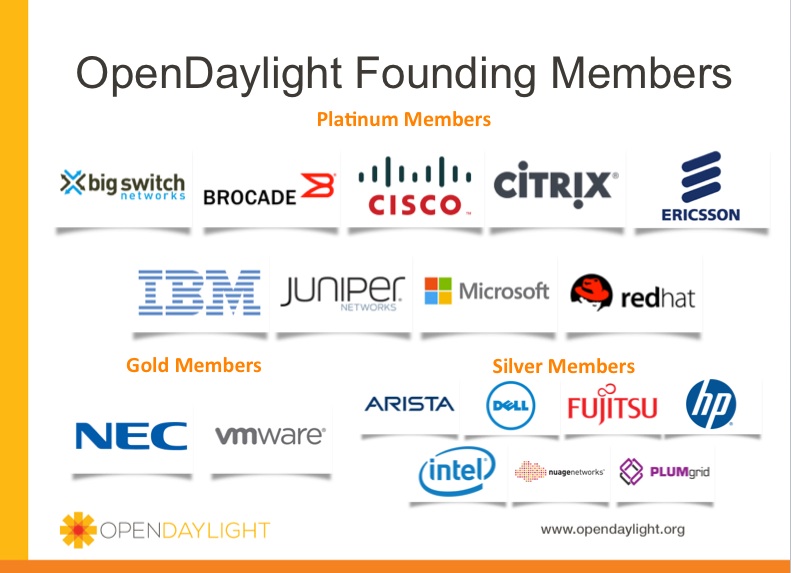 This is about code at the infrastructure level to help shape the future of SDN and every major player is in. This diversity is an early sign of a healthy community and the size and expertise of these companies demonstrate industry-scale support.
By building this level of infrastructure collaboratively, each company can innovate at higher levels of the stack and bring more innovative networking applications to their customers faster. Customers get more choice, better products and services, and increased ease in deployments.
Sounds pretty familiar, right? In the open source community, we know these benefits well. It’s exciting to see the networking industry embrace this strategy. OpenDaylight underscores the trend that is driving innovation today throughout the entire technology industry: a fundamental shift in how software is built – – collaboratively.
In parallel, we have seen how cloud and virtualization technologies have changed every layer of the server and middleware stack. Today the same change is occurring at the networking layer. It’s the last mile of virtualization, and software is literally defining this path forward. We can’t even begin to predict what kinds of networking applications and technologies will come out years from now that will need to be supported.
The companies coming together today understand that the best way to address this historical moment in their industry is to do it together. Collaborative development and open source software, with their rapid iteration and peer review, are the driving force behind modern architectures and well recognized for accelerating technology innovation and adoption.
To facilitate a truly open ecosystem, OpenDaylight is OS agnostic and structured with an open source license, open design, open development, open contribution model and open governance model. The Linux Foundation is hosting this project because of its experience hosting and assisting some of the world’s largest collaborative development projects. Collaborative Projects at The Linux Foundation are independently funded and governed and we’re happy to support OpenDaylight with many of the same open source best practices familiar to other leading projects.
Based on the level of participation I’ve seen so far and the eagerness of the members to contribute code, I fully expect OpenDaylight to become an important part of networking in the years to come.
For more information on the SDN space and how OpenDaylight will address it, you can check out this video made in collaboration by the founding members of the Project: