
In a shocking move, Andy Rubin, Android’s founder, leaves Android behind but will stay on at Google. Sundar Pichai takes Android now as well as Chrome and Apps.
Read more at Enterprise Open Source Toolkit
I’ve always known that Open Source was a “Big Tent”. I worked at the Linuxcaffe (R.I.P.) in Toronto for 4 years, where I met a diverse clientele and was exposed to many exciting Open Source projects. The cafe’s atmosphere was inspired by the tolerance of the Open Source community, and made all sorts feel at home.
That sense was reinforced when I went to this year’s Linux.conf.au conference at the end of January. It was my first conference of any kind, and the first time I had ever been surrounded by people who cared enough about Open Source to spend a week swimming in it.
On the one hand, I was struck by the truth of some of the stereotypes: many beards, more Daves than women, at least one talk on the year of the Linux desktop. On the other hand, however, I was pleased by the diversity and thoughtfulness of the attendees. People had flown in from other countries. The organizers had a designated “diversity officer” to make sure that the conference was consciously inclusive. There were Makers, hackers, coders, writers, sysadmins, DIYers, and artists, all approaching Linux and Open Source with their own agendas.
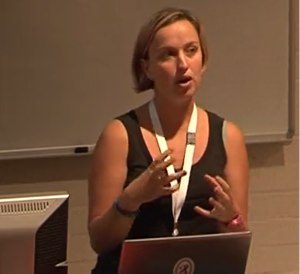 Three presentations in particular brought home the breadth of the community for me, especially in contrast to each other. Sky Croeser talked about her experience of trying to introduce Open Source tools to the production of a high quality anarchist magazine. Alan Leigh from the DSD told us about an Open Source data-recovery competition his department takes part in. And Joshua McKenty’s introductory OpenStack talk laid out the business case of the public hybrid cloud. It wasn’t the content of the talks that I found so illustrative, but the way each presenter framed the subject.
Sky Croeser is a Political Science PhD and activist. She studies the “likeable movements,” the Left, and their use of technology. She immediately took on one of the often-repeated tenets of Open Source by declaring that using Open Source software is making a political decision. Open Source orthodoxy says that there is no politics in good code. Without committing to either side of that debate, I can say that Sky seemed passionate about the transparency and horizontal organization of many Open Source projects.
In her conception of “the user” as a target group with needs that can be solved in code, Sky returned to the Open Source mainstream. In the case of an anarchist collective making a magazine, those needs are: secure communication, secure data storage, tools to simplify collaboration, and professional graphic design, layout, and publishing tools. She noted that because Open Source software is generally developed without a profit motive, it is probably best suited to address security and privacy related needs.
Sky also addressed a need that activists may not have articulated themselves, and a related irony. Activists would like the tools they use to be produced in a way that is consistent with their beliefs. The irony that is that many progressive activists use technology that is in conflict with their stated aims. A possible reason for this, Sky suggested, is one that technologists often overlook. We take our understanding of technology, and its production, for granted. However, more people use tech every day, without any idea of how it is made or where it came from. Activists care about, and advocate for a cause. They want effective tools to use, and may not have time to learn about their provenance.
In a transition that could only take place in a big tent conference like Linux.conf.au, Sky’s talk was followed directly by a presentation by Alan Leigh called “DSD and Open Source Software”. In case you didn’t know, the DSD is the Defense Signals Directorate, an intelligence agency in the Australian Department of Defense. Not only was this an ideological shift in presentations, but it focused on technology rather than experience. Alan didn’t have a philosophy to discuss. He tried to demystify his intelligence agency with concrete examples of how the DSD had contributed to Open Source projects like the “PyFlag” framework (a forensic analysis tool), “White Trash” (a Squid dynamic whitelisting module), and “Spill Guard” (a Microsoft Office data leak prevention tool).
The bulk of Alan’s talk was dedicated to the DSD’s software entry in the Digital Forensic Research Conference 2012 Forensic Challenge to analyze and recover data from hard disks. The rules of the challenge emphasize interoperability, multi-platform support, API consumability as an input to other tools, and Open Source. The DSD entry was called Pronghorn, “a proof of concept block analysis framework” that could harness a number of existing tools to recover information from hard disk images.
As Alan demonstrated Pronghorn in action, he discussed the merits of the Open Source tools for this type of work. In the problem of data recovery, it is easy to see the counterpoint to Sky’s position. Corrupted data may contain valuable information. The best code gets the information out. The uses of the data itself are not the main concern. Alan’s talked focused purely on the importance of building quality, purpose-driven tools, using Open Source software.
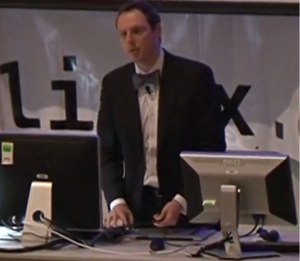 Joshua McKenty’s Introduction to OpenStack talk also recognized the needs of users, and the power of Open Source in meeting them. Joshua gave a historical account of the birth of OpenStack from his time at NASA. His work there related to processing the massive amounts of data NASA was receiving from Mars. When Joshua “got tired of working on an Open Source project that hadn’t released any source code” he put a bunch of his work on his blog. That got him into trouble, and the interest of Rackspace, where similar work was being done. The rest, as they say, is history, as OpenStack came from the combination of Rackspace and NASA code.
Where Joshua’s emphasis differed from Alan’s and Sky’s was in the implications. He talked about the importance of solving big data and resource utilization problems. He nodded to the transparency and collaborative synergies of the Open Source methodology. He put this all into perspective when he said that the companies involved in OpenStack have something like 5 trillion dollars in market capitalization. That is several times the size of the Indian economy. There were two key themes in Josh’s talk. The first was the importance of openness. The second was, “we can all make a lot of money solving the big problems of governments and enterprises”.
That is where OpenStack is quite different from many other Open Source projects: it was created specifically to solve the problems of large organizations. Linux, Python, Drupal, and Apache all exist to fill niches we can mostly relate to. Efficient provisioning of data centers to handle petabytes of data in redundant, disaster-proof configurations, is beyond the experience of the average computer user.
Alan and Sky discussed the ways that Open Source can solve the problems of people, or small groups. Joshua’s talk focused on making money by addressing the needs of large organizations. The only place they could all fit comfortably together is within the big tent of Open Source software.
You can watch Sky’s and Joshua’s presentations. Alan’s was not recorded.

In a steady fashion, almost all users of digital technology and devices are using open source, simply because so many open source software components help drive proprietary applications and platforms. The proliferation of open source components is starting to have a very positive effect on the cloud computing scene. As just one example, Netflix–which has a very robust cloud-based proprietary platform–has released Chaos Monkey and a number of other meaningful open source components that can make cloud deployments stronger.
The problem that MIT researchers are tackling is that cloud deployments often call for a lot of expensive hardware to deal with servers that are partitioned into virtual machines, large memory requirements and more. That’s especially true for database-driven applications.