
With just over a month to go before it is finalised, the openSUSE developers have published a release candidate for openSUSE 12.3 with refreshed desktop packages and an updated kernel.
Read more at The H
Linpus Linux 1.9 “Lite”, a desktop Linux distribution featuring a customised GNOME 3 desktop with HTML 5 widgets and support for touch screens, has been released: “Linpus, a leader in the field of open-source software in the consumer space, announced the release of the latest version…
Much of the excitement around the Raspberry Pi announcement a year ago stemmed from the promise of a $25 version that would follow the initial $35 model. That stripped-down “Model A” version of the open source Linux board is just now reaching customers, creating the potential for a new wave of low-cost, battery-powered gadgets from robots to surveillance balloons and WiFi-connected remote sensors. The unbeatable price and under 2-Watt power consumption furthers the overlap with microcontroller-based boards like the Arduino, and should tempt more Arduino hackers to try out Pi designs.
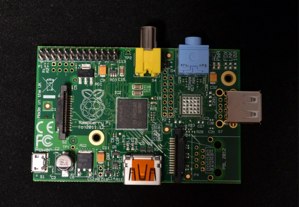 The Model A went on sale to European users starting this week for 15.93 Pounds (about 18.8 Euros) before tax. North American sales at $25 are promised “very soon” (see details farther below).
The Model A uses the same 700MHz ARM11 Broadcom processor as the wildly successful original, but cuts RAM in half to 256MB. It also sacrifices the Ethernet port found on the Model B, as well as one of the two USB ports. It retains the HDMI, RCA video, and audio ports, as well as the SD card, LEDs and GPIO.
Until October, the Model B was also limited to 256MB, and that model has already been vetted on ARM-ready Linux distributions including Arch Linux and the custom-fit Raspbian. The Raspberry Pi Foundation notes that even the XBMC media center distro runs fine on 256MB, although with input limited on the Model A to a USB-based wireless dongle instead of Ethernet, streaming video throughput would drop. The more limited I/O also makes it less compelling for the Model B’s main target application: computer science education.
If the $10 discount doesn’t seem worth the sacrifices, consider this: power consumption is estimated by the foundation to be about a third of the already stingy, 3.5-Watt Model B. More specifically, explained the foundation’s executive director Eben Upton in an email to Linux.com, power usage has dropped by 67 percent.
“The current reductions in power are entirely due to the removal of the Ethernet and USB hub chip,” explained Upton. “We will be doing some software tweaks to bring the application processor power consumption on the A down further. These will apply to the B as well, but their effect will be diluted by the fixed overhead of the Ethernet and USB.”
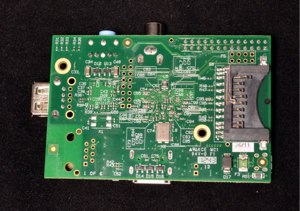 The Model A’s low consumption opens up the Raspberry Pi to more battery- and solar-powered applications, including robotics and sensor networks, says the foundation. Other applications are said to include industrial control modules and automated headless front-ends.
While the Model A retains the 3.37 x 2.125-inch (85.6 x 54mm) footprint and weighs 10 grams less than the Model B’s 41 g, the need for fewer batteries can lighten the load on many devices.
“One interesting area where the Model A’s power consumption translates into actual improvements in performance is in ballooning and rocketry,” said Upton. “The reduction in battery mass will give you an increase in maximum altitude.”
Many of these high-flying applications, including Pi-based hobbyist drones, would also benefit from a new camera module that was unveiled this week. There are few details and no release date on the camera, which will support both Pi models, but according to Wired, it will cost $25 and will likely top out at five megapixels. Previously, the foundation demonstrated a 14-megapixel prototype.
Whether the device is flying, rolling, handheld, or stationary, we can expect to see a new wave of low-cost, WiFi-enabled “Internet of Things” gadgets based on the Model A. Previously, devices with this kind of power/price range have run on low-power microcontrollers beyond the reach of Linux, such as an 8-bit ATmega-based Arduino module.
Considering there’s already significant overlap between the open source Arduino and Raspberry Pi communities, the arrival of the Model A is likely to lure more Arduino hackers to try a slice of Pi. According to Rahul Kar in a Raspberry Pi Blog comparison between the Arduino and Model B, the Arduino can be used as training wheels prior to moving up to a more advanced Pi design.
The Arduino is easier to develop for, has more built-in interfaces, and is more power stingy than the Model A, averaging 0.5 Watts, according to Kar. Yet, the Pi offers more real-world ports and has a much faster processor. The better graphics, video, and networking support is supported with a more dynamic Linux application development environment. Both Pi models are also cheaper than most Arduino boards such as the $50-60 Arduino Mega2560.
There are also Linux-ready alternatives, including the open source BeagleBone, which is roughly the same size as the Raspberry Pi, and offers many similar features. The BeagleBone supplies a 720MHz Cortex-A8, ARMv7 processor that is more powerful than the Pi’s ARM11 chip, and is better capable of running advanced Linux distros like Ubuntu and Android. Further advantages include a real-time clock, more GPIO, interfaces like CAN and ADC input, standard headers, and a built-in touchscreen interface.
But the BeagleBone lacks the Pi’s HDMI port, and sells for $89 — more than three times the cost of the Model A. While its power draw is the same as the Model B’s 3.5 Watts, it can’t touch the Model A’s roughly 1.2-Watt operation.
At least one early bird has already built a gadget using the Model A. On Feb. 5, Jason Birch announced he had converted his Model B-based portable game player for MAME games to a Model A. He reports it now lasts 4.75 hours, up from 3.17 hours, running on six AA batteries.
Although this is not the promised 67 percent reduction, it’s still significant. According to the Raspberry Pi Foundation’s Upton, the discrepancy is probably due to the MAME player’s display, which he said accounts for “25 percent of the power in the original design and 50 percent in the new one.”
Most of the early devices will be similar retrofits of existing Model B projects, said Upton. Indeed, the higher power consumption of the Model B hasn’t stopped hackers from developing Pi-based battery- and solar-powered devices, as well as robots and sensing equipment.
In January, Libelium’s Cooking Hacks open hardware division announced a Raspberry Pi controlled e-Health Sensor Platform designed for testing biometric health products. The device is essentially a wireless-savvy shield that can connect to either Arduino or Raspberry Pi boards. Libelium offers its own commercial Linux-based mesh sensor network called the Meshlium Xtreme.
The Model A went on sale to European users starting this week at Farnell and RS Components, with the latter selling it for 19.22 Pounds (about 22 Euros or $30 US) including VAT, with shipment within a week. North American shoppers will soon be able purchase the board for $25 US plus tax via RS partner Allied Electronics, but with a longer delay expected, says the retailer.