If ever there was any doubt about the business value of free and open source software, a quick glance at the Linux Foundation’s list of supporting memberswill surely suffice to lay any remaining questions to rest.
Many of the world’s largest and most successful enterprises are using Linux and other free software to run and advance their businesses, and that usage is on an upward trend.
Of course, it’s one thing to use free and open source software (FOSS) within the enterprise, but it’s quite another to build a whole business around it. Red Hat is the obvious poster child in that domain, but another promising young upstart is showing significant potential to follow in its footsteps.
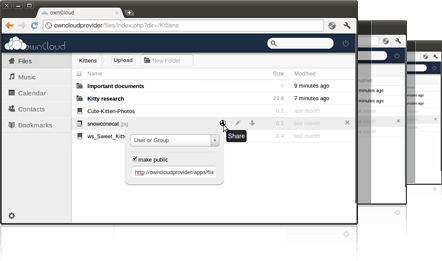
ownCloud is open source file sync and share software that gives users location-independent storage in the cloud. Earlier this month the project celebrated its third year of operation, with milestones along the way including the founding of a company by the same name in 2011.
In light of this recent anniversary, Linux.com had a chance to speak with Frank Karlitschek, ownCloud’s founder and CTO, along with company CEO Markus Rex and Joseph Eckert, vice president of corporate communications, about the open source project, the company, and the lessons learned so far.
“I Saw Problems”
“I was always very involved in free and open source software,” began Karlitschek, whose many roles in the community have included serving on the board of directors for KDE.
“Three years ago I had an opportunity to keynote at a KDE event in San Diego, and I thought, let’s look a bit into the future,” he recalled. “I could already see the trend of things moving to Dropbox, which was pretty much the only solution for cloud at the time. I thought this was interesting, but I also saw problems.”
Specifically, Karlitschek identified privacy and cost issues for home users, and was inspired to launch an open source project to help solve those problems.
“The Control IT Doesn’t Have”
It wasn’t long, however, before it became clear that organizations and enterprises faced many of the same issues as well as a big one specific to the organizational realm: IT control.
“The real problem with Dropbox is not so much security—it has terrific encryption,” Eckert told Linux.com. “It’s control—the control IT doesn’t have.”
Specifically, “the storage is not on their servers,” he explained. “Every organization of any size already has fairly good data storage, privacy and governance, but all these tools go out the window when they use a foreign file sync and share.
“When they use us, it’s a native file sync and share,” he added. “That’s a big deal, and it’s only possible because of open source.”
“We Can’t Do This Alone”
Indeed, numerous factors led ownCloud to choose an open path.
“From the beginning, the main reason for doing it open source was the extensibility—the ability to integrate,” Eckert said. “It’s not just an app with third-party storage; it clings into and can take advantage of your existing IT infrastructure.”
Free software “has the benefit for enterprises that they can look at the code and audit it,” Karlitschek added. “Especially for governments, it has to be free software so they can look at the code, review it, and make sure it’s OK for their sensitive data.”
Given the fast pace at which technology changes, an open development process also has big benefits for the project itself. “Our company can talk about what should or shouldn’t be in ownCloud, but it’s so important to open up and make it transparent, because we get so much input,” he said.
From a startup’s perspective, meanwhile, there are yet more benefits to the open approach. “We are a young company, and we’ve received significant funding, but we have limited resources,” Karlitschek explained. “If our 10 developers, say, try to do as much as Google’s 100, we’re going to fail.”
With an active open source community, by contrast, “we have so many volunteers,” he added. “We can’t do this alone.”
“Enterprises Need Enterprise Features”
Development on the project progressed quickly, with features such as LDAP integration, encryption, photo galleries and music streaming being added early on.
“Sharing files is great, but sooner or later you need to also have something to change and share and edit and view your files,” Karlitschek noted. Also fairly early in the process, ownCloud added a small app store for publishing and sharing plug-ins, for example.
Fast forward a few months, and “it became clear this was a good opportunity for a startup,” Karlitschek said. “Enterprises need enterprise features, consulting, and customization.”
That vision was brought to life in 2011, when ownCloud Inc. officially launched, and it’s already grown to include some 35 employees and 50 enterprise customers. Today, the company is gearing up to launch ownCloud 5.0, which is expected next month with features including a new encryption system.
Lessons Learned
What lessons has ownCloud learned along the way about building a business around open source? CEO Markus Rex had a few to share.
1. “Community is the Key”: “Frank Karlitschek is keeping us honest and open to community needs,” Rex told Linux.com. “The growth of our community, our contributors and our download numbers are proof enough.”
2. “Having a Great Installer Is Not Enough”: “With modern package management, the ease of LAMP and availability of tools like the Open Build Service, installation of OSS applications should always be a breeze,” Rex explained. “But that’s not enough; the focus has to be on a great out-of-the box experience where someone can easily and quickly see the value of the software—in our case, quickly set up a FSS solution for 10 to 20 people. The great out-of-the-box experience is important to our enterprise customers to show them the value of the ‘tools’ we invest in to strengthen our subscriptions.”
3. “Subscriptions Must Provide More Than Support”: “Subscriptions are three things: SLA/support, tools and influence,” Rex said. “Influence on the roadmap, tools including product differentiation, certification and support. This also means that a company creating an OSS business has to put together all of those things and message all of those things at the same time. Our 50+ customers prove that we put this together, but there continues to be a lot of work to do and it will be a continued area of investment.”
4. “Branding is Extremely Important”: “A smart brand and the outreach to the press and analysts through all social media channels is the groundwork for success,” Rex concluded. “One year later we can truly claim that we are—by far—the leading open source file sync and share solution.”



 Version 0.9.4
 A buffer overflow when decoding ASF files has been found and patched in VLC, but the fix is currently only available in source or in nightly binaries. Users should be aware and should avoid ASF files from untrustworthy sources…Read more at
  Ever since Microsoft’s Windows 8 OS arrived, many Linux users have been asking which distribution they can download and install that will just work out of the box on their new certified Windows 8 machines. That’s been a difficult question to answer, thanks to the whole UEFI Secure Boot BIOS implementation found in Windows 8 machines, which prompted last year’s post “