This week, Mozilla has released an update to Firefox 18 that fixes stability issues and the developers of the unofficial Waterfox fork have delivered a version for Windows users who want a 64-bit version of the browser. In the meantime, a controversial and unpublished study from Microsoft and HP claimed that the City of Munich’s migration to Linux had cost the taxpayer a lot more money than officially announced.
At times, I feel like I’m a bit on my own in my opinions of software. Most of it is too big, too bloated, and tries to do too many things while doing none of them well. I like to keep a minimalist approach to the servers I maintain, running only the software that I absolutely need, and nothing more. So, it feels like a breath of fresh air to find suckless.org, “software that sucks less”.
While most of my ideas about server setup and design are from a sysadmin’s level, the members of the suckless.org community are focused on far deeper problems, citing issues with core libraries and programming languages. For example, under their Stuff that sucks page:
These libraries are broken/considered harmful and should not be used if it’s possible to avoid them. If you use them, consider looking for alternatives.
Lennart Poettering decided to refute a few systemd myths on his blog, where “a few” means “30”. “There’s certainly some truth in that. systemd’s sources do not contain a single line of code originating from original UNIX. However, we drive inspiration from UNIX, and thus there’s a ton of UNIX in systemd. For example, the UNIX idea of ‘everything is a file’ finds reflection in that in systemd all services are exposed at runtime in a kernel file system, the cgroupfs. Then, one of the original features of UNIX was multi-seat support, based on built-in terminal support. Text terminals are hardly the state of the art how you interface with your computer these days however. With systemd we brought native multi-seat support back, but this time with full support for today’s hardware, covering graphics, mice, audio, webcams and more, and all that fully automatic, hotplug-capable and without configuration.“
With the Intel Haswell product launch coming up soon, here’s a look at how the Intel “Ivy Bridge” HD 4000 graphics support has matured on the seven most recent Linux kernel releases. This benchmarking shows how the performance of the Intel DRM driver has changed between the Linux 3.2 kernel and the Linux 3.8 kernel that’s presently under development when using the integrated graphics found on the latest-generation Core i7 CPU.
Since openSUSE is a community driven project the candidate will have to work with the openSUSE community prior experience with FLOSS communities will be a plus. The candidate will work with several senior graphical designers at SUSE.
The openSUSE Team, together with the openSUSE community develop a wide variety of activities that requires design skills, such as the distribution itself, tools interfaces….Read more at Muktware
A new public development release of Elive, a Debian-based distribution featuring a highly customised Enlightenment 0.17 desktop, is out and ready for testing: “The Elive team is proud to announce the release of development version 2.1.27. This version includes some miscellaneous features like: multiple improvements in Enlightenment 0.17….Read more at DistroWatch
Last week I pointed out how Google is contributing a lot to Coreboot since they are enjoying this open-source BIOS/UEFI because they can ship it on Chrome OS devices for allowing very fast boot times, great customization possibilities, and good security with having full source access. In this article are some development statistics surrounding Coreboot to show the most prolific contributors, the pace of development, and other traits for this open-source project formerly known as LinuxBIOS…
Linux gets my pick as the best multi-media production platform because it is flexible, efficient, and secure. Your system resources are going to your work, rather than in supporting a bloaty operating system further bogged down by marginally-effective anti-malware software. In our previous installment we covered a range of excellent drawing and painting, photography, 3D rendering, and desktop publishing applications for Linux. And my favorite Linux distros for serious multi-media production.
Today we’re going to enjoy a tasty sampling of the high-quality video creation and editing software for Linux. You oldtimers are probably familiar with these, but there are more Linux newcomers than ever, so let’s start with…
OpenShot
I really really really like OpenShot. It probably won’t impress professional videographers who like having a million bells and whistles (or maybe it will), but it impresses me for its useful feature set and excellent user interface. This is my #1 choice for beginning video editors because of its ease-of-use, and its well-chosen feature set.
The Power of Love, Gabrielle Aplin, created with OpenShot and Ardour
It supports high-definition video, Blu-Ray, 3D, tethered shooting, integration of video, audio, and still images, all the usual effects such as scrolling titles, pans, and fades, animations, speed changes, audio mixing, export to multiple formats and quality levels including YouTube and Vimeo, and tons more. It is under active development and has great community support. This may be the only video program you’ll ever need.
Blender
Blender is a fabulously sophisticated 3D computer graphics and animation creator. Check out the Blender gallery for a sampling of movies created with Blender. It supports a large range of high-end abilities such as ray-tracing, key-frame animation tools, object tracking, super nice character modeling, realistic physics for great liquid and smoke/mist/gas effects, and realistic movements of objects and characters, and excellent realistic light effects.
The main learning curve with Blender is developing a grasp of all of these concepts; once you get that part down it’s like a light goes on and everything makes sense. It also has a nice game-creation module, and superior compositing.
Cinelarra
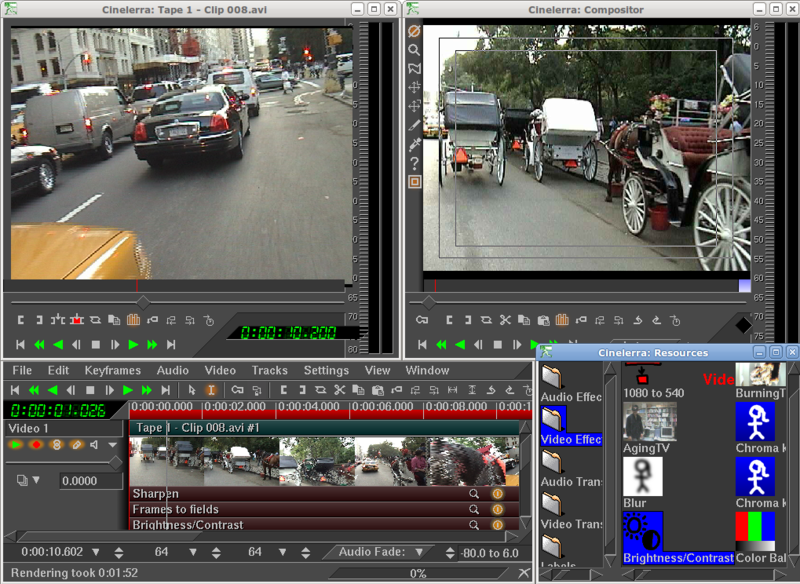
Cinelarra is for video producers who need more than OpenShot, and who want a native Linux professional-quality video editor that supports high-resolution audio and video, and advanced features such as hue and saturation, overlays, denoising, compression, normalization, time stretching, realtime effects, nested sequences, color balance, image flipping, text-to-movie, batch render and batch capture, compositing, and much more. Cinelarra has nice integration between audio and video, and makes it easy to control synchronization. Blender and Cinelarra work well together; create your splendid animations in Blender and then integrate them into a movie in Cinelarra.
Cinelarra has two versions: the unsupported community version and a commercial edition. Every six months the nice Cinelarra developers release the latest source code. It’s not widely available in the usual distro repositories, but the good Cinelerra-CV folks bundle it up into Arch, Debian, Fedora, Ubuntu, and other distro packages. There is a Cinelarra PPA— Personal Package Archive– for Ubuntu users. PPAs are user-supported repositories for specific applications, like Cinelarra. They’re not official repos, but they allow you to use your normal Ubuntu package manager to install and remove third-party software.
Of course there are many more good video editors for Linux such as Kdenlive, PiTiVi, Avidemux, and Lightworks for Linux keeps getting a lot of attention even though it’s still vapor. It is a feast of riches, so enjoy!
Three years ago today we flipped the switch on at opensource.com. Technically, we removed the htaccess file to allow anyone to access the site. Since that point, we’ve been steadily providing stories that highlight how open source is having a positive impact on the world and building a community around that mission…Read more at OpenSource.com
Dice this week released it’s annual Salary Survey (2013-2012 Salary Survey) and the results were good news for everyone, showing the largest jump in tech salaries in more than a decade. But the news was especially sweet for Linux pro’s.
Furthermore, while average tech bonuses were down a bit, Linux pro’s saw a bump in bonuses.
Why does Linux talent garner a higher salary and bonus? At least one reason can be found in what Dice cited as the three skill areas in the highest demand: mobile, cloud and data. Linux is the foundation for each of these technology trends – from Android in mobile to open cloud and the high-performance servers that support big data. Generally, Linux runs more of today’s computing infrastructure than ever before, and the demand for Linux talent and the benefits that come with those jobs is supporting evidence.
If you’re interested in learning more about Linux, whether you’re a total newbie, have flirted with the mailing lists or are an experienced Linux pro, you might check out what the Linux experts have told us about how to get paid to work on Linux. The biggest piece of advice? Start contributing to open source projects now and build your reputation. So much software is developed today in the open, and it creates a virtual resume of your work. Don’t be a phantom.
It’s never been easier to get involved in Linux. What are you waiting for? The payoff could be huge for you, and your contributions huge for the advancement of Linux.

 This week, Mozilla has released an update to Firefox 18 that fixes stability issues and the developers of the unofficial Waterfox fork have delivered a version for Windows users who want a 64-bit version of the browser. In the meantime, a controversial and unpublished study from Microsoft and HP claimed that the City of Munich’s migration to Linux had cost the taxpayer a lot more money than officially announced.
 Lennart Poettering decided to
  A new public development release of Elive, a Debian-based distribution featuring a highly customised Enlightenment 0.17 desktop, is out and ready for testing: “The Elive team is proud to announce the release of development version 2.1.27. This version includes some miscellaneous features like: multiple improvements in Enlightenment 0.17….Read more at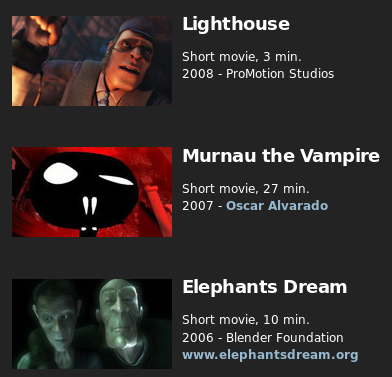

 Dice
Dice