

Community Driven Ubuntu Phone Core Apps
 When we announced Ubuntu for phones on the 2nd January, we also had a call for volunteers to help create the core applications that would be part of the platform. Like any phone OS we need to provide a calendar, calculator, email, social media apps and more. Ubuntu has long been an open community project and we wanted to work with our community from the outset to work on a set of apps that we can all be proud of.
To do this we included a form on developer.ubuntu.com and asked interested Qt/QML developers to fill it in if they were interested in participating. In just a few days we had over 1500 people fill in the form, expressing tremendous interest in being part of these projects and making an awesome Ubuntu phone platform.
We then finalized our list of apps that we think we need and then reached out to the most experienced of these volunteers and broke them into teams, with one team per application…Read more at jonobacon@home
Is this 3D-printed robot the first of thousands?

I love the one-upmanship going on in the word of 3D printing.
At CES 2013 I saw 3D-printed skateboards, flowers, and gear assemblies, and meanwhile there are now plans to print everything from body parts to buildings. So printing robots was only a matter of time.
InMoov is a full-size humanoid robot made from 3D-printed parts. Designed and built by Gael Langevin of Factices Ateliers in France, InMoov began last year as a hand, then an arm. It’s now two arms and a head…Read more at CNET News
Do Linux Servers Need Antivirus?
 Having your datacenter audited at the office can be a painful experience. One of the toughest is known by the initialism “PCI”, which stands for Payment Card Industry. The PCI audits are in-depth, and require several layers of security, logging, and documentation. Unfortunately, many of the requirements of such audits are derived from a Windows centric environment, and make little sense in a pure Linux system. At the top of this list is the requirement for anti-virus to be installed on all servers, but how necessary is this precaution in real life?
A couple of my coworkers and I like to play a bit of a game, we pick out a system and see how long we can keep it up without requiring a reboot. (Current winner right now is sitting at 1761 days, not sure if we will be able to beat that.) There are reasons why that machine has not been updated, and we take appropriate precautions to restrict access to the box. There was even a time, years ago now, when we ran our web servers with a default install of SUSE (SuSE? SuSe?) Linux with a public IP address on the Internet, and left them there, unpatched, for years. I’m not saying this was a good idea, it certainly was not, and it is not something I would do today, but requirements were different then. We did frequent checks of the server health and monitored the logs, and never saw a problem. Talking with other Linux sysadmins and open source enthusiasts, I don’t think I’m alone with this experience…
Originally published on Ostatic.
Wrap-up: Live Linux Q&A on Getting Started with Linux
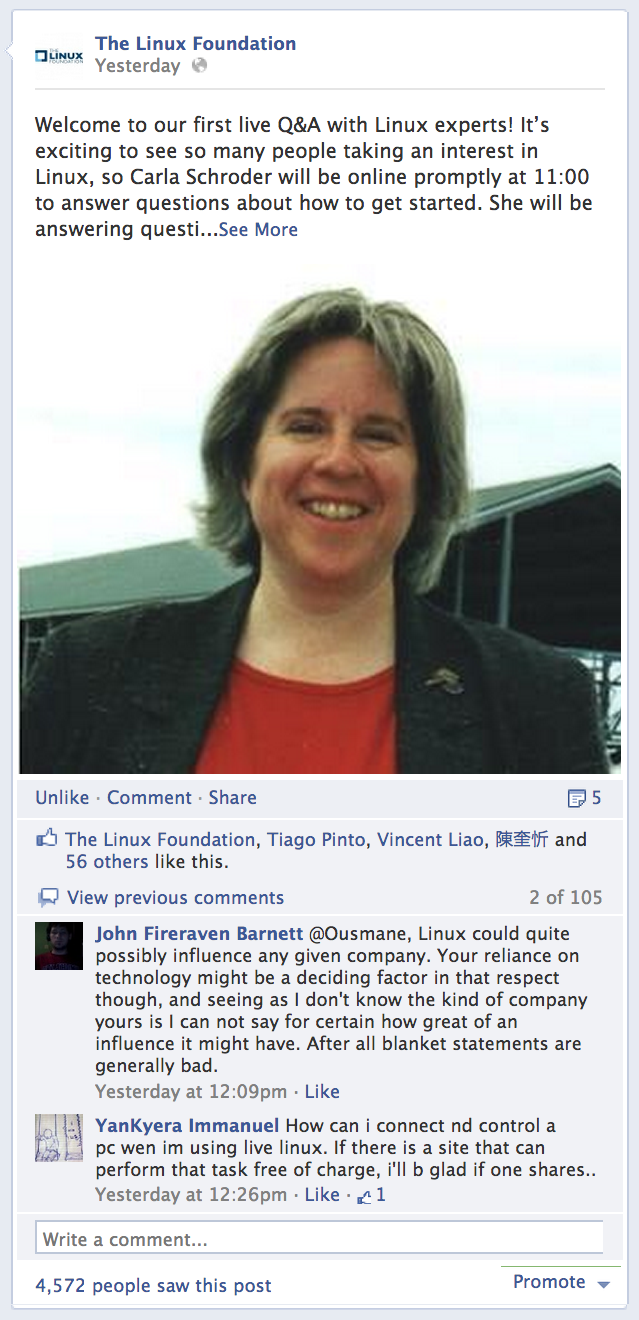 We recently conducted a Live Linux Q&A on Facebook, which was our first in a new series of live Q&A opportunities with Linux experts hosted on The Linux Foundation’s social channels. This debut Q&A featured Linux.com freelance contributor Carla Schroder, who answered questions about how to get started with Linux.
Questions were received by community members on topics ranging from malware to popular OEMs and distributions to virtualizaiton software choices, and much more.
Generally for new users, Carla recommended “getting familiar with how to install and remove software. Linux distro’s have centralized software repositories – – kind of like app stores, but Linux has had them almost from inception – – so managing software is super easy.”
Carla wasn’t the only one answering questions, either. Members of the community chimed in with helpful advice for everyone. David Chiodo suggested Linux User Groups as one place to start for newbies, for example.
There was some debate about whether or not CentOS was the best distro choice for noobs. Carla suggested it for system and network admins wanting to learn their way around Linux. Other Q&A participants suggested Ubuntu and Peppermint.
Some members of the Live Linux Q&A wanted to know more about going from newbie to pro and how to become certified. Carla suggested that the top three skills to get under your belt before choosing a specialty would be: bash scripting, basic network and system administration, and proficiency in another scripting language like Python, Ruby or PHP. She also suggested Red Hat, LPI and The Linux Foundation for Linux training and certification.
Carla suggested not to rely just on books, since Linux is developed so rapidly and books can become out of date quickly. She suggested reading distribution documentation to keep up to date. Specifically she recommended Red Hat documentation, as well as Arch Linux, which she said is great choice for new sysadmins. Carla also suggested online resources such as Linux.com, LinuxToday, LWN.net, The H and Lxer.
To review the comments and conversation in more detail, you can visit the Live Linux Q&A on Facebook.
These Live Linux Q&As will rotate throughout our social channels, from Facebook to Google+ and Twitter to LinkedIn, so you can connect when/where it makes the most sense for you. And, we’ll be sourcing experts from a variety of places that include Linux.com, our Linux training instructors, the Linux kernel development community, Linux community projects, our members and more. Stay tuned here at my blog and in our social channels for updates on the next Live Linux Q&A.
In the mean time, you can find lots of resources from throughout the community. Keep an eye on our Linux training opportunities, as well as Linux.com for free tutorials and tips.
Puppet Labs gets $30M investment from VMware
 VMware puts $30 million into the open source and enterprise configuration and management framework company, becoming its largest investor…Read more at The H
Open Source Skills Continue to Have Clout in the Job Market
 Career site Dice.com is out with results from its 2013-2012 Salary Survey, which confirms that times are getting much better for people seeking technology-focused jobs. And, in particular, the results reflect a trend that we saw gaining pace last year, which is that skills with open source platforms and tools can greatly increase your likelihood of getting hired and commanding a top salary. Here is more on what Dice found.
“Technology salaries in the U.S. saw the biggest jump in more than a decade, according to the 2013-2012 Salary Survey from Dice, the leading career site for technology and engineer professionals,” said Dice’s announcement, which added:
“Out of the big three, mobile, cloud and data, there’s one that is having a disproportionate impact on salaries – it’s big data. Salaries reported by those who regularly use Hadoop, NoSQL, and Mongo DB are all rospects look state-by-state in the United States…Read more at Ostatic
Ubuntu developers debating move to rolling release model
 There could be major changes coming in how Ubuntu is released next year if the Ubuntu kernel developers have their way. In a broadcast conversation between Ubuntu Kernel Team Manager Leann Ogasawara and Canonical developer liaison Daniel Holbach, Ogasawara talked about discussions that the Ubuntu kernel developers had been having concerning switching the distribution’s release cycle to a rolling methodology with Ubuntu 14.04. The plan could see Canonical, the company behind the distribution, release a long term support (LTS) version every two years with rolling updates in between. Ogasawara and Holbach, both Canonical employees, acknowledge the virtues of the new approach to the developers, but Ogasawara is sceptical that users of the distribution would be satisfied with a concrete release every two years…Read more at The H