Home Blog Page 2066

Microsoft may invest $1B-$3B in Dell buyout, report says

Microsoft may contribute $1 billion to $3 billion to help take Dell private, according to a new report.

CNBC’s David Faber, citing sources, said the Redmond, Wash., software giant is in talks with Dell CEO Michael Dell and Silver Lake Partners, the private equity firm eyeing a Dell buyout. He noted the investment wouldn’t necessarily give Microsoft a significant equity stake in the company, but would help raise the funding needed to complete a deal…Read more at CNET News

Nouveau Can Beat NVIDIA With Cairo In Select Cases

Chris Wilson has shared his testing experience of Cairo with NVIDIA ION hardware on the open-source Nouveau driver and the closed-source NVIDIA blob. In certain situations, the Cairo performance does better with Nouveau than the official NVIDIA Linux driver…

Read more at Phoronix

Calling All Hackers: Pwn2Own 2013 Is Offering Big Money for the Best Hacks

Slowly but steadily, the Pwn2Own hacker contest has become an important fixture in the world of testing the security of software applications, operating systems and hardware devices. The computer hacking contest is held annually and gets sponsored by titan-sized technology companies.

Last year, we reported on how a group of French hackers won cash prizes in the competition for uncovering big bugs in the Google Chrome browser.  This year, HP TippingPoint, a sponsor of Pwn2Own, has made clear that it is expanding the focus of the competition beyond browsers. Also, Pwn2own 2013 will include $560,000 in prize money for demonstrations of exploits in the major web browsers, Adobe Reader, Adobe Flash or Oracle Java.

Pwn2Own always runs in conjunction with the CanSecWest security conference, which is coming up March 6 to 8 in Vancouver.

According to a TippingPoint post:

“The contest will take place the 6th, 7th, and 8th of March in Vancouver, British Columbia during the CanSecWest 2013 conference. This blog post will be updated as the contest plays out and get real-time updates by following either @thezdi or @Pwn2Own_Contest on Twitter or search for the hash tag #pwn2own”…Read more at Ostatic

NetworkManager in GNOME beta supports AP operation

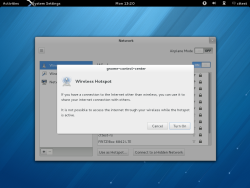
Network ManagerIn the latest GNOME 3.8 beta, NetworkManager makes the transition from version 0.9.6.4 to a pre-release version of NetworkManager 0.9.8. In addition to setting up an ad-hoc Wi-Fi network, where the Wi-Fi hardware and drivers support it, it is now able to set up an access point. The next major release of the network configuration program, which is used in many other desktop environments, also supports 4G LTE network modes, bridge master devices and bridge ports…Read more at The H

LTSI v3.4 Released

Part of supporting the demand for Linux in consumer electronics is ensuring there is a common Linux base that is maintained and supported for the typical lifetime of a consumer device, usually two years, and that supports a large variety of consumer electronics products. The Linux kernel is released at such a rapid pace that until now, device makers were doing significant back-porting, bug testing and driver development on their own, which carried substantial cost in terms of time-to-market, as well as development and engineering effort to maintain those custom kernels.

LTSIThe Linux Foundation’s Consumer Electronics (CE) workgroup founded the Long Term Support Initiative (LTSI) to address this issue collaboratively. Today, the project provides for both an annual release of a Linux kernel suitable for supporting the lifespan of consumer electronics products and regular updates of those releases for two years. Linux kernel maintainer Greg Kroah-Hartman oversees this maintenance and the LTSI kernel tree for this industry-wide project created and supported by Hitachi, LG Electronics, NEC, Panasonic, Qualcomm Atheros, Renesas Electronics Corporation, Samsung Electronics, Sony and Toshiba.

This week the CE working group is releasing the LTSI 3.4 kernel. It is based on the Linux 3.4.25 kernel release and includes a number of backported features from newer  releases.

 Highlights from today’s release include:

* The Contiguous Memory Allocator (CMA), which is extremely useful for embedded devices that have very limited hardware resources and will better handle the large memory requirements of multimedia applications. CMA originally was merged into the 3.4.0 kernel release, but its functionality was quite limited. Since then, the feature has been significantly improved in thekernel.orgreleases and those fixes have been added to the LTSI 3.4 kernelrelease. For more information about this kernel option, please visit LWN.net.

* AF_BUS, a kernel-based implementation of the D-Bus protocol. This feature was created for systems that required a faster D-Bus speed than the existing userspace method could provide, specifically the automotive entertainment systems. For more information about this feature, please see LWN.net.

* CoDel (controlled delay), a transmission algorithm that optimizes TCP/IP network buffer control, is backported for LTSI 3.4. This is a feature used to help control the “buffer bloat” problem that has been identified by the networking community as an issue that all devices need to be aware of. This feature was backported from the 3.5.0 kernel.orgrelease.  For more information about it, please see this LWN.net post.

Platform specific board support was backported from newer kernel versions, allowing the Armadillo 800, AT91, kzm9d, kzm9g, and Marzen platforms to work properly with this release.

For more information about LTSI and the latest release, please visit the LTSI website. 

Please Join Us: The 100 Linux Tutorial Campaign


100 Linux Tutorials

We know that the Linux community is growing. It’s getting bigger every year as it moves across industries and geographies. Our Who Writes Linux paper documents each year the increasing number of contributors, sponsors and the pace of development. Only the collaborative development model can deliver and support this kind of rapid growth.

The Linux development community is responsible for some of the most important technology breakthroughs of the decade. Just take a look at the recent Consumer Electronics Show (CES) to see the kinds of products and innovations that Linux is making possible. To sustain this virtuous cycle, we need to spread knowledge and information about Linux to the masses. There are thousands of “newbies” coming to Linux every day. We see them online, at our events, in our Linux training courses and joining The Linux Foundation as individual members.

But how can we as a community make sure that developers and IT managers new to Linux have the basic information they need to start contributing and benefiting from Linux right now? We’ve come up with one way we think we can help, but we can’t do it alone.

The 100 Linux Tutorials Campaign is a yearlong effort to build a collective knowledge base of Linux videos.

We invite you to share your knowledge with users and developers new to Linux. You can help remove barriers to learning Linux and transfer expertise around the globe. This contribution to Linux is a very important one. We know that together we can achieve our goal of collecting 100 Linux tutorials this year and making learning Linux as easy as clicking the mouse. We’ve already had contributions from Linux kernel developer Greg Kroah-Hartman and other members of the community.

You can share original video tutorials you’ve created, or you can upload Linux tutorial videos that you’ve found helpful to the Linux.com video forum from other locations. As we begin to receive the videos, we will feature and promote the best ones. This will spread the information fast and give the video creators (you!) exposure in the community.

We’re planning a celebration for when together we hit the 100 milestones. Stay tuned for more details as we edge closer to the triple digit.

Please join us and be a part of this worldwide effort. Upload your Linux tutorial now.

Your First Bite of Raspberry Pi

I have to give Kyle Rankin all the credit for my Raspberry Pi collection. I never really felt geeky enough to do anything with an Arduino, and for some reason I mentally lumped the RPi into the same world. Boy was I short-sighted! Thankfully Kyle showed me the light, and I managed to snag some of the new 512MB model B units. more>>
 
Read more at Linux Journal

Samsung mobile head confirms 8-inch Galaxy Note

An 8-inch Samsung Galaxy Note no longer exists solely in the realm of unicorns and Apple TVs. A Korean news site is reporting that Samsung mobile honcho JK Shin has confirmed plans to release a midsize version of the tablet.

Samsung’s game plan of late seems to be to cover all bases, with a wide array of smartphones and tablets that come in a variety of shapes, sizes, and price points. An 8-inch Galaxy Note to continue the trend could debut at February’s Mobile World Congress…Read more at CNET News

Security advisories for Monday

LWN.net LogoDebian has updated asterisk(regression in previous update).

Fedora has updated php-ZendFramework (F18; F17; F16: denial of service), drupal6-context (F18; F17: information disclosure), gnupg (F17; F16: memory access violations), kernel (F18: denial of service), moin (F18: multiple vulnerabilities), rubygem-actionpack (F18: multiple vulnerabilities), rubygem-activesupport (F18: multiple vulnerabilities), rubygem-activerecord (F18: multiple vulnerabilities), thunderbird (F17: multiple vulnerabilities), and gnupg2(F16: memory access violations)…Read more at LWN


How To Upgrade From Fedora 17 To Fedora 18 With FedUp (Desktop & Server)

How To Upgrade From Fedora 17 To Fedora 18 With FedUp (Desktop & Server)

This article describes how you can upgrade your Fedora 17 system to Fedora 18 with the help of the Fedora Updater (FedUp). The upgrade procedure works for both desktop and server installations….Read more at HowtoForge