
We’re back! It’s 2013 and we have three more profiles to share with you in our 30 Linux Kernel Developers in 30 Weeksseries. We’ll be introducing another series a little later in the year that we hope can further help to illustrate the inspiring community of individuals that build Linux. If you have ideas and/or feedback on these kinds of series, please let us know in the comments section.
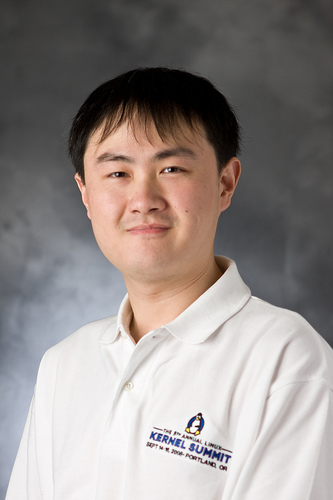
Today we profile Herbert Xu. His answers are both concise and wise.
 Name
Name
Herbert Xu
What role do you play in the community and/or what subsystem(s) do you work on?
I co-maintain the crypto subsystem. I also participate in the development of the network stack.
Where do you get your paycheck?
What part of the world do you live in? Why there?
Shanghai, China. It’s a great place to be in general. It also hosts a lively Linux community.
What are your favorite productivity tools for software development? What do you run on your desktop?
My favorite development tool is elvis, a vi clone. I run Gnome on my desktop but most of it is filled with a single terminal running screen.
How did you get involved in Linux kernel development?
I started out as the Debian kernel maintainer in 1997 and went on from there.
What keeps you interested in it?
Being at the cutting edge of technology always excites me.
What’s the most amused you’ve ever been by the collaborative development process (flame war, silly code submission, amazing accomplishment)?
How people work round the clock on a single problem and are still able to stay fresh thanks to time zones.
What’s your advice for developers who want to get involved?
My advice is the same as Jay Leno’s advice for driving in China: “Be careful, but be strong.”
What do you listen to when you code?
Silence.
What mailing list or IRC channel will people find you hanging out at? What conference(s)?
#netdev
LinuxCon
 The Nexus 7 seems to have become the tablet development platform of choice; now webOS Nation
  The open-source AMD Radeon Linux graphics stack has been deprecating the user-space mode-setting (UMS) code for a while and is now finally making the kernel-space mode-setting (KMS) support the default Radeon interface for the Linux kernel…Read more at
  Anke Boersma has announced the release of Chakra GNU/Linux 2013.01, the fifth update of the project’s “Claire” series featuring the new KDE 4.9.5 desktop: “The Chakra project team is proud to announce the fifth ‘Claire’ release, (a code name that follows the KDE SC 4.9 series). The day….Read more at
  Computing industry powers are doubling the data-transfer speed of USB 3.0 from today’s 5 gigabits per second rate to 10Gbps.
 If you need to get your luxury oven warmed up before you get home for your frozen gourmet pizza or beef roast,
  Probably no other Linux team was any more excited by Enlightenment’s recent
  Read more at
  A project to move NASA’s content management system to an open-source-based architecture has been slowed down because of a bid protest by a proprietary vendor, according to a report by Frank Konkel in
  It’s the time of year when many writers and analysts are considering what lies ahead for leading technologies in the next 12 months, and Jim Whitehurst, Red Hat’s often-quoted CEO, offered up his views on the matter in a