Home Blog Page 2090

Half of all app store revenue goes to just 25 developers

Apple’s App Store and the Google Play store each claim to offer over 700,000 apps to choose from, but only a tiny fraction of them bring in significant revenue for their developers, according to research from analyst firm Canalys.

In fact, the company says, of the $120m in total revenue generated from paid app downloads and in-app purchases in the US during the first 20 days of November 2012, fully half was split between just 25 developers.All but one of those top 25 earners were game developers, including Disney, ​Electronic Arts, Gameloft, Glu, Kabam, Rovio, Storm8, and Zynga, among others.

Read more at The Register

Development Release: Red Hat Enterprise Linux 6.4 Beta

Red Hat Enterprise LinuxRed Hat, Inc. has announced the availability of the beta release of Red Hat Enterprise Linux 6.4: “Today, Red Hat announced the beta availability of the next minor release of Red Hat Enterprise Linux 6, Red Hat Enterprise Linux 6.4. This release includes a broad set of updates….

Read more at DistroWatch

MariaDB Foundation to Safeguard Leading Open Source Database

“The MariaDB Foundation has the potential to become a new beacon for the MySQL ecosystem. SkySQL is pleased to support the Foundation,  which can show leadership and continued evolution of the most widely used Open Source database.†said Patrik Sallner, CEO of SkySQL

Peter Zaitsev, co-founder of Percona said “We are delighted to support the MariaDB Foundation. We see the Foundation as a way of guaranteeing the stability and production engineering we need in the core code we share with so many other companies and users…” Read more at the MariaDB blog.

Most Popular Android Tablet: Nexus 7

Click here to read Most Popular Android Tablet: Nexus 7There are plenty of great Android tablets on the market now that weren’t around even a year ago. If you’re looking for one to wrap up for someone special, get your game on, or get some work done, you have plenty of options. Earlier last week, we asked you which models you thought were the top of the class, and then we took a closer look at the five best Android tablets. Now we’re back to crown the overall winner.

Google’s Nexus 7 took the top spo by a broad margin with over 55% of the total vote. Most of you praised its size, battery life, beautiful display, and …Read more at Lifehacker

Google grants $23 million to nonprofits in new award program

Scott Harrison, CEO of charity: water, onstage today at LeWeb 2012.The funds go to will go to philanthropic organizations tackling big global programs using novel applications of technology. Google today announced a new charitable grant program designed to help solve big problems using technology. Today the company announced its first round of Global Impact Awards, granting $23 million to seven organizations it says are changing the world.

Read more at CNET News

OpenACC Still Not Loved By Open Compilers

The OpenACC 1.0 API has been public for more than one year as an open standard to simplify parallel programming on CPUs and GPUs, but to this point it’s basically only backed by commercial compilers. OpenACC is similar to OpenMP in terms of using PRAGMA compiler directives and special functions for tapping multiple CPU cores in an easy and straight-forward manner with C/C++ and Fortran code, but unlike OpenMP, OpenACC is also aware of GPUs…

Read more at Phoronix

Web served, part 3: Bolting on PHP with PHP-FPM

A Web server that can only serve out static pages is fine for a lot of folks. If you just want a homepage with a list of your favorite links and some pictures of your cat, then a bare Web server is all you need. However, if you want to learn about doing more interesting stuff—setting up a forum or a wiki, or using popular blogging apps—then you need some way of generating dynamic content—that is, a website that can be changed or updated programmatically, rather than one made simple static files.

As with most Web server-related things, there are many paths to dynamic content. However, some of the most popular Web applications—things like phpBB, MediaWiki, WordPress, and Drupal—use a server-side scripting language called PHP. That’s what we’re going to install, because it’s relatively easy to get PHP up and running and because having PHP available gives you a tremendous amount of flexibility in what you can do with your Web server.

PHP-FPM

One advantage Apache has over Nginx is the ease with which PHP can be enabled. Nginx, unlike Apache, has no ready-made modules to install, so there are several packages we need to pull down and several configuration files to edit to get PHP working. Never fear, though—we’ll cover every detail…Read more at Ars Technica

Keen On… Ray Kurzweil: How Computers Will Reverse Engineer The Human Mind By 2029

Screen Shot 2012-12-02 at 7.54.35 PM

A new Ray Kurzweil book is always a major event. And his latest work, How To Create A Mind: The Secret Of Human Thought Revealed, is classic Kurzweil – both infuriatingly brilliant and brilliantly infuriating. Given Kurzweil’s remarkable intelligence, it might not be a coincidence that How To Create A Mind is a book about intelligence – focusing, in classic Kurzweilian territory, on the growing intelligence of machines. As Kurzweil told me, with products like IBM’s Watson, Apple’s Siri and Google’s self-driving cars, we are already on the road to a world in which computers will operate at the level and with the speed of the human mind.

This singularity of the mind and the machine will be reached by 2029, Kurzweil explained to me. In the meantime, he told me, there are many opportunities – from biotech, electronics, and neuroscience to natural language – for entrepreneurs to help build this brave new world.

So is Kurzweil right? Are we really on the brink of reverse engineering the brain so that technology will know how to create a mind? And if so, as I asked Kurzweil, how will the arrival of truly intelligent machines affect the human mind itself.

Read more at TechCrunch

A round-up of all things Steam right now! [GOL]

Time to do a round-up of all the latest on the Steam front for all of you, especially those not including themselves unofficially in the beta.

Steam Client
Firstly Steam itself got updates:

  • added libgl1-mesa-glx and libgl1-mesa-dri dependencies to the Steam package
  • fixed the minidump generator to upload properly versioned minidumps
  • initial bootstrap now generates minidumps
  • fixed window titles for the Gnome desktop
  • fixed overruns when drawing multi-line text
  • fixed crash that occured when downloading TF2
  • bootstrapper now continues execution even if UI can’t be displayed
  • fixed numpad key symbol occurences when in Num Lock mode
  • fixed a common joystick crash

There are still of course a number of issues still present like when visiting Discussions using the Steam Linux client it gets laggy because of the hover over text (where it shows you a snippet of the post within).
You cannot close it to any kind of tray icon, closing just minimizes the application….Read more at Gaming on Linux


Linux Tips: The Misunderstood df Command

I call df, or disk free, the misunderstood command because new Linux users often expect it to tell the sizes of directories and files. But it doesn’t do that– it’s for displaying useful information on filesystems. When you invoke it with no arguments, it shows free and used space on all mounted filesystems, their partitions, and mountpoints:

$ df
Filesystem      1K-blocks       Used Available Use% Mounted on
/dev/sdb1        29222392   19353412   8404256  70% /
udev              1982916          4   1982912   1% /dev
tmpfs              809892       1072    808820   1% /run
none                 5120          0      5120   0% /run/lock
none              2024724       1388   2023336   1% /run/shm
/dev/sdb3       593262544  200333868 363234532  36% /home/carla/moarstuff
/dev/sda1      1730404792 1616359192  27442000  99% /home/carla/storage
/dev/sda2       221176480  160279584  49824796  77% /home/carla/1home
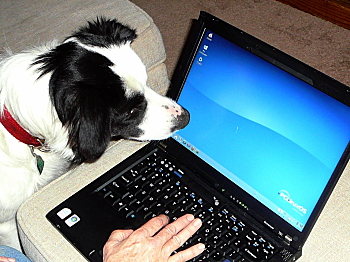
firecracker the dog is fascinated by Linux filesystemsFirecracker the dog is fascinated by Linux filesystems


Add the -h switch for human-readable format, and get rid of the virtual filesystems that exist only in memory, and display just the partitions on your hard drives with grep:

$ df -h |grep ^/
/dev/sdb1        28G   19G  8.1G  70% /
/dev/sdb3       566G  192G  347G  36% /home/carla/moarstuff
/dev/sda1       1.7T  1.6T   27G  99% /home/carla/storage
/dev/sda2       211G  153G   48G  77% /home/carla/1home

df does not operate on individual files or directories, but only filesystems. If you give it a file or directory name as an argument, it gives information for the filesystem the file is on:

$ df -h /var
Filesystem      Size  Used Avail Use% Mounted on
/dev/sdb1        28G   19G  8.1G  70% /

I like it for quickly finding out which partitions files are on. It identifies the filesystem types with the -T option:

$ df -Th |grep ^/
/dev/sdb1  ext4    28G   19G  8.1G  70% /
/dev/sdb3  ext3   566G  192G  347G  36% /home/carla/moarstuff
/dev/sda1  btrfs  1.7T  1.6T   27G  99% /home/carla/storage
/dev/sda2  ext4   211G  153G   48G  77% /home/carla/1home

And you can hunt down specific filesystem types:

$ df -ht btrfs
/dev/sda1  btrfs  1.7T  1.6T   27G  99% /home/carla/storage

Consult man df and man grep to learn more about what these excellent commands can do. Both are non-destructive commands that only read information, so you can experiment safely.