
Various improvements to the major open-source Linux graphics drivers will be landing with the Linux 3.8 kernel in the months ahead…
Read more at Phoronix
A few years ago, Brazilian developer Daniel Neis Araujo couldn’t imagine building open source health care equipment that could compete with traditional and respected proprietary solutions. But recent advances in Linux and the open hardware movement have allowed a faster development pace and a lower cost of entry for startups in the telemedicine field, in particular, he said.
 So six months ago he co-founded Atto Systems Engineering in Florianópolis, Brazil, with the aim of making intercommunication between medical devices better and cheaper. They’re using Android on BeagleBoard to help solve some critical issues, including system consistency after crashes over time, touchscreen interfacing, supported hardware and overall system performance.
“We think that if we can push a little more of the “linux philosophy” into this field, we’ll make it better,” Neis Araujo said via email.
The startup has faced some criticism from the health care establishment for its open source technical approach, he said. But they’re trying to solve problems that would otherwise have no commercial viability.
“When a few kids, in a short time … creat(e) solutions as good, as stable and cheaper than the few proprietary ones, well, they are magicians (not the case), or the technical tools they use must be really powerful,” Neis Araujo said.
This is not his first open source project. Neis Araujo has worked since 2005 as a developer on Moodle, a Learning Management System at Federal University of Santa Catarina that provides virtual classrooms for teachers and students to interact via forums, quizzes and other activities.
He later went to work for the university, helping to maintain its main Moodle deployment and assist in e-learning undergraduate and post-graduate courses. He’s worked with Linux since taking an undergraduate computer science class in 2004.
“Today, the whole infrastructure we use for the Moodle deploys at UFSC are based on Linux, Apache and MySQL (and recently we’re trying Nginx),” he said. “I help tune and keep all these services running for 500K+ visits / week.”
He recently joined The Linux Foundation as an individual member to give back to the community and get more involved with kernel development. Welcome Daniel!
It may still be a bit early for the ubiquitous end-of-year story looking back at 2012, but even now, it seems safe to say that the “Linux preloaded” trend will surely go down in history as a big part of what has characterized this year in desktop computing.
Back in July, we recounted a few of the Linux-preloaded options that had emerged in recent months, and since then many more have appeared.
 Think Linux is just a hobbyist’s platform for manual installation by experts who already know it well? Think again. As the following examples show, vendors are increasingly selling it preloaded and ready to go as a compelling Windows 8 alternative.
1. System76 Sable Complete
Fans of Linux in general and Ubuntu in particular are no doubt already familiar with System76, and late last month the company released its Sable Complete all-in-one Ubuntu desktop starting at $749.
With a 21.5-inch, high-definition 1080p display, this new desktop PC features edge-to-edge glass and aluminum trim along with quad-core, third-generation Intel Core i5 or i7 processors and Intel High-Definition 2500 or 4000 graphics.
2. System76 Bonobo Extreme
Even more recently, System76 unwrapped its 17.3-inch Bonobo Extreme, a high-performance Ubuntu laptop featuring what the company calls the “world’s fastest” mobile GPUs as well as memory capacities of up to 32GB, as much as 3TB of storage and a  3rd generation Intel Core i7 CPU. Pricing starts at $1,499.
3. ThinkPenguin
Then, too, there are new options preloaded with Linux Mint available through that distro’s new online store. Offered via a partnership with ThinkPenguin, these new desktops start at $249 while notebooks are priced from $499. Either way, 10 percent of the purchase price goes towards the Linux Mint project.
4. Asus F201E
Looking a bit further back, we’ve also seen Asus launch not just one but two laptops with an Ubuntu Linux option. First, there’s the Asus F201E with an 11.6-inch HD display, a 1.1GHz Intel Sandy Bridge dual-core Intel Celeron 847, and an Intel HD 4000 integrated video subsystem. With 4GB of RAM and a 500GB hard drive, this device is priced at 299 euros, or about $382 — 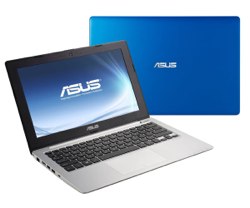 considerably cheaper, it’s worth noting, than the Windows 8 equivalent.
5. Asus X201E
The Asus X201E, meanwhile, is a lower-end version of the F201E that features a 1.1 GHz Intel Celeron 847, 2GB of DDR3 RAM and a 320GB hard drive. Pricing was expected to be in the vicinity of $315 and the computers are now available through select online stores.
6. Diablotek
Last but not least, there’s the Diablotek U310 all-in-one PC-in-a-keyboard now available for $199.99 on Amazon. Featuring an Intel Atom D525 1.8GHz dual-core processor as well as 1MB L2 cache and 2.5 GT/s DMI, this device includes 2GB DDR3 RAM along with a 500GB SATA 2.5-inch hard drive. Ubuntu Linux is the operating system that comes preloaded.
Linux-preloaded PCs may not yet be in every corner computer store, but there’s no doubt the options are increasing rapidly. For those who wish for a Linux PC every holiday season, 2012 may be the year that wish finally comes true.
In this video, Buddy Bland from Oak Ridge National Laboratory describes the new Titan supercomputer, which just came in at #1 on the TOP500. As a hybrid system, Titan derived 100 percent of its LINPACK performance from NVIDIA K20X accelerators.
We were able to get a 10x improvement on our LINPACK score versus what we got with Jaguar three years ago for only 19 percent more power. So that’s a big win. And that carries over to the many applications also. We will see a big improvement in the performance with only a minor increase in the total power that’s being used. And we have to do that as we move to the Exascale machines that we’ll be building in the future.”
Related posts:
 It’s no secret that Linux has marched to much success on servers over the years, but not everyone knows that much of the infrastructure of the web sits on Unix and Linux platforms. Web survery frim W3Techs has compiled its latest numbers on this front, and in addition to the fact that almost a third of websites surveyed report using Linux, a surprising seven percent of respondents say that they’re running Ubuntu. That includes popular sites such as TMZ.com, according to W3Techs.
W3Techs’ numbers for Ubuntu usage reflect growth, too. Last year, the firm had only 5.5 percent of responding sites saying that they used Ubuntu. TMZ.com, Twitpic.com and numerous other popular sites cited Ubuntu use.