
The Pixman rendering library is out with a major new release that presents several interesting new features…
Read more at Phoronix

The Galaxy S III has overtaken Apple’s iPhone 4S for the first time ever to become the top selling smartphone for Q3 2012, according to Strategy Analytics. Samsung claimed the pole position by shipping 18 million copies of its flagship handset during the quarter, compared to Cupertino’s 16.2 million iPhone 4S units. Of course, serendipity is also likely at play, as the iPhone 5 hit shelves towards the end of that period, likely cannibalizing 4S sales — in fact, the market research firm thinks Apple’s new top handset will likely trump Samsung in Q4. That means the Korean giant may have to step up its game, or it’ll just be keeping the top spot warm for its arch-competitor. Check the PR after fold for more info.
Continue reading Samsung Galaxy S III dethrones iPhone 4S as smartphone sales champ for Q3 2012
Filed under: Cellphones, Mobile, Apple, Samsung
Samsung Galaxy S III dethrones iPhone 4S as smartphone sales champ for Q3 2012 originally appeared on Engadget on Thu, 08 Nov 2012 06:25:00 EDT. Please see our terms for use of feeds.
Permalink  TNW | | Email this | Comments

Municipalities across America should be working to bring open source educational tools to schoolchildren so they will have the necessary digital literacy skills to tap into their creativity and imagination, or even to provide them with valuable future life and workforce skills. And the case of the Feoffees of the Grammar School in Ipswich, Massachusetts—the oldest charitable trust in America—illustrates this point well.
This week CloudStack 4.0 released its first code since Citrix turned the project over to the Apache Foundation in April. The release brings CloudStack one step closer to graduating from incubation to a top level Apache project.
CloudStack 4.0 also brings an array of new features, though the open source cloud computing platform has been largely focused on legal documentation and code review.
 The first noticeable change is Amazon EC2 and S3 integration. But the most anticipated additions are key networking functions similar to those in OpenStack’s recent Folsom release with the integration of the Quantum project.
That the CloudStack release would mirror its rival open source Infrastructure-as-a-Service platform shouldn’t be a surprise considering that the projects are looking to solve similar problems in software-defined networking, said David Nalley, an Apache CloudStack developer at Citrix. Both projects also employ developers from Nicira (now part of VMware), the originator of Quantum, he said.
“It’s in everyone’s best interest to work with the next generation networking technology,” said Chip Childers, an engineer at Sungard Availability Services and a CloudStack committer. “The specifics about how each software package deals with network topology design and automation isn’t as important as getting it in and integrated.”
Two of the top features in CloudStack 4.0 were already integrated into Citrix’s commercial cloud but hadn’t yet made their way into the upstream open source version, Childers said:
“It’s modeled after Amazon, but its use case is driven toward customers that like tiering of their applications,” Childers said.
2. Integration with Nicira’s Network Virtualization Platform (NVP) product provides inter-VLAN routing.
“Traditional network virtualization is becoming much more intelligent,” Childers said. “Interacting with new networking controllers is important for scaling user experience in a way that doesn’t strain resources.”
Looking forward to a 4.1 release, Citrix’s Nalley says there are plenty of ways to get involved in the project. Once 4.0 is out, the community can choose which features it will focus on next. And many proposals have already been submitted in anticipation of the CloudStack Collaboration Conference in Las Vegas, Nov. 30 – Dec. 2.
“The important thing is we continue to march on and add functionality and features,” Nalley said.
As the project matures and reaches top-level status at the Apache Foundation, Childers also hopes to accelerate the pace of integration with other technologies into 4.1.
“I’m looking forward to working with others in the community to see what kind of internal re-factoring we need to do for new technologies to be integrated and support projects that want tighter integration,” he said.
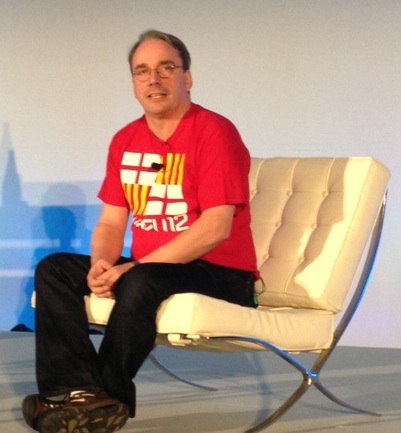 When Linus Torvalds sits down for a chat, people listen. And at Torvald’s keynote presentation Wednesday morning during LinuxCon Europe, the standing-room-only crowd proved just how much star power the Linux kingpin has. Accompanied by long-time collaborator and pal Dirk Hohndel, Torvalds fielded chummy questions from his friend as well as lively challenges from the audience. Here are a few of the highlights.
Hohndel: Linux is at drinking age now; it’s 21 years old. Everyone wants to know what’s next, but before we go there, what has been your favorite highlight of the last 20 years?
Torvalds: The biggest highlight is the thing I didn’t expect. Twenty years ago, I sat in a dark room alone. I was a single person working on a small project on my own. These days, what makes Linux so much fun is the discussion, the community, the arguments. It keeps us interested, motivated, and always discussing how things can be done better.
Hondhel: That’s an insider answer. What has been your biggest impact outside this community?
Torvalds: It’s not about what I achieved, but what we achieved. It’s about what Linux has allowed others to do. Think about the One Laptop Per Child project. There are so many people doing things with Linux to improve the world.
Audience: What worries you about future?
Torvalds: I’m an optimist. I’m not really worried about future, and I don’t worry about the technical side of the kernel at all. The things that make me stay up at night are usually around difficult personal relationships. The kernel people like arguing. And while being heated is not necessarily bad, sometimes our personalities clash … a lot. Then there are the legal situations. The patent system is just broken, and bogus copyright laws are very irritating.
Audience: The kernel is always changing. What can you tell companies that want to use Linux, but are struggling to keep up with all the changes?
Torvalds: Hardware companies like to use Linux in the embedded world, but they come from a model where you do development for 1-5 years and then leave it unchanged from 5-15 years. Some embedded companies want us to use this same development model. But we can’t say that we won’t change the kernel, because we need to stay stable internally. I don’t think our model is going to change much.
Hohndel: The ability to make changes is one of the major strengths of Linux. We do our development upstream. Embedded hardware companies should try a little harder to work upstream. It’s an advantage. It’s a way to innovate and create interesting products.
Audience: The kernel keeps getting larger and larger. Is there some procedure to get rid of the things that don’t work and that no one uses anymore?
Torvalds: We do remove code occasionally, but only if it has major problems. We have two architectures that haven’t worked for two years, but there’s a reason why we haven’t removed them. There’s always somebody, some random person, who will step up and fix parts that don’t work. It’s fun to see. There’s no cost for maintaining code that no one uses and that doesn’t work, so it’s better to just leave it be in case someone wants to come in and maintain it.
Audience: What about the Google Android situation?
Torvalds: The Android “situation” is no different than the Red Hat or SUSE “situation” 10 years ago. A lot of vendors end up doing their own forks. Google said they needed to make these changes, and we just decided that the Android thing was working for Google. There was a lot of discussion and bad blood about this. People tried to convince Google to change they way they do things. But this is how development happens. Companies come up with new usage models, and it tells us that we need to change. Google has one hundred million devices running their code. They must be doing something right.
Audience: The kernel maintainers are getting older. What about your efforts to recruit younger people?
Torvalds: We are, by admission, 20 years older than we used to be. At the same time, we have all kinds of young people coming in all the time, even high-schoolers. But because the kernel is so important for so many companies, we also get a lot more established professionals whose job it is to do kernel development work.
Hohndel: I know you won’t give us a 5-year outlook about where we’re going, but what about the next 6 months?
Torvalds: We have things coming up. There’s been a lot of discussion about ARM 64 but most of it has been about the name, not the code. In the end, my will prevailed, and it will be named ARM 64. As for kernel releases, they aren’t based on features, but instead on the 3-month release window. So I don’t need to plan ahead. We get it all ready, and whenever it’s ready it gets merged. Really, we don’t have a lot of plans, but everyone seems happy.