
Cloud strategy is now indivisible from enterprise computing – can Oracle retain its vast customer base in this new era?
Read more at ZDNet News
Finland native, LinuxCon Europe keynoter and Eucalyptus Systems CEO Marten Mickos took a few minutes to share his latest thoughts on what open cloud really means and what role Linux and open source software are meant to play in the technology shift being prompted by cloud computing. LinuxCon Europe takes place November 5-7, 2012 in Barcelona.
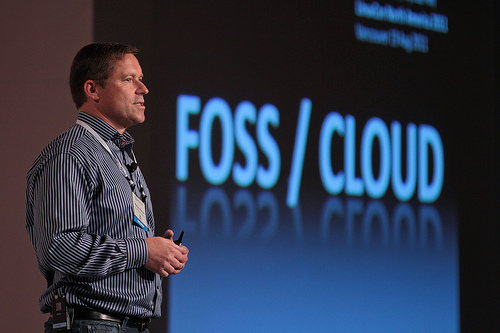 Q: We know that your keynote presentation will address how open source cloud platforms are liberating application workloads. Can you give us just a bit more about what we can expect from this keynote?
Mickos:The purpose of a compute cloud is to provide freedom to application workloads: freedom to scale elastically, freedom to run on public or private infrastructures, and generally freedom from the underlying hardware. Increasingly, those workloads are mobile apps and services. In my keynote, I will present the Eucalyptus vision for the future of cloud, and what that means for those who build apps and those who build and operate clouds.
Q: Can you tell us more about your partnership with Amazon? It seems quite unique.
Mickos:Amazon Web Services and Eucalyptus struck a partnership earlier this year with the purpose to bring more compatibility between AWS and on-premises environments. We work together in two ways. We address customer needs together where there is a need for workload movement or separation between public cloud and on-prem environment. And AWS helps us increase the level of AWS compatibility in our product. Today we have game services, telecom equipment manufacturers and government agencies who are using AWS and Eucalyptus in concert. Longer-term, it seems that nearly everyone will need a hybrid cloud.
Q: When people talk about the open cloud, what does it mean? Is it open standards and APIs, or is it access to the source code? Both? What really matters?
Mickos: Openness provides many distinct benefits. With open APIs, you have the freedom to move to another provider. With open source code, you have the freedom to modify the code, which equates to freedom from lock-in. With higher level cloud services (SaaS), it’s important that your data is not locked in. We believe all of those things matters. That’s why we built Eucalyptus as an open source platform, implementing the leading cloud API with open source code. Can’t get more open than that.
Q: The last time the IT industry experienced a major shift, it was due to Linux and open source software. It transformed the industry. Today, cloud computing represents another major shift. What role does Linux and open source play now?
Mickos: We have learned by now that open source is *always* a superior way to produce software. But open source software has an even more important role in the infrastructure that keeps our online world running. Infrastructure software components have critical dependencies on each other and only by keeping the code open can you fully trust that the entire system can be quickly fixed if something is wrong in one of its pieces. Linux and the hypervisors in its kernel are at the center of this new world. Eucalyptus clouds run some of the most pioneering workloads in the world, and every now and then we detect a weakness in a software component that we interact with. We have direct access to the code and direct contact to the team that maintains the code, and within days or just hours, the problem is usually fixed. You don’t get that in the closed source world.
 Open source cloud computing solutions have been proliferating, as businesses and organizations demand flexible solutions for deploying public and private cloud applications. Among these solutions, OpenStack remains one of the highest profile examples, with vendors ranging from Hewlett-Packard to Red Hat to Dell supporting it. But, OpenStack competes directly with Eucalyptus Systems, which we’ve covered since its inception here at OStatic, and with Citrix’s CloudStack.
Despite all this competition among open source cloud platforms, we noted the other day that not everyone is so smitten with the trend. And, according to the results of a new survey from Zenoss, there are many concerns about open source cloud offerings.
 Researchers are using supercomputers to understand how high-frequency computer trading is changing Wall Street. At the University of Illinois, assistant professor of finance Mao Ye and Chen Yao and Jiading Gai used supercomputing resources made available through the National Science Foundation’s XSEDE program. Launched in July 2011, the program supports research in areas not traditionally involved with HPC.
Fifteen years ago, trade was done by humans,” says Ye, “and you didn’t need supercomputing to understand and regulate the markets. Now the players in the trading game are superfast computers. To study them you need the same power. The size of trading data has increased exponentially, and the raw data of a day can be as large as ten gigabytes.”