
Big Blue updated its Power server line, launched a new high end storage system and gave its latest mainframe a software update.
Read more at ZDNet News
Jos Poortvliet has announced the availability of the initial development build of openSUSE 12.3: “Milestone 0 of openSUSE 12.3 is out! While we’re still discussing the schedule and won’t be deciding anything before the openSUSE Conference in Prague later this month, development is picking up steam. Changes: KDE….
The past year or so has seen a number of new technologies emerge based on The Linux Foundation’s Yocto Project, including several that have gone on to be certified as officially Yocto-compatible through the project’s new Compliance Program.
Swedish Enea is one of those; in fact, along with Mentor Graphics and Wind River, it was among the very first companies to be named Yocto Project compliant.
 That happened back in August, but recently Enea has made the news again, this time for the release of version 2.0 of its Yocto-based Enea Linux distribution. Launched late last month, Enea Linux v2.0 is a hardened, commercial grade Linux distribution for next-generation communications and networking systems.
More than half of the world’s macro cell base stations and more than three out of four LTE base stations run on Enea software, the company says. Now, with this new update, Enea Linux is reaching a new level of maturity.
120 Packages for Telecom Needs
The Yocto Project was created in October 2010 with the aim of simplifying the build process for teams working on embedded Linux systems such as routers, NAS devices and the like, regardless of the hardware architecture that’s used.
“Yocto is becoming the de facto standard for building and configuring embedded Linux,” Enea says on its website. “By utilizing Yocto, Enea Linux leverages the open source community to provide a mature product in less time, and customers meet a familiar environment in which there is no lock-in or hidden agendas.”
Enea first announced its Yocto-based Enea Linux distribution back in March, complete with more than 120 packages chosen specifically for telecom needs. Since then, the integrated, modular system has been providing a comprehensive cross-development tool chain and runtime environment for common networking target architectures.
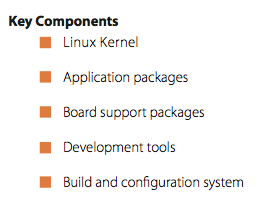 An All-Linux Solution
Enea’s Light-Weight Runtime Threads (LWRT) technology, for instance, offers improved real-time characteristics in Linux user-space, delivering scheduling, message passing, and resource management functionality. The result is that applications can run with improved determinism and minimal overhead, thus addressing some commonly held concerns about traditional Linux solutions.
LWRT is an all-Linux solution based on a single Linux kernel, and it combines high throughput and low latency. The user-mode scheduler in LWRT can handle context switches deterministically in significantly fewer cycles than native Linux can, Enea says.
With guaranteed performance and quality of service, Enea Linux supports both reference and customer target hardware and can be customized or adapted as needed.
‘We See Broader Uses of Linux’
The new release is significant, and “it will be interesting to watch as software continues to play a larger role in everything from infrastructure to networking to storage to applications,” 451 Research senior analyst Jay Lyman told Linux.com.
“I think it also highlights how we see broader uses of Linux in virtual and cloud computing server instances, mobile devices, embedded systems, etc., but we also continue to see the advantages of access to source code and customization in specific industries and verticals,” Lyman added. “In the case of Enea, we are seeing a Linux distribution specifically tuned to meet the connectivity, scalability and performance demands of today’s wireless industry.”
Most of the work in open source communities takes place over mailing lists, IRC, code repositories, and ticketing systems. In other words, efficient collaboration tools that let folks from all over the world work together without having to be in the same location. But face-to-face meetings are valuable too, which is why we’re putting together the CloudStack Collaboration Conference this fall.
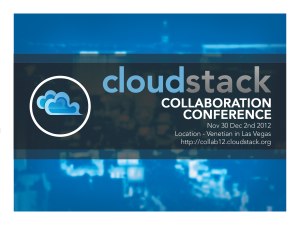 So what’s the conference all about? In a nutshell, we’re getting users, developers, and integrators together to share information about CloudStack. We’re also conducting a number of workshops to help developers learn about CloudStack, and to discuss some of the ideas for future releases of CloudStack.
We also want to make sure that we hear from others in the IaaS ecosystem. We’ll have talks and workshops that center on configuration management, monitoring, virtualization, and so on.
Since the event is in Las Vegas, it should go without saying that we also will be having plenty of fun to offset all the hard work going on at the conference. We don’t want to give away too many details yet, but you won’t want to miss our evening events!
Want to get involved? The conference is free to attend, and will be appropriate for anyone working with or thinking about deploying an open cloud based on CloudStack.
The dates for the conference are Nov. 30 – Dec. 2. You can register today. Note that it’s free to attend, but we have a hard limit on the number of folks who can attend – so be sure to register quickly!
The event is being held at The Venetian, and we’ll have a special rate for attendees. Watch the website for more details on that.
Want to present at the conference? We’re looking for talks and workshops on the following:
Deadline is Oct. 5, which is approaching rapidly. See the CloudStack Collaboration Conference site to submit a proposal.
If you’re interested in CloudStack in particular, or open cloud in general, there will be a lot to like at the CloudStack Collaboration Conference. If you’re working with or thinking about deploying an Infrastructure-as-a-Service cloud, you don’t want to miss the conference.

It’s no surprise that the pace of technological innovation in the startup and web development world greatly eclipses the pace of technology adoption at most enterprise organizations. Enterprises are generally slow, risk averse, and demand long-term support for products in which they invest. Startups, web development shops, and open source enthusiasts move at a significantly faster pace. While some enterprises are just now moving from the venerable CVS version control system to something like Subversion, the bulk of today’s generation of developers are using git (and GitHub).
Enterprises looking to attract new talent would do well to figure out how to use git, since most new hires will come in with mastery of it and will find it annoying to use crufty older version control systems. Unfortunately, enterprises often have well-established release processes built around their existing tools, making it extremely hard to replace them with something new like git.
Perforce, the company behind the Perforce version control system, is today announcing Perforce Git Fusion in an effort to bring the best of both worlds to enterprises and their developers. Perforce’s commercial version control system has typically been targeted at traditional enterprises, who benefit from its access control mechanisms and compliance auditing. The Perforce Git Fusion product purports to allow developers to use git just like they normally would but actually store everything in the Perforce central system.