
The new tablet, which has disadvantages and advantages when compared with the Google Nexus 7, is clearly priced as a reaction to that and other recent devices – the last Acer seven-incher launched at £300.
Read more at ZDNet News
The official launch of the OpenStack Foundation drove the open source cloud news this week. Here is a collection of news articles devoted to the announcement and some analysis of where the project is headed, including one board member’s open criticism that the project should have rejected VMware’s application for membership.
OpenStack Foundation Launches With $10M in Funding, 5600 Members
eWeek
The OpenStack Foundation had its official launch this week, just a few weeks in advance of the OpenStack Summit to be held Oct. 15-18 in San Diego.
Oops. OpenStack Board Member says Letting VMware Into Project was a Mistake
Network World
Mirantis co-founder Boris Renski wrote a blog post expressing regret that the open source cloud project had welcomed VMware as a member. The promise of building a VMware alternative was what attracted many project members in the first place, he said. What’s the incentive now?
Red Hat Plans To Do For OpenStack What It Did For Linux
ZDNet
Red Hat released a positioning statement on its blog this week that makes clear its goal to make OpenStack the de facto cloud software standard for the enterprise. Collaboration with upstream projects and contributing code upstream are keys to their strategy.
Will OpenStack Usher in a Cloud Revolution?
Datamation
This second-day analysis outlines many of the complaints critics of OpenStack have voiced recently and the challenges that lie ahead for the project.
SUSE’s Alan Clark Elected Chairman of OpenStack Foundation Board
IT News (press release)
In case you missed it, Alan Clark, a Linux Foundation board member and director of Industry Initiatives, Emerging Standards and Open Source at SUSE was elected to be chairman of the OpenStack board at the end of August.
We kick off our LinuxCon Europe Q&A series today with keynote speaker and openMaterials Co-founder Catarina Mota. Mota shares some really interesting insights with us on open hardware, her favorite projects and how open hardware compares to open source software. I’m really looking forward to hearing her speak at LinuxCon Europe in Barclenoa November 5-7, 2012.
 Q: We understand you will talk about open hardware at LinuxCon Europe. Can you give us a bit of a peek of what we can expect?
Mota: In the last few years, open source hardware went from an obscure hobby to a burgeoning movement built on values and practices derived from open source software, hacker culture and craft traditions. This expansion is visible in the exponential growth of the community of developers and users, the increase in the number and revenue of open source hardware businesses, and the emergence of a large number of new DIY gadgets and machinery, from digital fabricators and microcontrollers to soft circuits and tech crafts.
What is most interesting is that the accessibility of hardware plans, along with the communities and collaborative practices that surround them, is lowering the barrier to entry and encouraging people of all ages and walks of life to create, hack and repurpose hardware. So these open and collaborative practices, along with the increasing accessibility of manufacturing tools, are leading to a fascinating explosion of creativity and innovation. In my talk I’ll draw a snapshot of the evolution and current state of the open source hardware movement and the impact it’s having on manufacturing, business, education and beyond.
Q: Can you tell us more about openMaterials.org and your work there?
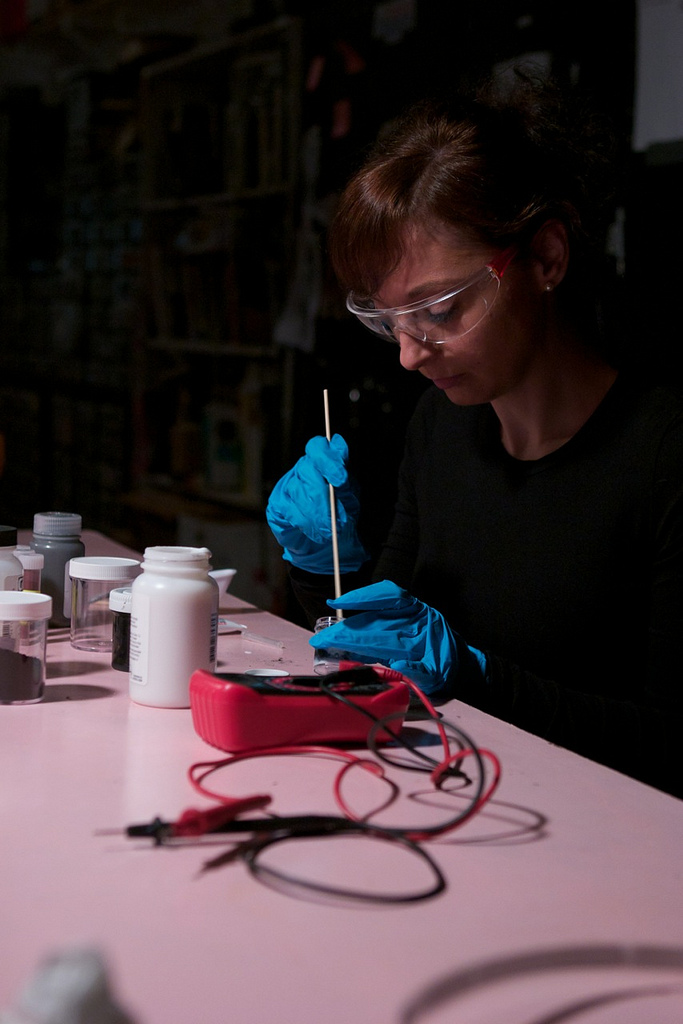
Mota: Open materials began like most open source projects: a problem for which there was no solution available. Back in early 2009, Kirsty Boyle and I were collaborating on an interactive installation. The project required several smart materials — this is an umbrella term for materials with properties that can be altered in a controlled manner and includes things like paints that change color at given temperature, shape memory metals and plastics, conductive inks, conductive textiles, etc. As soon as we began researching solutions for the project, we realized that not only most of these materials were not available in small quantities, but also that there was hardly any information available on how to use them. The only way to figure out how to activate the few materials we could acquire was through trial and error. Since Kirsty and I both believe in open source, we quickly realized that we had to share all this work so others wouldn’t have to reinvent the wheel. That’s how Open Materials came to be.
These days my work on the project consists mostly in sourcing, testing, finding uses for and documenting materials. I have very loose criteria for selecting them and it depends very much on my interests at any given time. But they’re almost always materials that can be obtained in small quantities, that are compatible with most hackers’ and artists’ budgets, and that don’t require highly specialized lab equipment. The goal is to further empower hardware DIYers by providing information about materials that they don’t normally use or may not even know exist.
The next step in the roadmap to open sourcing materials is to develop simpler methods for DIY manufacturing. This is very much in the beginning, but there are already a few interesting examples out there such as recipes for making conductive ink, developed and published by hackerspaces and university labs, and bio materials like homemade plastic and green tea leather. Hopefully, as interest in these materials and techniques grows, we’ll start to see substantial progress.
Q: Are there any particular projects that you think provide a good example of openness in hardware in action?
Mota: This is a difficult question… there are so many great open source hardware projects! Since I can’t list all of them, I’ll mention some that have one of my favorite characteristics: they’re tools to make things and more tools.
Arduino is one of the most emblematic. It’s a microcontroller (a small and inexpensive micro-computer) which is so accessible that almost anyone can use it. This is one of the reasons there are now hundreds of thousands of Arduinos in the hands of hardware hackers, artists, students and scientists. It’s also one of the first platforms people learn to use when they’re introduced to DIY electronics.
RepRap is another classic example. It’s an open source 3D printer that can even generate some of its own parts. From the RepRap project emerged several other derivatives. One of the earliest was the MakerBot CupCake CNC, but there are so many these days that I lost count. Another interesting one is Lasersaur, an open source laser cutter. These digital fabricators are playing a very important role in the expansion of open source hardware. Not only they are introducing an increasing number of people to open source, but they’re also great tools for prototyping and even manufacturing other open source products.
There are so many useful, fun and overall wonderful projects that I could continue listing them all day.
Q: How does open hardware compare to open software?
Mota: In essence, open source hardware (OSHW) offers the same advantages as open source software: better products, faster R&D, reduced IP costs, and user-based innovation. However, due to the nature of the final products, there are also some substantial differences in the ways they are developed and produced.
On the development side, unlike most open source software projects, which are often developed by hundreds or thousands of programmers concurrently working towards a single release, open source hardware progresses through iteration. The initial designs are typically created by a small group. Once released, these designs are modified and improved by others who then release the revised files. These alterations can in turn be incorporated into the original creator’s design and so on and so forth. Each new version of a device is almost always released as a standalone product, a derivative. So, while in software, collaboration is the norm, in hardware iteration and derivation are much more frequent.
Also, since its output is a physical product, OSHW faces challenges that don’t arise in OSS, namely in what concerns medium to large scale manufacturing. Though, a few have found ideal solutions for this: digital fabricators for small scale production, outsourcing for large scale production, and group orders for medium scale production. More and more the community is looking for solutions that involve local manufacturing while still keeping production costs competitive enough. One of the most debated solutions, which hasn’t yet been put to the test in any meaningful scale, is distributed manufacturing (aka crowdsourced manufacturing).
Distribution, on the other hand, is very similar between the two. Most hardware starts as software (schematics, CAD drawings, bills of materials, spec sheets). At the end of the day, this is the essential characteristic that enables open source hardware: the fact that its source is digital and can be distributed and duplicated just like software. Naturally, the plans to make something would be meaningless if they couldn’t be materialized. That’s why accessible open source tools to make things and more tools play such an important role.
Thank you, Catarina. It’s fascinating for us to hear more about open hardware and we’re looking forward to your keynote in Barcelona! Linux.com readers: You can get more information and register for LinuxCon Europe on The Linux Foundation Events website.

For $35, you can’t expect too much out of the tiny, 700MHz computer Raspberry Pi. However, according to the official site, you can now overclock the little processer up to 1GHz without voiding your warranty. More »


