
Paul Mah takes a closer look at Ultrabooks and concludes they deliver on the promise to provide functionality and portability.
Read more at Enterprise Open Source Toolkit
To the casual shopper, the Razr i smartphone announced by Motorola yesterday might seem much the same as any other Android 4.0 (“Ice Cream Sandwich”) phone. Yet, the 4.3-inch Razr i is also the first smartphone with a 2GHz clock rate, and the first Intel “Medfield” Atom-based phone to launch in multiple markets.
More significantly, the battery is claimed to last much longer than on earlier phones featuring Medfield chips. Battery life has long been a challenge for Atom-based mobile devices, but if Motorola’s claims are true, the issue may be moot. The Razr i and its 2000mAh battery is claimed to offer up to 20 hours of use — almost as long as the long-lasting Razr Maxx and 40 percent longer than the iPhone 4S.
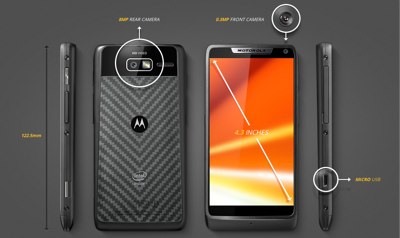 The Razr i is almost identical to Verizon’s ARM-based Razr M, which was announced earlier this month with the Razr HD and 4.7-inch Droid Razr Maxx HD. The new Razr models are the first Motorola devices to be developed under Google’s oversight. The Razr i has the added distinction of being the first product collaboration in Google’s multi-year Android pact with Intel.
Despite Google involvement, Android 4.1 (“Jelly Bean”) will not be on tap when the Razr i ships in early October in Argentina, Brazil, France, Germany, Mexico and the U.K. Like most ICS devices however, it’s slated for a downloadable upgrade. Clove Technology has opened pre-orders in the U.K. for the unlocked phone at 285 Pounds, or 342 Pounds ($556) with tax.
The 4.3-inch display on the Razr i and Razr M are limited to qHD (960 x 540) resolution, but they feature eye-popping Super AMOLED Advanced technology. The splash-resistant, Kevlar-reinforced screen extends almost to the edges of the aluminum-framed device, making the phone narrower than most 4.3-inch phones.
The 8.9mm profile is thicker than that of the original 7.1mm Droid Razr, but bests the 8.99mm Razr Maxx, and there’s no more cheating with a fatter hump on one end. The Razr i’s 8-megapixel camera is said to be loadable in one second and available with a 10-shot-per-second capability.
The Google influence can be seen in features like a Circles widget and an NFC (near field communication) radio. Like Google-branded Nexus devices, the Razr i appears to lack UI overlays or bloatware.
The 2GHz version of the Medfield Atom Z2460 appears to be a winner, according to early benchmarks from Engadget. The Razr i is significantly faster than the ZTE Grand X IN, which ships in Europe later this month with a 1.6GHz Medfield. In fact, the difference is more pronounced than the clock rate alone would indicate, suggesting more extensive optimization with ICS, and perhaps better optimization for Medfield. Before we start freaking out about Googarola run amok, note that Nexus devices from other vendors have enjoyed similar Google perks.
Note that the Razr M with its dual-core 1.5GHz Snapdragon processor is still somewhat faster than the Razr i on most tests, according to Engadget. The 2GHz Medfield has only one core, and Intel still has a way to go before Medfield is fully optimized for Android. Notably, however, the Razr i wins by an almost two-to-one margin on the all-important SunSpider benchmark of the Chrome web browser.
It’s unlikely the 3G-only Razr i will re-emerge in a 4G LTE version for the U.S. In the first half of 2013, however, Intel plans to ship a faster, dual-core Z2580 processor that supports LTE, as well as a stripped down Z2000.
When it ships in October, the Razr i will be the sixth Medfield-based Android phone to reach market. It’s the first, however, to move beyond Intel’s original, 4-inch, 1.6GHz Medfield reference design. In April, Lava launched the India-targeted Xolo X900, which according to Anandtech is impressive in single-task performance, and fairly competitive on other benchmarks. Battery life, however, was mediocre.
The Xolo X900 was followed by Lenovo’s China-targeted LePhone K800 and Orange’s San Diego, which launched in the U.K. in June. Last month, Russian carrier MegaFon announced a similar MegaFon Mint. The aforementioned ZTE Grand X IN, deviates slightly from reference by moving to a curvier, 4.3-inch design.
While Intel is primarily focusing its phone strategy on Android, on tablets it is collaborating with Microsoft, optimizing its upcoming Clover Trail processor for Windows 8 based Surface tablets. On Sept. 17, Intel modified its statement from last week that Clover Trail would not support Linux or Android due to a lack of power optimization. Intel now says it is porting Android to Clover Trail after all, but that a version of the processor that is optimized for Linux and Android tablets is still in the planning stages. AMD’s rival Hondo processor will also initially focus on Windows 8 before expanding to provide optimization for Linux and Android, says the company.
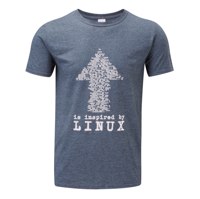
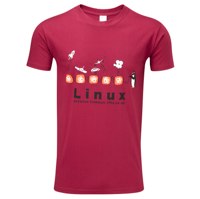 The two winning designs in the 2012 “Inspired by Linux” T-shirt Design Contest are now available for purchase in the Linux.com store.
 And the second place winner, Sabrina Aqil, uses a red background and unique graphic to illustrate how “Linux Lifts Us Up.”
Both carry a small Linux.com logo on the back and are available in sizes Small through XX-Large for $18 at store.linux.com.
It seems fair to say that security is never far from an IT executive’s mind, so the results of a recent survey focusing on enterprise cloud computing were particularly surprising.
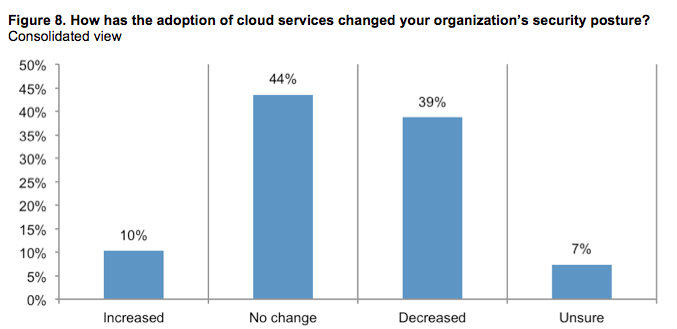
While 82 percent of the organizations that responded to the survey either plan to or already have moved sensitive or confidential data into the cloud, a full 39 percent believe cloud adoption has decreased their companies’ security posture.
 Not only that, but 64 percent of those with sensitive data in the cloud believe it’s the cloud provider’s responsibility to protect it, yet nearly two-thirds have no idea what their cloud providers are actually doing in order to keep that data safe, the survey found.
Dubbed “Encryption in the Cloud,” the global study of 4,000 business and IT managers was conducted by the Ponemon Institute for Thales e-Security. Representatives from both firms will present results from the study at a webinar on Tuesday, Sept. 25.
Five Things to Ask
One interpretation of the data is that “for many organizations the economic benefits of using the cloud outweigh the security concerns,” as Larry Ponemon, chairman and founder of the Ponemon Institute, suggests.
Another possibility, however, is that companies’ inherent security-mindedness simply hasn’t yet caught up with their haste to begin taking advantage of the cloud.
In either case, John Howie has a few suggestions. Specifically, focusing in particular on public cloud providers, Howie — who serves as chief operating officer for the Cloud Security Alliance — suggests that companies ask vendors the following five questions.
1. ‘Show me your certifications and attestations.’
This one “isn’t so much a question as a demand,” Howie told Linux.com. “What I’m looking for is a 27001 certificate, hopefully with a statement of applicability.”
Such certificates are awarded to organizations that have gone through an accredited certification process in line with the ISMS standard ISO/IEC 27001:2005. In other words, “this is proof that they’re running an information security management system that meets or exceeds the goals” of the standard, Howie notes.
Howie also says companies should expect to see a Service Organization Control (SOC) 2 Type 2 report. In addition, depending on the industry, they may also want to see proof of the provider’s compliance with the Payment Card Industry Data Security Standard (PCI DSS) or other niche-specific requirements.
Bottom line: “If you can’t show me those, I’m walking away,” Howie said.
2) ‘Share with me details of past incidents in your cloud and how you handled them.’
In other words, this is a way to see what the provider’s incident-response process looks like, Howie explained.
“Many won’t tell you about specific incidents, but they will share their process,” he noted.
Either way, that’s key information for a prospective consumer of the cloud service. “If I feel I have been hacked, this will tell me how do I respond, how do I work with them for investigation, etc.,” he explained.
First and foremost, you want to know that the provider has such a process in place and has used it before, Howie said.
3) ‘Where exactly is my data going to run from?’
On this point it’s not a street address that you’re looking for, “but you do need to know where your data and apps service will run from,” Howie pointed out.
That’s primarily because of the region-specific regulations and tax implications that may affect you. “At the end of the day, the [cloud service] consumer is responsible for compliance,” he added.
4) ‘What is your program for business continuity and disaster recovery?’
In particular, companies need to know whether they will be responsible for such functions themselves, or whether their provider has a mechanism in place.
For Infrastructure as a Service (IaaS) platforms such as what Amazon offers, it’s typically the cloud service consumer’s responsibility, Howie noted, though many corporate users don’t realize that.
For Software as a Service (SaaS) such as hosted mail or unified communications, however, it’s generally the cloud provider’s responsibility. In that case, you’ll want to hear the vendor confirm that they’ll do the failover as well as details such as how long it will take and where your data will get moved when that happens, Howie explained.
For Platform as a Service (PaaS) offerings, meanwhile, the answer to this question will vary depending on how the service is managed and run, he added.
5) ‘What kind of service-level agreement (SLA) do you offer?’
Last but not least, Howie also advises that companies make sure to ask about the details of their cloud provider’s service-level agreement (SLA) or terms and conditions, including in particular uptime and privacy commitments.