
A cash reward is the result of careful planning and design.
Read more at ZDNet News
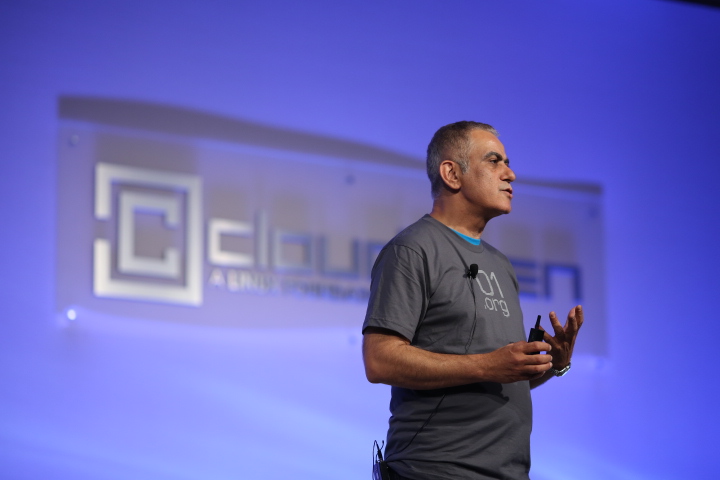 The past 24 hours have flown by so quickly here at LinuxCon and CloudOpen in San Diego. We had some serious laughs as the Linux kernel developer panel took the stage Wednesday afternoon, sailed to Qualcomm Innovation Center’s fun party at the Bali Hai Restaurant and saw more great speakers Thursday morning from Qualcomm, Facebook and Twitter.
The Wednesday afternoon keynotes began with Imad Sousou, Director of the Intel Open Source Technology Center with a talk focused on Web technologies and the role of Linux at Intel. There are two big challenges to writing and running applications on the Web, Sousou said. First, there is no standard API; Web standards have so far been focused on the browser, he said. And second, performance at the graphics layer. It’s still difficult to get a Web application to perform with the same fluidity as a native application, he said. Intel is working on open source solutions to both of these big challenges.
Sousou was followed by Kyle MacDonald, vice president of cloud at Canonical, who discussed the many partners Ubuntu is working with to implement the OpenStack cloud platform. The company is focused on finding solutions for deploying large-scale applications on the cloud using its open source Juju tool.
The afternoon wrapped up with the Linux Kernel Developer Panel, moderated by SCSI subsystem maintainer James Bottomley. The panelists cracked jokes and answered questions from the audience with a steady stream of entertaining and informative banter.
When Intel kernel developer Sarah Sharp suggested that a mentoring program would help attract younger developers to work on the kernel, for example, Bottomley asked kernel creator Linus Torvalds who he would mentor.
Torvalds had a quick reply: “We don’t want to scare away even more young people.”
Linux Foundation Fellow Greg Kroah-Hartman pointed out that the Kernel Summit is more about process than technical solutions so it doesn’t appeal as much to developers. And Ted Ts’o, a kernel developer at Google, suggested holding more technical workshops at the Summit to attract developers. (For more details of the kernel developer panel, see our live blog transcript from Wednesday.)
Rob Chandhok of Qualcomm began the Thursday morning keynotes with a talk about mobile connectivity. The huge growth in the number of Internet connected devices — including laptops, phones, sensors and appliances — and their proliferation across the globe is creating new issues in providing fast, secure access to the Web. Qualcomm is asking: how will these devices all communicate with each other? The company’s AllJoyn open source project is trying to create a platform and standards for this “Internet of things,” Chandhok said.
Facebook’s Amir Michael spoke next on the Open Compute open source hardware initiative. Open source components to the cloud can be found at all levels, except the hardware layer, Michael said. He advocated for companies to join the open source hardware movement in order to speed the pace of innovation, increase efficiency and reduce the environmental footprint of cloud computing.
And wrapping up the morning keynotes was Chris Aniszczyk, open source manager at Twitter. He gave a behind-the-scenes look at the open source technology that lies behind each tweet and spoke of his company’s desire to be more involved in the the open source community. For more on the Thursday morning keynotes, see our live blog transcript.
There’s been no end to the controversy generated in the Linux community by Microsoft’s Windows 8 Secure Boot plans, and scarcely a week goes by without the discussion or announcement by one distribution or another of some new possible approach.
The problem, of course, stems from Microsoft’s decision to enable the Secure Boot technology in the Unified Extensible Firmware Interface (UEFI) in Windows 8 hardware, meaning that only operating systems with the right digital signature will be able to boot. While it will apparently be possible to disable Secure Boot on x86 Windows machines — or for users to enroll their own keys — that won’t be the case on ARM-based hardware.
Since the topic arose last fall, both the Linux Foundation and the Free Software Foundation have weighed in with their own views on the matter, and a community effort has also been launched to help developers work around the technology. Several distros, meanwhile, have crafted their own approaches.
Here’s a quick rundown of where things stand.
 Back in May Fedora was the first to speak out about its planned approach, which primarily involves paying $99 to Verisign for unlimited use of Microsoft signing services, allowing its first stage boot loader to be signed with a Microsoft key.
While Fedora did explore the possibility of producing a Fedora key and encouraging hardware vendors to incorporate it, that strategy was ultimately rejected for several reasons, including the near impossibility of getting all vendors to do so, according to Red Hat developer Matthew Garrett.
Paying for a Microsoft key, on the other hand, “ensures compatibility with as wide a range of hardware as possible and it avoids Fedora having any special privileges over other Linux distributions,” Garrett explained. “If there are better options then we haven’t found them.”
Fedora later announced a second “custom mode” alternative scheme whereby “a site will create their own keys and deploy them in system firmware, and will do their own signing of binaries with it.”
 Though Canonical founder Mark Shuttleworth has indicated that plans for Ubuntu are still a work in progress, those published (PDF) so far involve using an Ubuntu-specific key. Canonical chose to do it this way in part because of the fact that Ubuntu is relatively commonly preinstalled on PC hardware, it says — a fact that sets it apart from most other distributions.
Another key difference in Canonical’s approach is that Ubuntu will use Intel’s efilinux rather than the GRUB 2 boot loader because of concerns about licensing under GPLv3.
 Last but not least, SUSE Linux spoke out earlier this month with its own approach, which in many ways combines a bit of each of Fedora’s and Ubuntu’s tactics.
Essentially, SUSE plans to start with a shim based on the Fedora shim loader, and to make two versions of it available: one signed with SUSE’s own key, similar to what Canonical is planning, and another signed with a key provided by Microsoft. In either case, by default the shim will verify that GRUB 2 is trusted using an independent SUSE certificate embedded in its body, though “Machine Owner Keys” will be able to override that default SUSE key as well.
Whether openSUSE will follow SUSE’s approach isn’t yet clear.
Fedora’s approach drew considerable criticism early on from many who viewed it as a sort of capitulation to Microsoft. The Free Software Foundation, on the other hand, has said it prefers it over what Ubuntu has planned.
In the meantime, James Bottomley, chair of the Linux Foundation’s Technical Advisory Board, has created a platform for further work on the problem that uses a boot system based on Intel’s Tianocore, which is an open source implementation of UEFI.
Finally, it’s also worth mentioning an entirely different kind of solution that sidesteps all this brouhaha altogether: completely open hardware from vendors like ZaReason.
 The might of OpenStack’s very big backers has become more and more apparent in recent weeks. Announcements from Red Hat, Rackspace and Canonical in just the past few days show OpenStack to be emerging as the clear leader in open cloud platforms. Now, as GigaOm reports, The OpenStack Foundation has just named its top leaders, and they are from heavy-hitting Silicon Valley companies. Alan Clark, director of industry initiatives and open source for SUSE is reportedly chairman. And Lew Tucker, Cisco’sVP and CTO of cloud, is reportedly vice chairman. SUSE has also just launched its OpenStack platform.
“SUSE added a new face to its infrastructure-as-a-service (IaaS) portfolio with the August 29 unveiling of SUSE Cloud at the CloudOpen conference. An OpenStack-based automated cloud computing platform, SUSE Cloud promises improved resource utilization and speedier workload provisioning while also adding another voice in support of the OpenStack effort.”
SUSE’s announcement follows Rackspace, which has begun calling itself “the open cloud company,” announcing the release of Rackspace Private Cloud software, built on OpenStack and designed for companies that want to install, test and run a multi-node OpenStack-based private cloud environment. Then there was Red Hat’s announcement of its upcoming OpenStack-based cloud platform, already available in a preview edition. And now, as it releases a significant update to Ubuntu 12.04, Canonical is also doubling down on its OpenStack focus. As it releases Ubuntu 12.04.1, Canonical is launching Ubuntu Cloud Archive, an OpenStack software archive.
Finally, let’s not forget that HP is placing a big bet on OpenStack as well. It won’t be a surprise to see this week’s CloudOpen conference bring more OpenStack-related news. This is clearly an open source platform with backing and momentum.
Huawei didn’t have any new hardware to show during its packed press conference, but it did have an early version of its Emotion UIskin for Android devices. Aiming to make its smartphone experience a little gentler for first-timers, while offering up a slightly different flavor of Google’s OS, Huawei’s been polling its customers, running user experience salons and meeting regular groups of between 40 – 70 consumers to understand what was working — and what was definitely not. To this end, the company’s “driven [itself] crazy” by keeping to a tight schedule and releasing iterative updates every two weeks (at least for beta) and monthly for stable builds.
Filed under: Cellphones, Software, Mobile
Huawei shows off early version of Emotion UI for Android, packs a ‘stock’ stock skin too (hands-on) originally appeared on Engadget on Thu, 30 Aug 2012 10:49:00 EDT. Please see our terms for use of feeds.
Permalink | | Email this | Comments
 As The Linux Foundation’s LinuxCon and CloudOpen conferences kick into high gear in San Diego, Calif., you can get free live streams of the keynote addresses, and much more. We published an infographic yesterday, supplied by The Linux Foundation and based on IDC research, that reveals some interesting trends about the convergence of cloud computing an open source. Here are some of the other announcements and free resources related to the conferences.
The keynote schedule for LinuxCon is available, and rememer that you can watch live streamed keynotes online. We detailed some of the scheduled guests and sessions in this post.
In conjunction with the conference, The Linux Foundation announced that Code Aurora Forum (CAF) will become part of Linux Foundation Labs. CAF includes many companies in the mobile wireless space and helps advance open, mobile wireless projects.
Also announced: The embedded Linux Yocto Project is announcing a new compliance program. The Yocto Project includes elements that make the embedded Linux development process much easier and faster, as well as standardized.
Stay tuned for more news from these conferences, which run through tomorrow.
The Linux kernel is the world’s largest collaborative development project. Almost 3,000 individual contributors work together to create and maintain an operating system kernel that works on everything from wristwatches and mobile phones to mainframes, along with all the peripherals imaginable for each platform. Linux creator Linus Torvalds sits at the top of a loose hierarchy of kernel maintainers and acts as final arbiter for what does or does not get included.
So how does one go about contributing a substantially new technology to the kernel?
Sage Weil was working on a distributed file system for Linux as part of his PhD research at University of California, Santa Cruz. This was before the advent of the buzzword “big data”, and therefore before things like Hadoop or Amazon’s S3. His research into distributed fault tolerance led him to the conclusion that the best way to manage a clustered filesystem was at the kernel layer, rather than higher up in userspace. He called his filesystem “Ceph” — a shortened version of Cephalopod — as a nod to the “highly parallel behavior of an octopus.”
Weil was no stranger to open source or the Linux community. In 1996 he was one of the founders of the web hosting company Dreamhost. As his research progressed, he knew he’d need to get his kernel components integrated upstream if they were to have any real chance of practical application: no one was likely to compile a custom kernel just for a clustered file system.
So Weil did what any good hacker would do: he joined a couple of kernel-related mailing lists and started watching how things work.


