
Some six months after Sony took full control of Sony Ericsson, following a $358 million quarterly loss by the renamed Sony Mobile Communications, Sony announced it was cutting 15 percent of the unit’s workforce. Yet, the news was accompanied by several developments that point to a brighter, more open future for the struggling Android device vendor.
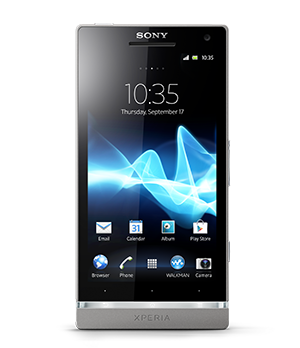 On Aug. 21, Sony Mobile ramped up its notoriously slow Android updates by releasing Android 4.0 (“Ice Cream Sandwich”) on eight Xperia phones, with three more coming soon. More significantly, the ICS-ready Xperia S phone was selected by the Android Open Source Project (AOSP) as the first non-Google/Nexus branded device to be targeted by its open source Android build.
The Xperia project will be the first experimental AOSP release, according to a Google Groups post by Google’s Jean-Baptiste Queru, Technical Lead of the project. The Xperia S will act as an open sandbox for exploring “bleeding edge” ideas for Android, wrote Queru.
The phone was chosen because “it’s a powerful current GSM device, with an unlockable bootloader from a manufacturer that has always been very friendly to AOSP,” wrote Queru. The project should accelerate Xperia updates, he noted, because many of Sony’s enhancements will already be baked into the code.
Usable code could take months to arrive, and Queru has refrained from promising a final build. Yet, AOSP will have help. On Aug. 21, Android Central quoted a statement of support from Sony, which added it would “see if there are things we can contribute with along the way.” According to Neowin, “trusted sources” within Sony Mobile stated on XDA-Developers that Sony is currently in negotiations toward contributing open source drivers. The project has also been joined by the CyanogenMod Android ROM project.
AOSP Gains Versatility
AOSP develops the vanilla code that appears on Google-branded Nexus devices like the Asus-manufactured Nexus 7 tablet or Samsung-built Nexus phones. An ICS build was released for the PandaBoard, and hackers have tweaked their own versions to support unlocked or rooted devices. However, the Xperia S will be the first third-party device to be targeted by AOSP.
The Xperia project is “experimental” in more ways than one. AOSP aims to fulfill its goal of being a modular system that can be augmented with device-specific components. Wrote Queru: “In theory, AOSP is designed such that it should be possible to plug in the files related to additional hardware targets. In practice, that has never happened.”
The project may also add credence to rumors that Google will simultaneously launch “Key Lime Pie” (most likely Android 5.0) on multiple “Nexus” devices from multiple vendors this fall. AOSP could be the mechanism to make it happen.
Sony Opens Up
Aside from its lawsuit against hackers trying to reinstate Linux support on the PS3, Sony has been a solid open source citizen in recent years. A gold member of the Linux Foundation, Sony dutifully posts its GPL-licensed code for its Linux-based consumer electronics devices.
Sony Ericsson, meanwhile, has become a leader for open Android practices, offering unlocked bootloaders and releasing preview versions of ICS for several phones. Sony Mobile is accelerating this trend. On Aug. 20, it released an Android-based sensor framework called DASH (Dynamic Android Sensor HAL) as an open source project. DASH enables custom ROM developers to control sensors on Xperia devices.
Google’s nod to Sony in its AOSP/Xperia announcement sends a clear message to other Android vendors: Pay now with upstream contributions to AOSP, and you won’t have to pay later with long delays in updating devices. Back in April, Queru singled out Sony for its rapid ICS port to the Sony Tablet S, a feat he said was aided by its frequent upstream contributions of patches to the AOSP codebase. Now, with Sony Mobile’s accelerated ICS updates, Google has more evidence for its argument that good open source practices can lead to greater agility.
Sony Mobile’s Tough Road
Sony Mobile will find it challenging to retake ground lost to vendors like Samsung and ZTE. The company’s mobile-device share idled at 1.9 percent in the first quarter of 2011 and 2012, just below Motorola and above HTC, according to Gartner.
By shedding Ericsson and moving Sony Mobile’s headquarters from Sweden to Japan, however, Sony Corporation’s new CEO Kazuo Hirai should have a freer hand to reinvigorate the Xperia line. The company has suggested it will further integrate the devices with its Smart TVs, including Google TV models, essentially turning Xperia into a mobile gaming platform. That process began last year with the announcement of a gamer-oriented Xperia Play phone and PlayStation Mobile development environment for converting PS3 games to Android.
A new dual-slider version of the Xperia Play is reportedly on the way, and Sony hopes to stay current with an Xperia S update called the Xperia SL. The SL maintains the impressive 4.3-inch, 720p display and 12.1-megapixel camera while advancing to a 1.7GHz Snapdragon. A quad-core Xperia T model is also expected.
If Sony accompanies these models with more competitive pricing than it has in the past, it may find success. But nothing will please consumers more than timely updates. If Sony Mobile continues that trend — and perhaps releases a “Key Lime Pie” device shortly after the update hits this fall — it will in part have open source to thank.
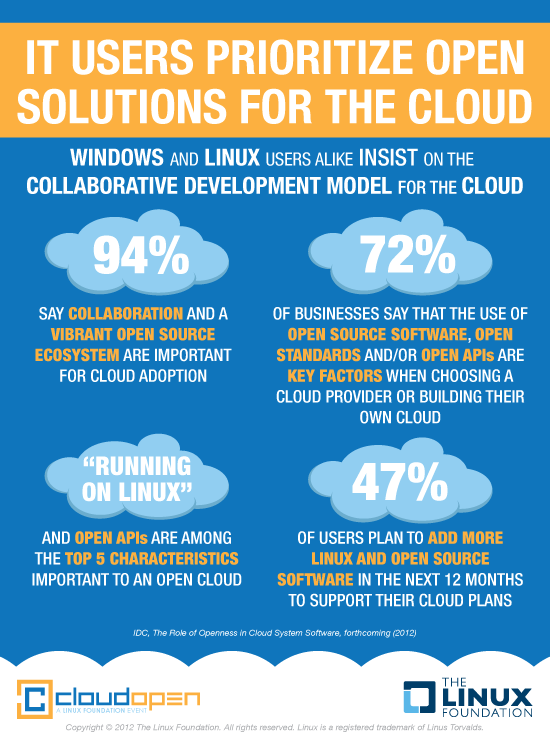 Because it’s the first-ever CloudOpen, we wanted to understand what users really want when it comes to building their cloud infrastructure and platforms and what they expect from vendors. We thought this information could be useful for this week’s event attendees, so today we’re releasing a handful of data points we surfaced in partnership with IDC from a survey, the IDC 2012 Cloud System Software Survey (forthcoming), conducted this summer. IDC received responses from 282 U.S. enterprises that have deployed or are interested in private cloud and that have 500 or more employees.