
The next generation of foundational IT innovation is largely being implemented above the hardware.
Read more at Enterprise Open Source Toolkit
Hybrid cloud environments may not yet be as ubiquitous as they’re widely predicted to be in the coming years, but it’s clear they offer many compelling advantages.
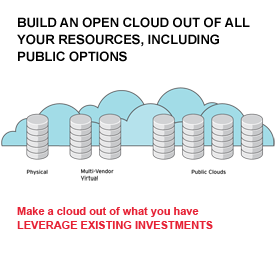 Comprising some combination of public and private clouds, hybrid clouds can give an enterprise the best of both worlds: “the elasticity, scalability and agility that the public cloud brings, but also the control, visibility and security that the private cloud offers,” as Brett Goodwin, vice president of marketing with Skytap, recently put it.
While many of the early users of hybrid clouds were Web 2.0 companies managing data on a massive scale, today these environments are becoming increasingly common in other enterprises as well, according to Bryan Thompson, vice president of technical services with Tier 3.
“We’re seeing more and more enterprise-class customers that have already virtualized and built an internal infrastructure resource,” Thompson explained. “Now they see the need to leverage the public cloud or multiple clouds for seasonal elasticity, for example, and are looking to leverage the hybrid cloud possibilities.”
As hybrid clouds become an ever more attractive option for corporate IT, this is a good time to start thinking about what it will take to get started building one. Luckily, there are plenty of experts out there with a growing body of knowledge and experience. Here are a few of their best tips and suggestions.
Enterprises looking to get the biggest “bang for their buck” in using the hybrid cloud should first look at areas with dynamic workloads, where demand may fluctuate, Skytap’s Goodwin suggested. Examples can include development and testing, virtual technical training, and software demonstrations for customers or partners.
Whereas areas with static workloads tend to be more economically run in-house, “we are seeing that those dynamic enterprise workloads are ideal candidates for the hybrid cloud and provide the biggest ROI,” Goodwin said.
Indeed, capacity on demand, disaster recovery and business continuance, or scaling an application for seasonal spikes, for instance, can all be achieved through the hybrid cloud. That happens “without the initial capital costs, all while having the security of an on-premise IaaS [Infrastructure-as-a-Service] platform,”David Butler, senior vice president of marketing at Eucalyptus, agreed.
Essentially, any enterprise working with a hybrid cloud should be able to securely move existing virtualized workloads into the cloud and export them again, so that it’s “basically an extension of your own infrastructure, but with the elasticity and on-demand configurability that comes with the cloud,” Goodwin explained.
Toward that end, when selecting a cloud partner, enterprises should make sure they’ll be able to establish a secure and reliable VPN connection between the cloud service and their existing network or infrastructure in just a click or two of the mouse, he advised.
They’ll also need the ability to run their permissions servers “either in the cloud or on-premise or some combination of the two,” he added.
Similarly, “one of the most common lessons… F5 hears from its customers is maintaining consistent performance and security for applications deployed into the cloud,” noted Lori MacVittie, senior technical marketing manager with F5 Networks and a member of the Steering Committee for the CloudNOW consortium of women in cloud computing.
“Sometimes this is because of network issues – because the interconnect for a hybrid cloud is often the Internet (and no one can control that). But other times it’s because of the variety of client devices being used to access the applications,” she explained. “Being able to replicate or extend the reach of services in the data center to the cloud side of a hybrid architecture offers a way to ensure consistent enforcement of security policies as well as employing performance-enhancing technology to address differences in the way client devices perform over the Internet.”
Other key factors to look for when choosing a hybrid cloud business partner include a complete Platform-as-a-Service (PaaS) capability as well as platforms and tools to simplify and accelerate the deployment, migration and management of resources and services, suggested Michael Hubbard, senior director of VMware’s Accelerate Advisory Services.
Portability is of paramount importance when building a hybrid cloud, and that’s true on multiple levels, said Bryan Che, senior director for product management and marketing with Red Hat’s cloud business.
First, there must be portability in the computing layer and in data and application dependencies, Che explained. Enterprises must also be able to write apps in their choice of languages and programming frameworks and have the freedom to deploy them to the cloud of their choice, he added. Finally, the apps themselves must be portable as well, with tools to make that easy.
“It doesn’t do any good if the apps don’t have supporting tooling to make them portable,” Che explained. “You need an automated way to get from one to another — otherwise it’s simply too cumbersome.”
Last but not least, Red Hat advocates using a truly open cloud for maximum benefits and flexibility.
Using open source software is “hugely important, but it’s not sufficient if you want to really be open,” Che explained. “Cloud computing is not just about technologies — it’s a whole architecture and how you operate IT. You really need to think about ‘open’ in many dimensions.”
Besides portability and open source, then, Red Hat also stresses five other key factors of an open cloud: community, open standards, freedom to use intellectual property (IP), deployability on a choice of infrastructure and extensibility with an open API.
“You already have heterogeneous technologies; if your cloud only works with a subset of that technology, what will you do when you finish the project?” Che concluded. “An open hybrid cloud is really the only approach that makes sense if you want to see this not just as a project but a defining architecture for your data center over the next decade.”