
Singaporean organizations cite lack of multi-skilled staff able to work in both arenas and easier management as reasons for division between IT and analytics departments.
Read more at ZDNet News
New technologies almost always pose a challenge for the CIOs who choose to deploy them, but often a big part of the difficulty is simply the learning curve associated with figuring out how to do it right.
The cloud is no exception. Now that cloud technologies are enjoying growing acceptance, it’s a pretty safe bet that there are plenty of anxious IT executives out there being kept awake at night by the fear of making a key blunder somewhere along the way.
Fortunately, increasing use of the cloud also means there are now numerous others who have “been there and done that,” as the saying goes, and can share the benefit of their experience.
Have you recently launched a cloud project or made plans to do so? Read on, then, for an assortment of tips and best practices from some of those who know the technology best.
 In this era of contagious excitement about cloud technologies, it’s all too easy to get caught up in the momentum and assume that the cloud will be the right solution for virtually any business or IT problem.
That, however, can be a mistake, according to Margaret Dawson, vice president of product management at Symform and a member of the CloudNOW network.
“One of the things we see in CIOs who are ahead of the curve is that they have established clear criteria for when to go to the cloud,” Dawson explained. “Make sure you’ve established your own internal criteria for evaluating whether it makes sense to solve a particular business or technology problem using a cloud solution.”
Key factors in making that decision include your resources — in terms of both budget and IT personnel — as well as your core competencies, your existing infrastructure, the need for security and compliance and any time constraints, Dawson advised.
“As CIO, your job is to figure out how technology can serve the business,” she said. “Your job has not changed. You need to start with the same questions.”

That said, a good strategy is to focus more on having an “innovation project” than having a “cloud project,” recommends David Butler, senior vice president of marketing at Eucalyptus.
“Because this is such a transformation, you can’t do it ‘just because’,” Butler explained. “You need to pick an area with high value.”
No cloud project will be wildly successful unless there are a lot of people consuming the services, he added. So, “one of the design points is to make sure there is both business and IT representation in making sure the service will be valuable. Make sure the right VPs believe those are valuable services that they want to consume.”
 In fact, “even more than most IT projects, cloud deployments require business engagement,” agreed Red Hat CIO Lee Congdon. “Make sure your business partners are owners and sponsors of your cloud initiatives. Share your strategy for cloud deployments broadly with your business partners and help them create and communicate a vision for the resulting innovation.”
On the flip side, “be very open to business partners that are pursuing cloud solutions independently and engage them with the intent of integrating their projects and requirements into your overall direction,” Congdon added.
Meanwhile, it can also be very helpful to have a strong project manager or liaison, according to JJ DiGeronimo, VMware’s global cloud solution director and a member of CloudNOW as well. That person should have good knowledge of internal processes and be empowered for cross-organizational coordination, she explained.

For a cloud project to be successful it’s essential to ensure that there will be trust and control, and standardization is the best way to make that happen, Eucalyptus’s Butler said.
For example, “you need a way to describe the service, how it’s contained, what the policies are, how it’s governed and how it’s billed,” he pointed out. “You want transparency, and there’s a need to standardize multiple levels in the stack.”
Similarly, “don’t lock your organization into non-standard solutions,” Red Hat’s Congdon advised. “Demand that your vendors give you open options and that they comply with emerging industry standards.”
Along similar lines, to avoid lock-in and ensure interoperability, CIOs should strive for openness on three levels: the applications, the cloud itself, and the virtualized infrastructure, or the data center, Butler said.
“Take advantage of customization and configuration,” he advised. “That doesn’t mean you have to adopt open source, but open source is the leader in speed of innovation. It’s easier to get access to valuable pieces, and you can move more quickly.”
Last but not least, it’s important to begin as soon as possible building the skills your team will need for effective cloud management in the future.
For instance, “architecture and integration skills will be critical for integration,” VMware’s DiGeronimo suggested.
Similarly, “Platform as a Service (PaaS) will be a revolutionary component of cloud computing,” Red Hat’s Congdon said. “Make sure you have technical people learning the characteristics of PaaS solutions. Develop and deploy pilot applications on these platforms.”
Two weeks from today The Linux Foundation will debut CloudOpen. This is a really exciting time in cloud computing, a time when developers and open source projects are clearly leading the way in technology innovation. The building blocks are in place thanks to decades of open source software development, and everybody is looking for their edge.
CloudOpen will provide a vendor- and project-neutral venue for collaboration and for advancing key technologies. CloudStack, Eucalyptus Systems, OpenStack, Gluster, oVirt, Chef, Puppet, Xen, KVM, OpenShift, Ceph and more will all be there, as will the vendors and users who want to understand how best to work with these projects.
Part of the event’s focus is ensuring that we all protect freedom, collaboration and access in this maturing computing environment. Users have gained massive advantages in the last two decades due to the rise of Linux and open source software, and together we can ensure those advantages remain as we move forward in the cloud. This is the only way that the full opportunity of the cloud can be realized.
As Amanda McPherson wrote in her blog, Why We’re Fighting for an Open Cloud, we must protect the freedoms we’ve come to expect lest the advantages users have come to know be lost.
To show your support for the open cloud, we’re revealing today a limited edition T-shirt titled “I Fight for an Open Cloud.” These shirts have been designed and produced to be available only at this first-time event.
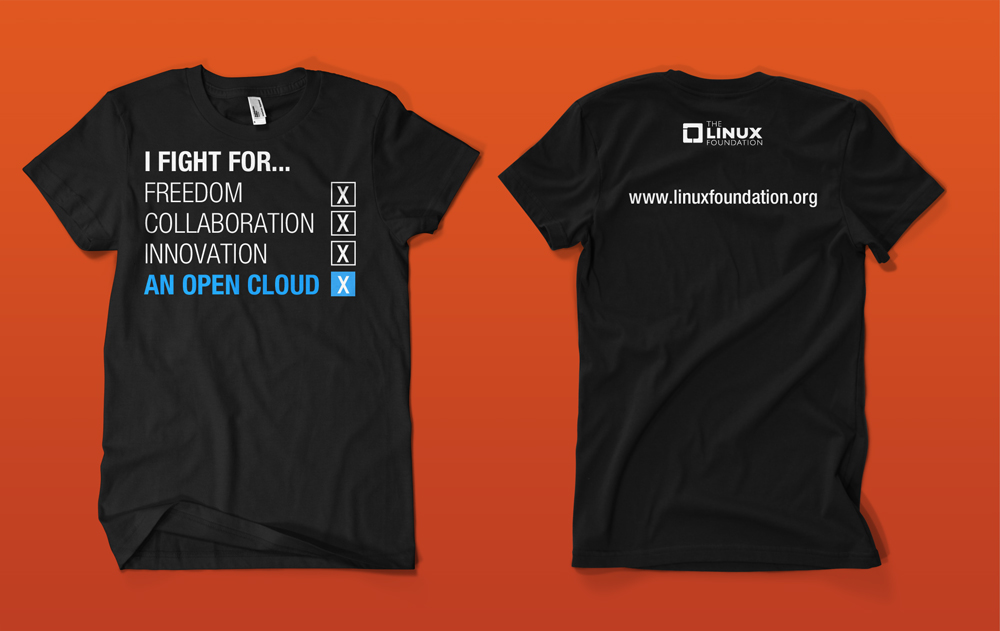
We hope you will join us in San Diego August 29-31 and that you’ll proudly wear one of these exclusive and stylish T’s. You can also grab a web badge on the Fight for the Open Cloud webpage. And, if you haven’t already, don’t forget to register!

Verizon subscribers jonesing for a 7-inch LTE tablet won’t have to consider springing for the pricey Galaxy Tab 7.7 any longer. The carrier just revealed plans to offer up a 4G-equipped (and previously hinted) version of Samsung’s Galaxy Tab 2 7.0 starting on August 17th. There’s no revolution under the hood outside of the cellular link: it’s still toting Android 4.0, the rear 3.2-megapixel and front VGA cameras, the 1.2GHz dual-core chip and a somewhat thin 8GB of built-in memory. At the $350 contract-free asking price, however, the tinier Galaxy Tab is low-hanging fruit for data lovers.
Continue reading Samsung Galaxy Tab 2 7.0 packing 4G LTE comes to Verizon on August 17th
Filed under: Tablet PCs
Samsung Galaxy Tab 2 7.0 packing 4G LTE comes to Verizon on August 17th originally appeared on Engadget on Wed, 15 Aug 2012 10:03:00 EDT.
Permalink | | Email this | Comments

Ever since HP killed off webOS hardware, the fate of the webOS GBU (general business unit) was as yet unknown. But according to a flyer that has floated out of the HP office, it would seem that the webOS group, along with Enyo and Cloud services, has branched away from the mother ship to start a brand new company: Gram.
According to a flyer sent out to announce the new brand, Gram is “Potent. Light. Nimble. At the core of all things big and small.” Alright? So what do you guys do at Gram?
“Gram is a new company leveraging the core strengths of webOS, Enyo and our Cloud offerings, as well as the firepower of our partners to create a technology that will unleash the freedom of the web.”
In other words, we have no earthly idea what Gram is all about. What we do know is that it will be a separate entity from HP, though still funded by the California tech giant. This will allow cash flow for the newborn company without tying it to the increasingly water-filled ship that is HP.
The folks over at webOS Nation managed to get their hands on an internal email to the new Gram employees, explaining that while the company is in stealth, workers should only build momentum for the brand with friends and family, but nothing further.

