According to IDC‘s latest figures, Android and iOS now account for 85 percent of the 152 million smartphones shipped in Q2 2012. Google’s OS powered 68.1 percent of all smartphones sold — with Samsung making the hardware behind for just under half of those. Apple’s smartphones now claim a 16.9 percent marketshare and while plenty of phone shoppers are holding out for the iPhone’s next iteration, iOS still saw double-digit growth in Q2. There’s more bad news for both BlackBerry and Symbian platforms, which, combined, accounted for less than 10 percent of all smartphones shipped last quarter. Windows Phone 7, meanwhile, hasn’t quite made it to that hallowed third place it reckons it deserves. The mobile OS continues to grow, however, albeit at a gentler rate than both iOS and Android. Microsoft’s likely pinning its hopes on the adjustable widgets and meatier specifications of Windows Phone 8 to draw in some new customers this fall.
At the recent Guadec 2012 GNOME developers conference, birds of a feather sessions saw the project set out goals for a GNOME OS initiative to improve GNOME for all users and developers.
The jury of the Ubuntu App Showdown has announced the three winners of the programming contest. The winning applications include a Google Reader client, a puzzle creator and a tool for bringing web applications to the desktop.
Since the HTC G1 introduced Android in October 2008, a multitude of vendors have shipped thousands of different smartphone models around the world. Yet only a few dozen have made a major impact. Here, I single out the 10 most significant Android smartphones in the platform’s short history. My criteria includes popularity, technological and design breakthroughs, and their debut of new Android releases. These were the phones that not only showed there were viable alternatives to the highly controlled, one-size-fits-all philosophy of the Apple iPhone – they were the phones that made people go “Wow.”
Although the list skews toward high-end models available in the U.S., it should be noted that Android’s success is due more to the wide variety of affordable options for consumers than in competing with the iPhone on the high end. In fact, a more suitable candidate for our list might be something like the Huawei C8650, a modest, 600MHz, 3.5-inch Android 2.3 phone that is still a top seller in China.
The C8650’s specs are not much different than the original G1, but it’s the software that makes all the difference. The simple, rough-hewn Android 1.0 — bereft even of a confectionary code-name — made for a somewhat bitter repast compared to Gingerbread, let alone the sweet delights of an Ice Cream Sandwich. Still, it was evident even in 2008 that the iPhone might soon have a real challenger on its hands.
The Linux kernel develops at a truly astonishing pace, with a new major version emerging every two to three months. For both new and already active kernel developers, keeping up with changes and new features is both challenging and worthwhile. With the recent release of kernel 3.5, we wanted to share our philosophy for having the most up-to-date materials in our courses.
It is very important to us at the Linux Foundation to ensure our training attendees receive only the most up-to-date and relevant information and to encourage the use of new and improved methods, with an eye on future trends in development.
While our attendees can range from experienced programmers with little Linux and/or kernel experience up to veterans, the bulk tend to be experienced and competent, but relatively new to kernel development. Our goals for our Linux courses are to focus on getting attendees comfortable in the Linux ecosystem and bringing them up to speed quickly.
We take very seriously the task of having them adopt the newest methods and avoiding using relatively antiquated ones that, while still supported, are effectively deprecated and may vanish in the future.
How Training Materials Stay Updated
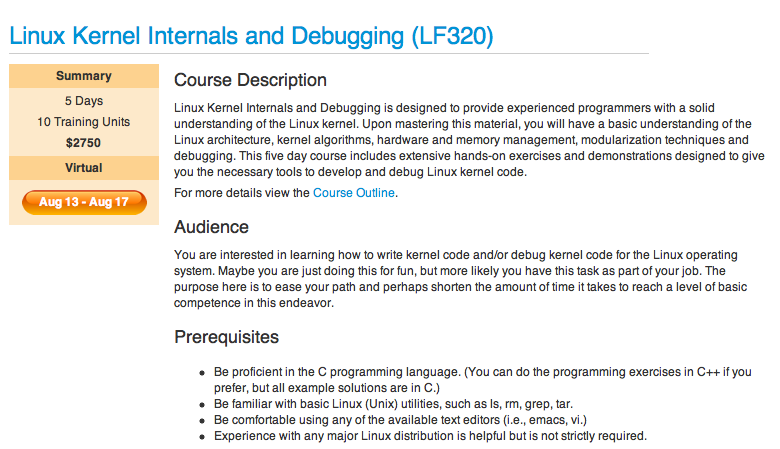
Keeping our Linux training materials and instructors in synchronization with the moving target of new kernel releases is almost an obsession of ours. To give an example, we began offering Linux Kernel Internals and Debugging [LF320] in November 2009, when the kernel was at version 2.6.31; with the current release being 3.5, there have been 14 major releases since them. LF320 has had eight major revisions in that period.
Depending on various factors, we put out a new version of our training materials at least at every other kernel release. Revise and release often has always been our operating method.
Methods we use to ensure currency of our Linux training include:
1) Our courseware developers take the time to monitor (and sometimes contribute to) the Linux Kernel Mailing List to watch developments in real time. We also closely monitor the Linux Weekly News, which consistently provides the most informed and competent coverage of Linux kernel development and trends.
2) Almost all printed references to kernel code in our Linux course materials contain both version and line numbers. This forces our courseware developers to check them every time a new kernel appears to see exactly what changes (if any) will affect the course materials and revise accompanying course text as appropriate.
It is not at all unusual to find significant differences this way that have not been noticed by simply following mailing lists and websites. Fields appear and disappear in data structures and even very old device drivers are rewritten to use newer methods and styles. We force ourselves to catch these modifications.
3) Our Linux courses are hands-on and exercise-based with most of the laboratories involving writing C code. All the example solutions code is verified to work with the newest kernel version and any adjustments and version dependence is coded in. We generally start this process well before the final release of the kernel by testing against release candidates.
All solutions are tested against both 32- and 64-bit Linux distributions from all major vendors. We make sure the solutions work both with the latest vanilla releases from kernel.org as well as distributor kernels; at this point we have full compatibility without modification going back at least as far as 2.6.32 and easy adaptation to earlier kernels.
4) Our instructors are made aware of pending changes and are asked for input before things are finalized; the instructors are the key link to the needs and demands of attendees and they play an active role in shaping content. They receive the new material immediately as it becomes available and we instantly swap it in for both the printed manuals and the instructor’s teaching materials.
While we want to promote new methods as good practice we also try to avoid premature promotion of new features (at least in detail), since it often takes a couple of kernel releases for new features to stabilize. So at first, we’ll add short descriptions in highlighted boxes and then later, develop new sections and sub-sections with detailed explanations of how to use them.
For example, we have introduced and then fully developed topics such as threaded interrupt handlers and high precision kernel timers (both of which arose from the real time preemption patch series) and tracing and debugging tools such as ftrace, perf and powertop. As new features get added we constantly rewrite.
Best Practices Help Everyone
When one looks at Linux training materials offered by other providers, one often sees features that are completely obsolete or deprecated appearing in the outlines. This is a red flag that either that the Linux training material hasn’t been updated significantly for years or doesn’t really exist.
We have other Linux courses that are more oriented to the user side and thus, are less dependent on exact kernel versions, such as LF312 Developing Applications for Linux, LF211 Introduction to Linux for Developers, and LF262 Developing with Git. While we don’t update them quite as often as the kernel-based classes, we still update them frequently to incorporate new material, improve the exposition, fix any errors, etc.
We believe we are helping our training attendees work efficiently (and enjoyably) as members of the open source community. Getting them to adopt best practices (often at the early stages of their journey) is of benefit to the entire community and expands it ranks.
Standardization is the biggest issue facing the open source cloud today, says Imad Sousou, director of Intel’s Open Source Technology Center. Adoption of open formats and interfaces will ensure flexibility and choice for users and vendors of the cloud.
It’s up to the innovators in this space — the developers and industry leaders, such as Intel – to set out those standards through open collaboration, he says. Initiatives, such as Intel’s Open Data Center Alliance and the OpenStack project, are leading the effort. And conferences, such as The Linux Foundation’s CloudOpen, to be held Aug. 29-31, also help push the discussion forward by bringing developers together.
Sousou, who will give a keynote presentation at CloudOpen on “The Importance of Linux at Intel,” answered some of our questions about how the community could create an open cloud and the role that Intel, as a hardware vendor, can play in the process.
How do you define the open cloud?
Imad Sousou: Interoperability is required for unfettered competition and unrestricted choice for users and vendors. Users must be able to come and go with no barriers to entry or exit, regardless of who they are and what systems they use.
The open cloud must meet these requirements:
– Use Open Formats, where all user data and metadata must be represented in Open Standard formats.
– Use Open Interfaces, where functionality must be exposed through Open Standard interfaces.
In addition, in the open cloud, various open source technologies should be available to build the right solutions efficiently and to drive innovation. These would include software stack and tools, such as the hypervisors or operating systems, middleware, such as databases and web servers, web content management systems, and development tools and languages. Such open source-based software solutions would reinforce interoperability.
What are the issues that need to be addressed to create an open cloud?
Sousou: The biggest issue is getting to the point where we have open standards on formats and interfaces that are independent of vendor and platform. Standardization, in the sense of “official” cloud standards blessed by standards bodies, is still in its infancy. However, approaches to interoperability that aren’t under the control of individual vendors and that aren’t tied to specific platforms, offer important flexibility. This allows the API specification to evolve beyond implementation constraints and creates the opportunity for communities and organizations to develop variants that meet their individual technical and commercial requirements.
What is the role of a hardware vendor, such as Intel, in creating open standards for cloud platforms?
Sousou: Intel’s core strategy is to make sure our platforms work seamlessly with our customer’s choice of operating environments. As an element of this strategy, we believe openness in software and architectures is a big win for users. This is also true for cloud computing, and Intel is willing to work closely with the cloud ecosystem to drive that direction. Intel helped form the Open Data Center Alliance, which works with existing standards organizations, such as DMTF, to help develop open, interoperable cloud standards.
Does there need to be an effort to create a standard or will a standard emerge through market forces?
Sousou: A standard will emerge through coordination efforts among developers, who are actually leading the innovation. From our experience, we believe that standardization itself cannot be effective without implementation. Fortunately, we have numerous successful open source projects for the cloud, and a standard is being defined. We believe coordinated efforts among these developers are crucial when defining a versatile standard. Conferences like CloudOpen will be tremendously helpful in that sense.
Can you give us a preview of your keynote at CloudOpen? Why is Linux important to Intel and how is that related to the open cloud?
Sousou: Today, Intel is one of the top contributors to the Linux kernel and Linux is the engine of the open cloud. The Linux kernel can be the hypervisor or it can be the operating system in the open cloud. Also, almost all open source projects support Linux. We believe our efforts on Linux and the open cloud will directly or indirectly benefit our customers.
Why does Intel find it important to attend and participate in events such as CloudOpen?
Sousou: As a key developer in the open source community, Intel will participate in CloudOpen to share our experiences and thoughts, concerning the open cloud, with other developers. At the same time, it provides a great opportunity for us to learn about many other open source projects that make up or support the open cloud. As mentioned above, participating in events, such as CloudOpen, is one of the most effective ways to help achieve the open cloud.
The OpenStack cloud platform hasn’t been short of powerful companies backing it, and now the OpenStack Foundation is finally heading into high gear, including preparing to hold elections to its board later this month. If you haven’t checked on how much support this promising cloud platform has, here are some details on the foundation and its structure.
As Computeworld reports, the OpenStack Foundation is preparing to hold its first board election in late August:
“Individual members will be eligible to vote for a third of the 24 places on the board. Half of the remaining 16 elected by Gold members of the foundation and half appointed by Platinum OpenStack Foundation members( Canonical, IBM, Nebula, Red Hat, AT&T, HP, Rackspace and Suse). On 19 July the OpenStack Foundation opened up individual membership of the organisation, with members allowed to participate in the board elections.”
The OpenStack Foundation is very well funded, and will help development of the platform move along at a solid clip. Considering the number if big tech companies backing the foundation, it could have considerable might in the cloud computing arena. The foundation will also preserve the open source goals of the original platform, according to its mission statement at least.
“These industry leaders, through their intent to become members of the Foundation, plan to provide technical and financial resources to ensure the long-term viability of the project, further accelerating open innovation and adoption of OpenStack,” says the announcement of the foundation.
antiX 12, a Debian-based distribution designed to run efficiently on older and low-specification computers, has been released: “15 months on from the release of antiX M11 series, we are pleased to announce the release of our antiX 12 series. Three variants available: full (697 MB) – features 5….


 At the Linux Foundation, we have a number of
  It’s up to the innovators in this space — the developers and industry leaders, such as Intel – to set out those standards through open collaboration, he says. Initiatives, such as Intel’s
  Does there need to be an effort to create a standard or will a standard emerge through market forces?
 The OpenStack cloud platform