Home Blog Page 2237

Red Hat: Open Cloud Requires Open APIs and Stacks

Red Hat announced the release of its Deltacloud 1.0 API last week and insisted that a truly open cloud requires open APIs as well as open source cloud platforms such as OpenStack. Like its sibling CloudForms platform, Red Hat’s homegrown Deltacloud API (a project now hosted by the Apache Software Foundation) is repositioned as a tool for building an open hybrid cloud.

5 Things to Make the Hybrid Cloud Enterprise-Ready

Skim any cloud computing survey done in the past year or so, and there’s a good chance you’ll find glowing predictions for the hybrid cloud. Scan the landscape for actual usage of these mixed public and private clouds by real-world enterprises, however, and you may come away with a different picture.
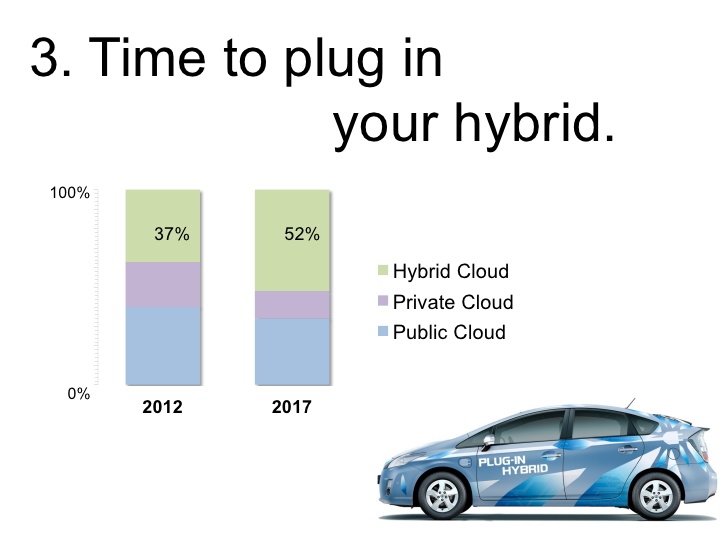
North Bridge Venture Partners slide on hybrid cloud

Why the disconnect?

“It seems very attractive to use a hybrid cloud, but existing enterprise applications are not designed to run in multiple places, and the interdependencies are sometimes unknown by the business,” David Butler, senior vice president of marketing at Eucalyptus, told Linux.com. 

It’s certainly not that hybrid cloud environments don’t offer myriad benefits; that they clearly do. Rather, a number of factors are just now beginning to fall into place that will propel their adoption, according to several experts.

Hybrid Cloud Adoption to Grow

Optimistic data about the hybrid cloud abounds. A few cases in point: 

* In a survey released back in February, Frontier Technology and Vision Solutions found that “hybrid models are the most popular choice for companies looking at how they can make the most of cloud computing for their business needs.”

* Recent data (PDF) from IDG Enterprise predicts a considerable jump in adoption of hybrid clouds over the next 18 months.

* RightScale’s recent survey, released in June,  found that 53 percent of respondents were pursuing a hybrid cloud strategy.

* Also from June, a North Bridge Venture Partners study predicted that “within five years, hybrid clouds will be the emphasis of 52 percent of respondents’ cloud strategies.”

The Best of Public and Private Clouds 

There are also clearly many potential benefits to using a hybrid cloud. Flexibility, portability, choice and the ability to pay only for what you need, for example, are foremost among those benefits, said Michael Hubbard, senior director of VMware’s Accelerate Advisory Services.

So, too, is the ability to “align application SLAs [service-level agreements] to the proper virtual data center, which may or may not sit inside your four walls,” Hubbard explained.

Indeed, “there’s a whole lot of complexity associated with building your own internal private cloud,” noted Brett Goodwin, vice president of marketing with cloud computing provider Skytap. “A lot of the technology is still fairly young and evolving quickly.”

As for public clouds, “they’re great for applications where you want people to be able to access it over the internet,” Goodwin added. “But even in multitenant environments, there can be accessibility or security concerns.”

The hybrid cloud, on the other hand, “really gives you the best of both worlds: the elasticity, scalability and agility that the public cloud brings, but also the control, visibility and security that the private cloud offers,” he said.

Hybrid Clouds Not Well Understood

So why aren’t hybrid clouds more commonplace in enterprises today?

“Part of the challenge is terminology,” Skytap’s Goodwin suggested. “People understand what a private cloud is, and what a public cloud is,” but hybrid clouds are perhaps less easily understood.

Nevertheless, “we believe the hybrid cloud is really where we’re going to see enterprises benefit from cloud computing in a big way,” he added.

In order for that to happen, a number of things will need to fall into place, experts suggest.

5 Areas of Hybrid Cloud that Need Work

1. Visibility and Control

The early generation of cloud services did a good job of empowering users, Goodwin said: “They really nailed self-service.”

What was missing for enterprises, however, is “the visibility and control that IT in particular needs to manage that hybrid cloud resource as effectively as they manage on-premise resources,” he noted.

What’s needed, for instance, is “the ability for IT to set quotas, or limits, in terms of how much resources can be consumed,” Goodwin said, as well as features such as automated notifications and reporting.

2. Security

Security, not surprisingly, is another issue.

“I think security is a No. 1 concern that is difficult to prove,” said Butler of Eucalyptus. “Public cloud providers need to work closely with an on-premise IaaS provider to demonstrate the solution that works and provides security and best practices around operational functions.”

Ultimately, there needs to be a common toolset across the public and on-premise clouds that “just works,” Butler added. “The API wars have started, but at the end of the day, the speed and agility a business needs are truly based on getting an application running quickly and cost-effectively.”

3. Integration

Integration challenges also need to be addressed, noted Lori MacVittie, senior technical marketing manager with F5 Networks and a member of the Steering Committee for the CloudNOW consortium of women in cloud computing.

“Currently, challenges exist with integrating and normalizing network connectivity, integrating and managing cloud-based resources with datacenter hosted resources and systems, and integrating processes that control access to and delivery of applications from cloud computing environments in a way that’s consistent with business and operational policies,” MacVittie explained.

“These challenges are being addressed in a variety of ways, from software-defined networking (SDN) and network overlay protocols like VXLAN and NVGRE at the network layer to new solutions such as cloud gateways and brokers that address issues at the resource and process layers,” she added.

4. Data Synchronization

Then, too, there’s the need for synchronization of data between the datacenter and the public cloud provider, Butler pointed out.

“Standardization around the container of the application and data” is key, Butler explained. “This could include SLA, security, owners, backup/DR, etc. Just because the application moves does not mean we are not concerned with these things.”

5. Licensing and Support

Last but not least, “licensing of the OS and application that runs in two places will make the ROI/TCO easier to figure out,” Butler said. “Support also needs to be worked out. If the application runs on a cloud, will the ISV [independent software vendor] support it?”


More Android Malware Sprouting Up Amidst 2012 Olympics

Android is a common target for malware fiends, but the Olympics are providing cyber criminals with another opportunity.

Honeywell Signs Android Patent Agreement with Microsoft

Alongside announcing a new Android-based enterprise digital assistant, Honeywell has confirmed that it has signed a patent agreement with Microsoft over Google’s Android and Chrome OS

Read more at The H

30 Linux Kernel Developers in 30 Weeks: Arnd Bergmann


Linux kernel developer Arnd Bergmann is interviewed for this week’s 30 Linux Kernel Developers in 30 Weeks profile. Bergmann shares with us his focus areas at the moment as well as some specific advice for newbies.

Name

Arnd Bergmann

What role do you play in the community and/or what subsystem(s) do you work on?

I am co-maintaining the arm-soc kernel tree together with Olof Johansson. We pick up patches from dozens of ARM subarchitecture maintainers and consolidate patches for the merge window to send them upstream to Linus Torvalds. This nowadays amounts to about 1000 patches for each merge window.

I also review all new architecture ports submitted for inclusion into Linux, and I keep some watch over the drivers/char, drivers/misc and include/asm-generic directories in the kernel.

Where do you get your paycheck?

I work for IBM Deutschland Research & Development in Böblingen, which lets me work full time on the nonprofit Linaro project through an agreement with the IBM Linux Technology Center and IBM Microelectronics.

What part of the world do you live in? Why there?

I moved to southwest Germany for my job at IBM a little over ten years ago, when this was one of the few places in my home country that let me work on the Linux kernel.

What are your favorite productivity tools for software development? What do you run on your desktop?

I do almost all of my work using git and vim. I also use a fast x86 workstation for cross-building ARM kernels. I run Kubuntu on my desktop but have been thinking for a while about moving on to XFCE4 once I find a way to migrate my email setup away from kmail 1.12.

How did you get involved in Linux kernel development?

I started out as a Linux user with lots of unusual hardware in the late 90s that required kernel modifications to run. I kept sending mostly bug fixes through my time at university until I learned about the concept of actually getting paid to do the same things I did as a hobby.

What keeps you interested in it?

I can’t imagine doing anything else for a living after having looked into most kernel subsystems at some point over the last 15 years.

One of the best things about my work is that all the good work stays around, even if I change jobs or a project gets shut down.

What’s the most amused you’ve ever been by the collaborative development process (flame war, silly code submission, amazing accomplishment)?

I once reviewed a submission for a new architecture that was being proposed for inclusion. I told the author that those things need a lot of review cycles over months and listed about a hundred things that were wrong with it. A week later the developer came back with a new version that fixed all those issues and the code was accepted in the next merge window.

What’s your advice for developers who want to get involved?

Read a lot of code and code reviews from other people that are doing good work. When writing your own code or reviewing patches, think about how they would have done it.

For a first contribution, start with something useful and small like an obvious bug fix. A lot of bugs can be found by using automated tools that are listed in the kernel documentation.

What do you listen to when you code?

I used to listen to last.fm but that does not work well through the corporate firewalls, so I’m currently on radioparadise.com, which I play on a squeezebox.

What mailing list or IRC channel will people find you hanging out at? What conference(s)?

I attend the three or four Linaro Connect events every year and also LinuxCon and ELC when I find the time. My home IRC channels at the moment are #linaro-kernel and #armlinux on freenode.net.

LDTP 3.0 Automates GUI Testing on Linux

Following the release of its Cobra GUI testing tool for Windows systems, the GNU/Linux Desktop (GUI Application) Testing Project has released the new version of its Linux tool as well

Read more at The H

The Huge Nouveau Kernel Driver Rewrite Surfaces

Over the weekend there was the push by Red Hat’s Ben Skeggs that effectively reworks/rewrites the Nouveau DRM kernel module for reverse-engineered open-source NVIDIA graphics under Linux…


Read more at Phoronix

New OpenGL Standards Promise To Bring Better, Faster Graphics To Mobile And Desktop

Khronos opengl es

At SIGGRAPH 2012 today, the Khronos Group, the non-profit organization behind the OpenGL standard, announced the release of OpenGL 4.3, OpenGL ES 3.0 for mobile devices. OpenGL, in its various versions for mobile and desktop, is the one of the main standards for developing graphics-intensive 3D apps and games for the iPhone, Android and many consoles and desktop operating systems. Among the companies involved in the OpenGL working groups are heavy weights like AMD, Intel, ARM, NVIDIA, Broadcom, Apple, Google, Nokia and game developers like Epic, EA and Unity.

OpenGL ES 3.0, which remains backward compatible with ES 2.0, is meant to make life easier for programmers as it spells out tighter requirements for supported hardware features. The new spec also brings a number of OpenGL 3.3 and 4.x features to from the desktop to mobile. One of the most important new features in the new spec is support for new texture functionality that brings better texture compression (including the ETC2 and EAC standards) and a number of new hardware-accelerated features like instance rendering, occlusion queries and transform feedback to mobile.

OpenGL ES 3.0: Better Looking Mobile Games And Longer Battery Life

It’s worth noting that many developers currently pack different set of textures for different devices into one APK. Now, however, they will be able to use the same assets on mobile and the desktop, where the same features are also now part of the spec. Thanks to the improved compression features, those packages should be significantly smaller, which in turn should make downloads faster and reduce the memory footprint of these apps.

 
Read more at TechCrunch

Intel Works On Haswell HDMI/DP Audio Linux Support

Intel’s open-source hardware enablement under Linux of next year’s Haswell architecture continues. New HDMI audio patches have been published while the DisplayPort audio patches are still forthcoming…


Read more at Phoronix

Is GNOME in Free Fall?

Between the arrival of both MATE 1.4 and KDE 4.9 and the emergence of SolusOS’ brand-new GNOME Classic on the scene, there’s no denying it’s been an exciting few weeks here in the world of Linux desktops. That, in turn, has made it all the more difficult to witness the identity crisis that has apparently befallen GNOME itself. “Core developers are leaving GNOME development,” wrote developer Benjamin Otte in a recent blog post entitled, “Staring into the Abyss.” Not only that, but “GNOME is understaffed,” “GNOME has no goals” and “GNOME is losing market- and mindshare.”


Read more at LinuxInsider