
Vietnamese tech forum Tinhte is showing off what looks like RIM’s new 10-inch PlayBook. But while the hardware looks like it might almost be ready for launch—if it’s real—don’t expect to get your hands on one any time soon. More »
This Is Probably the 10-Inch PlayBook (That Won’t Be Out Until 2013)
Big Biz ‘Struggling’ to Dump Windows XP
Windows 7 is running in just 20 percent of large enterprises with the most difficult migrations yet to come.…
Apple Reportedly to Unveil iPhone 5, iPad Mini on Sept. 12
Both devices will be announced in the middle of September, followed by the release of the new iPhone on September 21, claims blog site iMore. [Read more]
AMD Open-Source S.I. Botched, Hope For The Future
We’re now going into eight months since the AMD Radeon HD 7000 series “Southern Islands” graphics cards first launched. In that time the Catalyst Linux support has been stable and fine, but the open-source driver support is still unusable…
Valve, Linux and the Windows 8 ‘Catastrophe’
Love knows no bounds, as the old saying goes, and there may be no better example than the Linux community’s feelings for Valve. That, of course, dates back to the magical day in April when the gaming company announced it was bringing its Steam gaming platform to Linux at last, causing no end of jubilation in the Linux blogosphere. Today, however, the flame of Linux geeks’ love for Valve burns brighter than ever before. The reason? None other than a series of comments made by Valve cofounder Gabe Newell at the recent Casual Connect videogame conference.
![]()
Microsoft Confirms Surface Will Ship Alongside Windows 8 on Oct. 26
Supersite for Windows is reporting that Microsoft has confirmed that the Surface is due to start shipping on October 26th, alongside Windows 8. More »
GNOME Developers Set Ambitious Goals at GUADEC
Two GNOME developers have set ambitious goals for the project at the annual GUADEC conference, including a release of the next version of the desktop in 2014. Not everyone agrees with their aims, however
CIOs Increasingly Bullish on the Cloud, Survey Finds
It’s easy enough to find rosy predictions for the cloud from the vendors of related products and services, but when CIOs speak out in favor of the technology, it’s hard not to sit up and take notice.
Such, in fact, is just what came out of a recent survey of IT executives from Host Analytics and Dimensional Research.
Whereas a few years ago we were still hearing considerable concern from CIOs on a number of fronts — security and control perhaps foremost among them — this new research suggests that these executives are increasingly optimistic about cloud computing’s many benefits.
‘Good for Business’
Commissioned by cloud corporate performance management and business intelligence (BI) provider Host Analytics and conducted by Dimensional Research this past May, the survey gathered the views of some 350 CIOs and IT executives on attitudes, trends and challenges pertaining to cloud adoption.
Adding further weight to Gartner’s cheerful spending forecast issued earlier this month — the research firm predicts that global spending on cloud computing will leap from $109 billion this year to $209 billion in 2016 — this new data also paints a clearer picture as to why that is so.
“The research shows the overwhelming majority of CIO and IT executives surveyed felt cloud solutions are good for business,” said Jon Kondo, president and CEO for Host Analytics. “When asked about further possible benefits of the cloud, most felt cloud technology offered strong financial benefits and also increased ownership for business stakeholders.”
‘More Ownership’
Some specifics: 92 percent of respondents said the adoption of cloud technologies is good for business, according to the report, while 67 percent said cloud technologies help IT deliver better systems at lower costs.
Sixty-two percent, meanwhile, said that SaaS applications give business stakeholders more ownership of key applications.
Of course, as is true in any real-world setting, the process of adopting cloud technologies doesn’t happen overnight.
To wit: 69 percent of respondents said their companies still work primarily with on-premise applications, for example, and 88 percent reported some challenges with SaaS business applications.
A full 67 percent singled out issues integrating data among applications, while 37 percent noted that IT had been asked to take ownership for solutions purchased without their input. Keeping tabs on where data resides was another challenge CIOs named.
‘High Optimism and Expectations’
“Businesses are investing heavily in cloud computing today,” said Diane Hagglund, author of the study and senior research analyst for Dimensional Research. “Our research reveals high optimism and expectations among CIOs and IT executives for cloud adoption and value, but also hurdles including the anticipation that IT will end up operating cloud applications bought by other areas of the business and without input from IT.
“In overcoming these and other hurdles to adoption, good communication is essential, but not always existent,” Hagglund added. “One silver lining: BI can help solve problems caused by siloed SaaS applications.”
Entitled “Current Trends in Cloud Adoption: A Survey of CIOs and IT Executives,” the full report is available as a free download (registration required) from the Host Analytics site.
Openfiler Enterprise NOS: Capable but Tricky

Openfiler is supposed to be an enterprise network storage operating system, and it is very capable, but in many ways it’s an exercise in frustration.
Rarely do our little IT empires grow in an orderly, cruft-free fashion, but rather they acquire new bits and pieces like old shipwrecks acquire barnacles. Barnacles acquire more barnacles, and mussels, limpets, anemones, oysters, and gosh knows what-all, and it all bonds together in a tough aggregate that’s nearly impossible to separate without damaging somebody.
Our datacenters grow in the same manner, and even with the best intentions and care rip-and-replace is rarely a feasible option, because just like our friends the barnacles when we change one thing it affects other things. Anyway we’re at the point where we don’t need fabulous new revolutionary technologies because Linux already has everything we need: networking, storage, services, virtualization, cloudy stuff… I think our most pressing need is for good management tools.
And so Openfiler 2.99 aims to be your one-stop storage management shop, a sleek lean network storage operating system with a nice Web control panel. Openfiler supports all manner of networking protocols:
- NFSv3 and 4
- CIFS/SMB
- FTP
- WebDAV
- HTTP.
And storage protocols:
- iSCSI
- Generic Linux SCSI
- Fibre Channel
- InfiniBand.
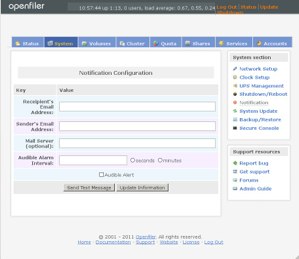
It offers snapshots and scheduled snapshots, live volume migration and replication, and fine-grained access controls on shares and quotas. It includes Cluster 3.0, DRBD, and Heartbeat for high-availability. Some other nice features are UPS (uninterruptible power supply) management, monitoring and notifications, and a Java-powered SSH console. (I know, just use the real console, but some users will like it.) The Web administration GUI is comprehensive and fairly well-organized.
The Ext 2, Ext 3, and XFS filesystems are supported, but oddly not Ext4, which seems like a natural for a storage operating system, since it supports very large storage volumes.
Some advanced plugins that are available only by subscription are the Advanced iSCSI Target Plugin ($1,295.80), and the Fibre Channel Target Plugin $1,295.80). Both are proprietary, and both are one-time, perpetual, per-instance licenses. You get some installation and migration help, and then additional support is extra.
Installation Gotcha
There are installation walkthroughs for both the text and the graphical installers. Be sure to review these because they contain the default login, and manual partitioning instructions. Do not let the installer automatically partition for you, because you won’t be able to create volume groups from the Web GUI.
Another gotcha is the screenshots don’t match what you’ll see in the installer, because they are for an older release.
Web GUI
The Web GUI is pretty nice and, in theory anyway, makes it fairly easy to set up some of the more difficult configurations such as RAID arrays, high availability, LDAP user authentication, or Windows Active Directory authentication. And it does live up to its promise of easier administration, and handles a lot of these tasks competently. But not all. For example, I thought it would be fun to pointy-click my way to an HA setup for once, instead of hassling with text configuration files. Usually I prefer text configurations because they are faster than wading through a GUI maze, and they’re easy to replicate, but Heartbeat’s ha.cf is a complex beast. In Openfiler it appears to be as easy as first visiting the Services tab and starting up Cluster, and then going to the Cluster Manager tab.
But no. Cluster does not start from the Services page. It just sits there and looks at me. So, after a fair bit of Web-searching I learned that is by design, because “Advanced features such as high availability (HA) and block replication, including WAN replication capability for remote disaster recovery (DR), support require an enterprise cluster or SME cluster subscription.” Now, I’m no ace Web programmer, but I do know how to put a sentence on a Web page that says “To activate this feature, please do such and so.” Which surely is preferable to leaving potential customers in the dark and thinking either they are missing something, or the product is defective.
No Documentation
Which brings me to my main gripe with Openfiler, and that is the lack of useful documentation, and what little they have is disorganized. There are no READMEs, no changelogs, no news, no blogs, no release announcements. When you click the “Release notes” button during installation all you get is a message that says “Release notes are missing.” The download page claims to offer multiple download images: an ISO for a hard drive installation, and several pre-fab virtual machine images. But there is only an ISO for the current release, 2.99, which was released in April 2011. There are multiple VMs for the 2.3 release, which is from February 2009.
Openfiler offers both community and commercial support. Their IRC channel and user forums are featured prominently on their front page, but they aren’t all that helpful. I had the IRC channel open for several days, and even though several dozen users were logged in it was very quiet. The forums have more questions than answers. So what is the puzzled admin to do? You can purchase an administration manual for $51.83. What do you get for your fifty-some dollars? I have no idea because there is no table of contents or overview, it doesn’t say how many pages it has, or even which version it covers.
Openfiler is based on rPath Linux. rPath is designed for easy customization and custom builds, and especially for building software appliances. The main difference for the hardworking system administrator is it uses the Conary package system, which is completely different from all the other Linux package managers, so you’ll have a whole new package manager to learn. The Web GUI does not include a package manager, though it does have a one-click system updater.
I’m all for software developers getting paid, and Openfiler’s pricing is more than fair. Support options range from about $1,000 to $5,500 per year, which are not out of line for a high-end enterprise product. Me, I wish there were fewer mysteries for getting product and release information, and for testing basic functionality. I’m more likely to become a paying customer when my first experiences with the product are pleasant and productive.

My Top Five Sessions at the CloudOpen Conference
CloudOpen will make its debut in a little over a month in beautiful San Diego alongside LinuxCon. While it will still be the best deal in technology conferences, the registration price goes up on Sunday. (Why do I think it’s a good deal? Two amazing conferences for the price of one, three amazing free as in beer parties, skateboarding lessons, hacker lounges and so on). This event will sell out so if you want to join us, please register today.
Here are my top five sessions at CloudOpen:
- Cloud API’s – The New Agent of Vendor Lock-In – Marten Mickos, Eucalyptus; Cole Crawford, Nebula; Sam Ramji, Apigee, Reuven Cohen, Virtustream. Like system calls, Cloud API’s are the bridge to the back end infrastructure that interface with the complex hardware below. Join a panel discussion with Marten Mickos, Cole Crawford, Reuven Cohen & Sam Ramji for a discussion on the current landscape of the technology people are calling the new anti vendor lock.
- User-Driven Innovation in the Open Cloud – Greg DeKoenigsberg, Eucalyptus Systems. The open cloud is still in its early stages of evolution — but its users are ready to innovate now. In this talk, we will discuss user-driven innovation and its role in the development of open source software in general, and in open source cloud software in particular, with examples of how users are hacking open source cloud software to drive their own innovation strategies.
- Beyond Open Source in the Cloud – Gordon Haff, Red Hat. Openness doesn’t stop and end with the submission of some format to a standards body or with the announcement of partners endorsing some specific technology platform. It doesn’t stop and end with open source either. An open cloud isn’t about having some singular feature. It’s about maximizing a wide range of characteristics that push the needle from closed to truly open. These include open source and open standards for sure. But they also include portability of applications and data, viable and independent communities, freedom from IP encumbrances, and APIs that are independent of specific implementations.
- OpenStack – Beyond the Software – Jonathan Bryce, OpenStack. “Open cloud is more than software. Open environments and ecosystems create incredible opportunities for users and businesses to push technology forward.
OpenStack is open source software for building clouds. Designed to be pluggable and extensible, OpenStack allows you to choose from a variety of commodity or enterprise hardware, tools and management options depending on your use case. - The DevOps Way of Delivering Results in the Enterprise – James Wickett, Mentor Graphics Corporation. Delivering Software as a Service in the cloud requires agility and speed. Sadly, those are two attributes that big companies aren’t usually good at doing. Instead of organizing to deliver results, companies tend to build silos where development, operations, QA and security operate as separate entities. DevOps unites these groups to deliver services faster and provide results that matter. This talk will arm you with the DevOps patterns to follow as well as point out specific anti-patterns to avoid. To show you how to implement DevOps in your org, this talk will cover sample architectures and Open Source tooling. Come hear how to start delivering results with increased agility and speed.
It’s hard to pick only five with great sessions on the schedule covering CloudStack, Chef, Ceph, Gluster, KVM, Xen, Ganeti and more. Many companies are researching and/or implementing cloud solutions right now. I hope CloudOpen will give you the data you need to pick the right open cloud technologies for your business. I hope to see you in San Diego!
Register before Sunday to take advantage of the lower pricing.