
After nearly ten years of work and various 1.9x pre-releases, the GRUB development team has finally released version 2.00 of the Grand Unified Bootloader
Open Cloud Roundup: Top Headlines Week of June 25
Red Hat dominates the open source cloud news this week with a string of product launch and acquisition announcements from the Red Hat Summit in Boston and the ensuing commentary from the blogosphere.
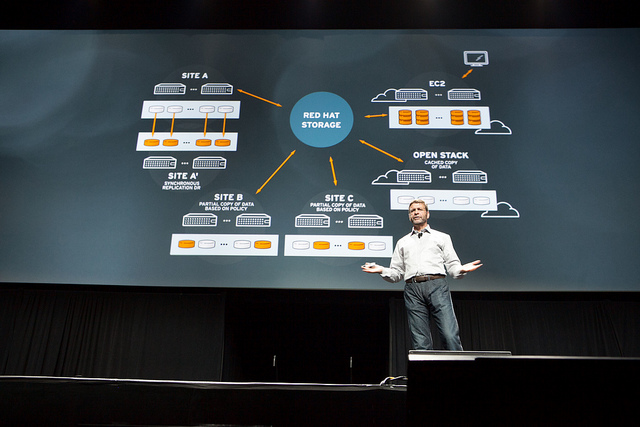
Red Hat: Keep clouds open, like Linux
The Register
Red Hat reiterated its definition of an open source cloud and rolled out several new cloud products this week at the Red Hat Summit in Boston. The Register offers a great, if long, summary post of the week’s announcements and Red Hat’s cloud strategy.
Red Hat Shifts Into Gear With OpenShift
Information Week
Red Hat’s OpenShift Platform-as-a-Service competes with VMWare’s Cloud Foundry, here’s a comparison of the companies’ offerings.
IBM: Open source is not winning the war in virtualization, cloud … yet
ZDNet
Open source may be driving innovation in technology, including cloud computing and big data, but it’s not dominant yet says IBM VP Robert LeBlanc in a presentation at the Red Hat Summit this week. He advocates open virtualization, which has too many variations for clients right now.
Asgard: Web-based Cloud Management and Deployment
Netflix
Netflix has open sourced its Asgard cloud management tool for Amazon Web Services.
New Open Cloud Computing Forum on Linux.com
Linux.com
Today we launched a new discussion forum for the Linux community focused on cloud computing and open source. Join the conversation!
New Open Cloud Computing Forum on Linux.com
Linux.com has started a new forum for community members to discuss cloud computing and the open cloud. Just like the Linux Foundation’s upcoming CloudOpen conference in August, the forum is intended to help highlight the people, projects and ideas behind the open source cloud and advance the conversation around creating open standards for cloud computing.
To kick off the conversation I’ve started a new thread on why it’s important to fight for an open cloud. The threat of vendor lock-in is a widely cited reason that received a bit of attention recently at GigaOM’s Structure conference. Several presenters ignited a debate over whether Amazon Web Services should be considered competition or the new de facto standard.
Rackspace’s Lew Moorman argued that businesses need an alternative to Amazon in order to escape the risk of lock-in. To ensure flexibility, freedom and affordability, companies need to be able to move their data around. And because Amazon runs on proprietary technology, it’s difficult to replicate their cloud services elsewhere.
Eucalyptus’s Marten Mickos in a separate Structure panel held that the Amazon API is the dominant force in the market now and smart vendors are aligning with it. Open source projects and companies can still provide flexibility even while integrating with Amazon.
Amazon certainly provides motivation for competitors but it’s not the only issue. Why build an open cloud?
Please feel free to start new forum threads based on your own interests and needs. There are plenty of technical and philosophical issues to discuss. I hope the new forum will be a resource for ideas and inspiration as well as another way to connect with other Linux professionals interested in cloud computing.
Visit www.linux.com/forums to join the conversation!
Why Every New Android or iOs Feature Is an Opportunity for Facebook
From Google Events to the Nexus Q home entertainment device, Google announced some really cool new social-oriented mobile features and services on Wednesday at its Google I/O developers conference. Apple did much the same earlier this month at WWDC, its World Wide Developers Conference. Ironically, though, the more impressive the proprietary features they debut, the more both companies open new opportunities for their competitors.
The problem – the elephant in the room, really – is that the vast majority of these new features and services work only on one company’s operating system. Folks on competing platforms are effectively locked out.
For Google and Apple, that’s competitive differentiation, intended to get people to choose their platform over the competitors. And there’s little doubt that these features will do just that – at least to a point.
Social Features That Separate People
But for users, though, these mobile-social features create a big, unexpected problem. Instead of connecting people and groups, they can do the exact opposite – separate groups according to what device they use.
Google Nexus Tablet Poses No Threat to iPad, Says Analyst
Despite its competitive price tag, the new Nexus 7 tablet is unlikely to knock the iPad off its perch, says analyst Brian White. [Read more]
What’s New In Android 4.1 – For Developers?
The Latest Details On Intel’s Valley View Atom SoC
Another Intel DRM pull request was submitted this morning for driver changes that will ultimately land in the Linux 3.6 kernel. With these latest open-source Intel driver changes, some new details are revealed about Intel’s Valley View — their next-generation Atom SoC that sports Ivy Bridge class graphics rather than any PowerVR cruft…
SImply Nobody is Rushing to Beat the Microsoft Licencing Price Hike
The expected hordes of customers gathering to renew Microsoft volume licensing agreements before the planned price hike next month failed to show up, say a bunch of reseller sources.…
Read more at The Register
Nexus 7 Tablet Guidebook Now Available
Google’s guidebook reveals all the details behind the new Nexus 7 tablet and spills the beans on the new Jelly Bean OS. [Read more]
Has the Command Line Outstayed Its Welcome?
There are many topics that tend to come up in a recurring manner around water coolers throughout the Linux blogosphere, and not just the great “Year of” debate, either. No indeed, another shining example more than a little familiar to most of us who spend any time here is the much-abused command line — specifically, whether it’s outlived its usefulness in this era of the GUI. Well guess what? The debate is back! So what shall it be? Has the command line interface outlived its usefulness? Or is there still a place for this trusty old tool?
![]()