Jeffrey Hammond had a message for LinuxCon attendees on Wednesday morning, “congratulations, you’re on the winning team. Open source has crossed the chasm.”
Hammond, principle analyst with Forrester Research, was talking about the results of surveys done in conjunction with Dr. Dobbs, Eclipse community surveys, and Forrester‚Äüs Enterprise and SMB Software Survey from 2008 and 2009. According to the data, it looks like open source is doing very well in the enterprise.
Why is it winning? Hammond says that open source initially wedged its way into enterprise environments based on cost savings. However, expanding the use of open source was not high on the list of the most recent surveys. Why? It’s already there. Hammond says that we’re now seeing the second wave of open source adoption, being driven by improved flexibility to execute and positioning enterprises to grow when the recession ends.
Hammond says that the urgency to adopt FOSS is fading. It’s not as important in 2010, because “it’s already happened. We’re there, we’ve arrived.” According to surveys, this is seen most in programming languages, operating systems, and then IDEs. Only one in five (21%) developers are not using open source as part of their work. Though that jumps to two out of five when looking at the Dr. Dobbs survey, which isn’t surprising since it largely focuses on developers working with Microsoft technologies.
Another thing that’s changed is that management has caught up to developers. Usually managers were not aware of open source use. 2009 was the year that management discovered open source use in the business. Now that they’ve discovered it, they like it. In some cases, management gives higher ratings of awareness of the use of open source, says Hammond.
You might expect that open source adoption would be roughly similar across companies of different sizes, but the survey shows something quite different. Larger companies report higher usage for a couple of reasons. Larger companies are going to report higher use because they use some of everything. Application servers and operating systems are highest in organizations larger than 20,000 employees.
But what’s more interesting is the “u-shaped” curve where very small and very large organizations show high adoption. Why? Hammond points out it’s because the organizations with more time than money will trend towards open source faster. Large companies have more people but have reduced IT budgets. In those cases, purchasing may be limited, but staff can be focused on deploying open source. Small companies don’t have as much money in the first place, and will turn to open source out of necessity.
Open source databases are outliers, with less adoption in larger companies. There’s still work to be done to convince large organizations that open source databases can meet their needs at scale. More small organizations are using open source databases.
Unfortunately, Windows still leads as the primary OS used for development. But Linux is “doing pretty good work,” says Hammond. 30% of developers say that they’re using Linux as their primary development OS on Eclipse; Dobbs reports 16% but a largely Windows-centric crowd. Which Linux? Ubuntu is leading by far with 17%, all the other Linux combined don’t touch Ubuntu. Hammond says that the focus on user experience is paying off with developers.
Deployment numbers are nicer for Linux. 40% are deploying on Linux, 36% on Windows from Eclipse; the Dr. Dobbs survey finds 23% deployment on Linux vs. 57% for Windows-centric developers. In both cases, organizations are deploying more on Linux than ever before.
Open source has blown the doors off with source control management. Subversion is the leader with 52%, and Git/GitHub with 6%. Open source is the clear winner in SCM. Git has crept up from 2% to 6%.
One might wonder, why is so much focus on developers. Well, OK, most open source folks wouldn’t wonder that but Hammond explained his reasoning anyway. “I would argue, open source is a magic bullet for developers because of what they have to deal with.” What do they have to deal with? The software “iron triangle” of cost, speed, and integration.
“The speed piece is not to be underrepresented; they want to turn on a dime. Developers get it, they don’t have to spend 10 weeks fighting with purchasing to get a development environment. They get the idea of how not having to deal with licenses and internal processes speed things up.
Aside from avoiding purchasing headaches, which is as good a reason as any, developers outside the FOSS community (for the moment) are realizing that access to source code counts. Hammond says that allows developers to solve problems more quickly without dealing with vendors that don’t care about their problems.
Tech Populism
Another interesting trend is the reverse of “tech populism.” Typically, tech has flowed from the enterprise to consumers. Hammond points out that tech is now being driven by consumer tech like smartphones and tablets. Things happening “outside the firewall” are driving technology, which has empowered developers to change corporate IT culture.
This may not be permanent, though. Hammond warns that managers are aware that this is going on and will try to reassert control. To win, drive affirmation and adoption through developers but be nice to management because they still write the checks. Management wants to know if their peers are doing it and case studies are increasingly important.
The good news is that Hammond says concerns over the IP and business viability are receding. Now it’s about how to scale and understanding difference between business models related to open source.
Trust, But Verify
Hammond closed the presentation in part by talking about best practices for adopting open source. First, he urged companies to appoint an open source software steward, and create a comprehensive policy around open source. He noted that about 36% of companies don’t have a policy regarding deploying and contributing to open source. He recommended creating a policy document that would outline the FOSS policies, though the length he suggested (20 pages) seems a bit excessive. Still, there’s no reason why a company of any size should be without a policy regarding open source at this point.
He said that companies should trust their development teams, but verify their work with code-scanning tools. This would illustrate why the open compliance program is so necessary.
Hammond says that open source has moved from “don’t ask, don’t tell” where managers don’t know about open source usage, to strategic adoption. Now it’s time to focus on secondary virtues of open source like speed, flexibility, and engagement. Cost is important, but Hammond says he hasn’t found anybody that says “we want to use open source because we don’t have to pay.” The reality is that open source is winning on its merits, not on its price.
Engagement is particularly important. The relationship with vendors of software has changed, and developers can go “as deep into the rabbit hole as they want…they felt like they own the system from stem to stern.” With ownership in the system, developers spend more time working with the business and have a higher level of engagement. Though Hammond didn’t put it this way, it’s clear that open source is winning because when developers engage with open source they become part of the movement and want to spread that through the workplace.

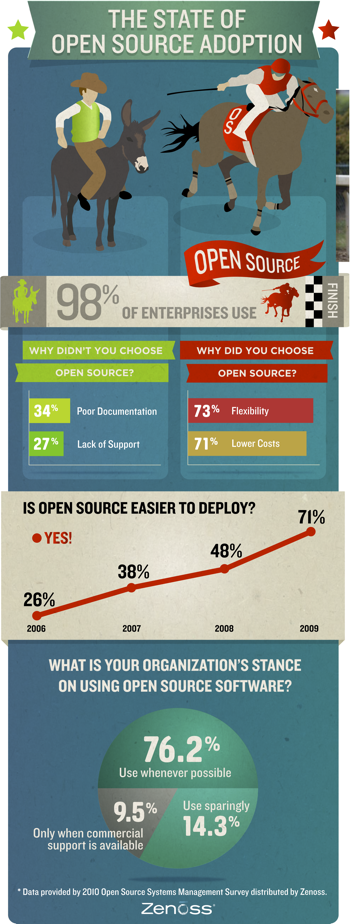 974 respondents at LISA 2009 and from the larger Zenoss community. Zenoss has been conducting the survey since 2006, and has found that open source is consistently finding greater acceptance among system administrators at the conference. While not a perfect sampling of the industry at large, the opinions of LISA attendees are important to understand the perception of open source in the enterprise.