Home Blog Page 2871

New Fonts For Ubuntu

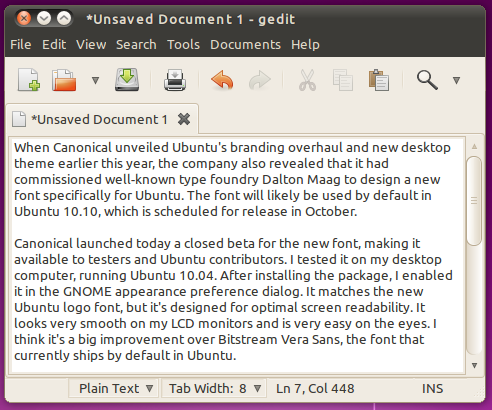
Since I can remember, all the Linux distributions always has a less than good defaults fonts (or maybe it was just my imagination) so I always has to change the fonts. The good news is Ubuntu change this, they now have a new type of fonts (Designed by Dalton Maag)

The Ubuntu font (family) is open-type ttf based font format and fully unicode compliant. It contains Latin A and B extended character sets, Greek Polytonic and Cyrillic extended. The font has been hinted for superior screen display. Its spacing and kerning is optimised for body copy sizes.

You can visit the Ubuntu blog for more info about this new feature, to do this just follow the link in the bottom¬

Source: Ubuntu Blog

Speed Up Your Ubuntu Machine Boot Time


This guide has been take from G-Hacks Blog and quoted has is. If you need more info you should visit the blog following the link in the bottom:

How this works

When you boot up your machine Grub does a search for all the necessary drivers to load. This takes time. Instead of making Grub search for these drivers, the profiling actually makes Grub remember every driver necessary to work, thereby cutting down all of the driver load times.

This is a proven technique that can help the boot process. It has actually been around since Ubuntu 6.04, so it has been tested and tested and does work. I will make this normal disclaimer. Even though Grub profile works, anytime you deal with your bootloader you take the chance that you can render your machine unbootable. So you use this tool at your own risk. Don’t take that to mean profile is a dangerous tool and your machine will wind up bricked and mocking you…that is just to say should something happen, you were warned.

How to add profiling

To do this you are going to have to modify your /etc/default/grub file. The edits are not challenging at all. So, open up a terminal window and get ready to work.

The line you are looking for is:

GRUB_CMDLINE_LINUX_DEFAULT=”quiet splash”

This is the line that gives the options to Grup upon boot. You need to add one more option to that line so it now looks like:

GRUB_CMDLINE_LINUX_DEFAULT=”quiet splash profile”

Save that file and then issue the command:

sudo update-grub2

You are ready to reboot your machine.

During this next boot time you will see a noticeable SLOW DOWN. This is normal because Grub is now running the profile. This is quite necessary.

Once the boot up is complete, open up that /etc/default/grub file, remove the profile entry you just added, and re-run the command sudo update-grub2. Now reboot your machine again and see if you don’t notice a distinct speed increase in your boot times.

Source: GHacks Blog

Two Apps That Make Backup Less Chore, More Lifesaver

Backing up data on my multiple Linux computers has always been a gray area for me. The process of backing up data for me boiled down to convenience and cockiness. I thought my no-app backup procedure was a better option. That twisted view nearly resulted in a data disaster for me recently. Having multiple computers all storing the same data tends to make reliance on an actual backup application seem to be a needless redundancy. But a round of system failures put my access to backup data at risk.

Read more at LinuxInsider

Hello www.linux.com

this is my first blog in www.linux.com, I love linux ! it made me crazy!

Migrate your Linux application to the Amazon cloud

Cloud computing and Infrastructure as a Service (IaaS) are well documented, but what’s often not discussed is how to get a running Linux application into a cloud computing environment. Discover how to move an application into the cloud and take advantages of the features this setup has to offer.

Open Source, Commercial Diverge in SugarCRM 6

Sugar CRM may have open source technology at its core, but with the latest release of its customer-relationship management platform offers two different interfaces for the commercial and community versions.

Read more at internetnews.com

Server Sales Spark Intel’s Big Quarter

The chip giant reported second-quarter revenue of $10.8 billion, up 34 percent year-over-year.

Read more at internetnews.com

VMware Debuts vSphere 4.1 in Major Cloud Push

VMware has taken the wraps off of vSphere 4.1, the latest iteration of its virtualization management software, offering support for far-ranging cloud-based infrastructures.

Read more at internetnews.com

Portable Thin clients Are ThinkPad-Based

VXL announced two portable thin clients designed in conjunction with Lenovo. The 11.6-inch Itona TL100 includes a 1.0GHz AMD Athlon Neo MV-40 processor, while the 14.1-inch Itona TL412 has a dual-core, 1.86GHz Intel Celeron processor, the company says….

Read more at LinuxDevices

The Diaspora Project: FOSS Community Builds a Better Mousetrap

When Facebook users started getting nervous about the social networking company’s privacy missteps, the open source community did what it does best — stepped up to build a better platform based on transparency and open source tools. Four college students from New York whipped together the Diaspora project, launched it publicly on April 24th, and promptly found themselves sitting on $10,000 in donations in just 12 days.

When the FOSS community rallies behind an idea, it doesn’t mess around. Indeed, seed money for the Diaspora project jumped to more than $24,000 in a matter of weeks (the developers say they’re not looking for further donations at this time). Although part of the Diaspora team’s initial success was simply a matter of being in the right place at the right time, it also speaks to how quickly the open source community comes together over projects that meet an immediate social need. Businesses and developers alike, take note: the next time you’re brainstorming your Next Big Idea, consider what the FOSS community might bring to the table when you need an “all hands on deck” development approach.

Read more at Intel OSS Blogs