Home Blog Page 383

Redcore Linux Makes Gentoo Easy

Raise your hand if you’ve always wanted to try Gentoo Linux but never did because you didn’t have either the time or the skills to invest in such a challenging installation. I’m sure there are plenty of Linux users out there not willing to admit this, but it’s okay, really; installing Gentoo is a challenge, and it can be very time consuming. In the end, however, installing Gentoo will result in a very personalized Linux desktop that offers the fulfillment of saying, “I did it!”

So, what’s a curious Linux user to do, when they want to experience this elite distribution? One option is to turn to the likes of Redcore Linux. Redcore does what many have tried (and few have succeeded in doing) in bringing Gentoo to the masses. In fact, Sabayon Linux is the only other distro I can think of that’s truly succeeded in bringing a level of simplicity to Gentoo Linux that many users can enjoy. And while Sabayon is still very much in active development, it’s good to know there are others attempting what might have once been deemed impossible:

Making Gentoo Linux easy

Instead of building your desktop piece by piece, system by system, Redcore (like Sabayon) brings a much more standard installation to the process. Unlike Sabayon (which gives you the options of a GNOME, KDE, Xfce, Mate, or Fluxbox editions), Redcore offers a version that ships with two possible desktop options: The LXQt desktop and Openbox. The LXQt is a lightweight desktop that offers plenty of configuration options and performs quite well on older hardware, whereas Openbox is a very minimalist take on the desktop. In fact, once you log into the Openbox desktop, you’ll be left wondering if something had gone wrong (until you right-click on the desktop to see the solitary menu).

If you’re looking for a more modern take on the desktop, neither LXQt or Openbox will be what you’re looking for. However, there is no doubt the combination of a rolling-release Gentoo-lite system that uses the LXQt and Openbox desktops will perform quite well.

The official description of the distribution is:

Redcore Linux is a distribution based on Gentoo Linux (stable + some unstable) and a continuation of, now defunct, Kogaion Linux. Kogaion Linux itself was a distribution based initially on Sabayon Linux, and later on Gentoo Linux and it was developed by RogentOS Development Group since 2011. Ghiunhan Mamut (aka V3n3RiX) himself joined RogentOS Development Group in January 2014.

If you know much about how Gentoo is structured, Redcore Linux is built from Gentoo Linux stage3. Stage3 a tarball containing a populated directory structure from a basic Gentoo system that contains no kernel, only binaries and libraries essential for bootstrapping. On top of stage3, the Redcore developers add a kernel, a bootloader and a few other items (such as dbus and Dracut), as well as configure the init system (OpenRC).

With all of that out of the way, let’s see what the installation of Redcore is like and how well it can serve as your desktop distribution.

Installation

As you’ve probably expected, the installation of Redcore is incredibly simple. Download the live ISO image, burn it to a CD/DVD or USB, insert the installation media, boot the device, log into the desktop (live username/password is redcore/redcore) and click the installer icon on the desktop. The installer used by Redcore is Calamares, which means the installation is incredibly easy and, in an instant, familiar (Figure 1).
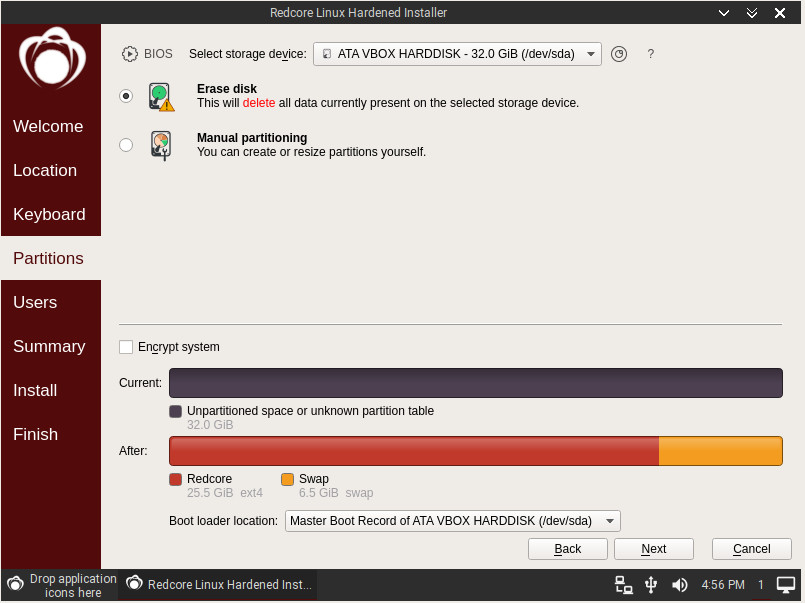
Figure 1: The Redcore-branded Calamares installer.

Everything with Calamares is automatic. In other words, you won’t have to manually partition your drive or select individual packages for installation. You should be able to start and finish a Redcore installation in five or ten minutes. Once the installation completes, reboot and log in with the username/password you created during installation.

Usage

Upon login, you can select between LXQt and Openbox. I highly recommend against using Openbox. Why? Because nothing will open from the menu. I was actually quite surprised to find the Openbox desktop fairly unusable upon installation. With that in mind, select the LXQt option and be done with it.

Upon logging in, you’ll be greeted by a fairly straight-forward desktop. Click on the menu button (bottom right of screen) and search through the menu hierarchy to launch an application. The list of installed applications is fairly straightforward, with the exception of finding Steam and Wine pre-installed. You might be surprised, considering Redcore is a rolling distribution, that many of the user-crucial applications are out of date. Take, for instance, LibreOffice. Redcore ships with 5.4.5.1. The Still release of LibreOffice is currently at 5.4.6. Opening the Sisyphus GUI (front end for the Sisyphus package manager) and you’ll see that LibreOffice is up to date (according to the package manager) at 5.4.5.1 (Figure 2).
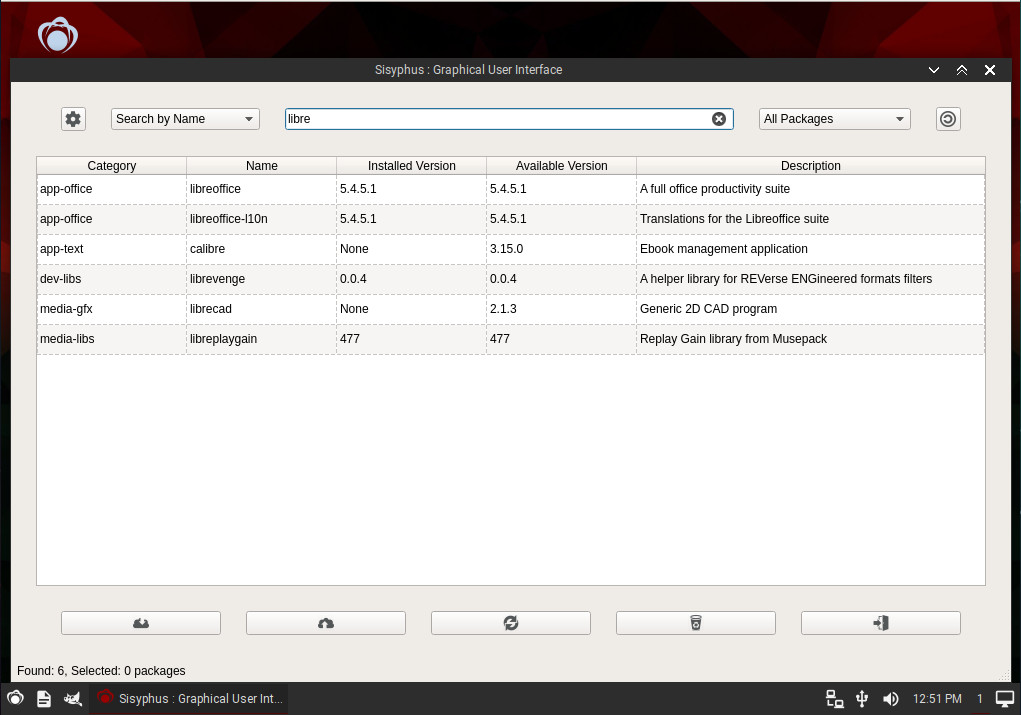
Figure 2: The Sisyphus GUI package manager.

If you do see packages available for upgrade (which you might), click the upgrade button and allow the upgrade to complete. Considering this is a rolling release, you should be up to date. However, you can search through Sisyphus, locate new packages to install, and install them with ease. Installation with the Sisyphus front end is quite user-friendly.

That default browser

You won’t find a copy of Firefox or Chrome installed on Redcore. Instead, QupZilla serves as the default browser. When you do open the default browser (or if you click on the Ask for help icon on the desktop) you will find the preconfigured home page to be the recorelinux freenode.net page. Instead of being greeted by a hand-crafted application, geared toward helping new users, one must choose a nickname and venture into the world of IRC. Although one might be inclined to think that does new users a disservice, one must consider the type of “new” user Redcore will be serving: These aren’t going to be new-to-Linux users. Instead, Redcore knows its users and knows many of them are already familiar with IRC. That means users don’t have to turn to Google to search for answers. Instead, they can chat with other users and even developers to solve their problems. This, of course, does depend on those users (who might be capable of answering questions) actually be logged into the redcorelinux channel on freenode.

That default theme

I’m going to make a confession here. I’ve never understood the whole “dark theme” preference. I do understand that taste is a subjective issue, but my taste tends to lean toward the lighter themes. That’s not a problem. To change the theme for the LXQt desktop, open the menu, type desktop in the search field, and then select Customize Look and Feel. In the resulting window (Figure 3), you can select from the short list of theme options.
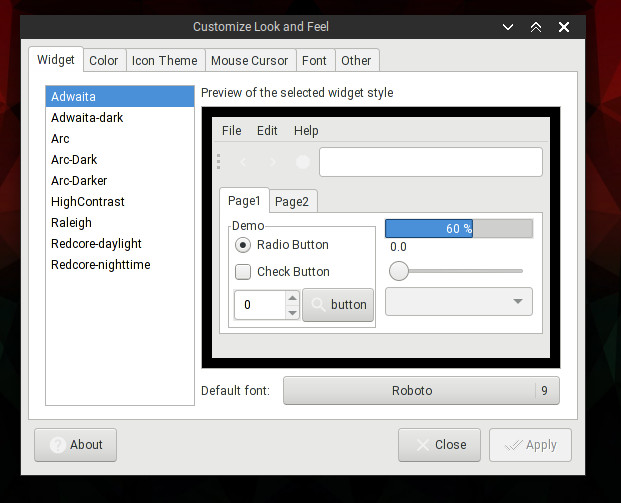
Figure 3: Changing the desktop theme in Redcore.

That target audience

So who is Redcore’s best target audience? If you’re looking to gain the benefit of Gentoo Linux, without having to go through the exhausting “get up to speed” and installation process required to compile one of the most challenging operating systems on the planet, Redcore might be what you’re looking for. It’s a very simplified means of enjoying a Gentoo-less take on Gentoo Linux. Of course, if you’re looking to enjoy Gentoo with a more modern desktop, I would highly recommend Sabayon. However, the LXQt lightweight desktop will certainly give life to old hardware. And Recore does this with a bit of Gentoo style.


Learn more about Linux through the free “Introduction to Linux” course from The Linux Foundation and edX.

This Week in Open Source News: OpenContrail Moves to The Linux Foundation, Enhanced Performance For Linux Games & More

This week in Linux and open source news, OpenContrail SDN becomes Tungsten Fabric, a new open source tool aims to improve the Linux gaming experience, and more! Stay in the open source know with our handy weekly news digest!

1) “This move is intended to expand the open source SDN developer community to bring about quicker development and to attract new users.”

OpenContrail SDN Moves to Linux Foundation as Tungsten Fabric– Data Center Knowledge

2) “Feral Interactive […] has released a new open source tool which is designed to ensure that Linux users get the best performance from its games.”

Feral Has Created a New Frame-Rate Boosting Mode for Linux Games– TechRadar

3) “MEF worked with The Linux Foundation and ETSI to develop an NFV and SDN certification to focus on related knowledge and skills. Meantime, MEF published specs for its Presto APIs.”

MEF Launches SDN Certification and Specs for Presto APIs– TechTarget

4) “A new open-source project from Google and Netflix aims to help other companies that want to modernize their application deployment practices.”

Google and Netflix Team Up On Kayenta, an Open-Source Project For Automated Deployment Monitoring– GeekWire

5) “Linux users can pick which of 10 Linux distros the Slimbook Curve 24-inch screen all-in-one one is delivered with.”

Linux All-in-One: Slimbook Curve Comes with Your Distro of Choice Pre-Installed– ZDNet

Using Open Source Designs to Create More Specialized Chips

Collaborating on freely available code enables companies and programmers to pool resources to solve common problems and avoid reinventing the wheel. Companies build competing products and services from these open source foundations that they might never have been able to build otherwise.

But the open source revolution has been slow to come to the hardware world. A number of open source gadgets and circuit boards have been released in recent years, but while it’s possible to run a laptop or server on nothing but open source software, the inner workings of our gadgets remain proprietary.

An open source chip architecture called RISC-V could soon help change that. Chip maker Nvidia and storage company Western Digital have both announced plans to use RISC-V chips in their core products, …

Read more at Wired

Submitting my First Patch to the Linux Kernel

I started using Linux three years ago while attending university, and I was fascinated to discover a different desktop environment. My professor introduced me to the Ubuntu operating system, and I decided to dual-boot it along with Windows on my laptop the same day.

Within three months, I had completely abandoned Windows and shifted to Fedora after hearing about the RPM Package Manager. I also tried running Debian for stability, but in early 2017 I realized Arch Linux suits all my needs for cutting-edge packages. Now I use it along with the KDE desktop and can customize it according to my needs.

Read more at OpenSource.com

​Google Fuchsia Is Not Linux: So, What Is It and Who Will Use It?

Google has been working on this open-source operating system since the summer of 2016. At first, we thought Fuchsia was for Internet of Things (IoT) devices. We now know it can also power Chromebooks and smartphones.

Is it a replacement for Android and Chrome OS? Good question. It’s not clear what Google plans for it. We do know it runs on Google’s high-end, Chrome-OS powered Pixelbook. You can also install it on Acer Switch 12 and Intel NUC and, eventually, on a Raspberry Pi 3. …

First, it’s built on the Zircon micro-kernel. Besides the microkernel, it includes a small set of userspace services, drivers, and libraries. These are used to boot the system, talk to hardware, load userspace processes and run them, and not much more. 

Read more at ZDNet

How to Scale Security with a Hardware Chain of Trust

A hardware-rooted chain of trust verifies the integrity of every relevant component in the cloud platform, giving you security automation that flexibly integrates into the DevOps pipeline. A true chain of trust would start in the host chip firmware and build up through the container engine and orchestration system, securing all critical data and workloads during an application’s lifecycle.

Hardware is the ideal foundation because it is rooted in silicon, making it difficult for hackers to alter.

The chain of trust would be built from this root using the measure-and-verify security model, with each component measuring, verifying and launching the next level. This process would extend to the container engine, creating a trust boundary, with measurements stored in a Trusted Platform Module (TPM) on the host.

Read more at The New Stack

Civil Infrastructure Platform Takes Open Source to an Industrial Scale

One of the less discussed uses for open source software is actually in the role that it plays for industrial-scale hardware. Whereas power plants, factories, and other large infrastructure projects were once ruled over nearly entirely by operational technology (OT) control systems, in recent years, information technology — built on open source software — has been making its way onto the scene in an increasingly significant way.

Additionally, another surprising fact is that the this push to use open source in complex hardware operations has been embraced by industry leaders. One company helping to lead the charge is Siemens, one of the world’s largest producers of hardware devices, Siemens. Siemens plays an active role in advancing open source in the industrial space, with a focus on making open source security a priority for development, in part through their involvement in the Civil Infrastructure Platform (CIP) initiative.

Wolfgang Mauerer, a professor of theoretical computer science at the Technical University Regensburg, and a senior key expert at Siemens’ Corporate Research Competence Centre Embedded Linux, says that his company has “been actively supporting open source for quite a while now and actually there’s a fair amount of products that run Linux, based from Siemens.”

Siemens Depends on Open Source for Meeting Long-Term Requirements

One of the major product lines that Siemens produces is MRI scanners, which are used in hospitals to help give doctors a better picture of what is going on inside their patients. These machines, which Mauerer terms as not being traditional industrial devices but engineered in the same way, run on Linux.

“We chose Linux for these devices because we can satisfy quite different requirements that way,” explains Mauerer. “We have real-time requirements in these machines, and Linux is the only operating system that can satisfy these needs.”

Mauerer says that their decision to turn to open source was made in part because they needed an operating system that would be flexible enough to work with a wide range of needs over time.

As opposed to most consumer products which normally have a shorter lifespan of only a few years before being replaced, industrial systems are expected to last for a decade or more. As such, they need to be supported longer and have a system which can adapt with new updates as they are needed. He adds that there were concerns that commercial operating systems could become outdated over the lifetime of the devices, and that only something like Linux could give them the dependability and longevity that is required.

Mauerer points out that if they were dependent on a closed system, “then we couldn’t retrofit it with the real-time capabilities that we need.”

Siemens is currently running a number of open source projects that receive external contributions from universities and others, including their partitioning tool called the Jailhouse Hypervisor.

Securing the Future of Development for Infrastructure

Along with companies like Toshiba and Hitachi, Siemens is a founding member of CIP, which was created with the aim of “establishing an open source ‘base layer’ of industrial grade software to enable the use and implementation of software building blocks in civil infrastructure projects.”

As a member of CIP’s technological steering committee, Mauerer says that they hope to encourage a more secure environment for collaborative security. “One reason for founding CIP is that we would like to share important patches to the kernel exports,” he says, noting the lack of a central authority for ensuring that best security practices are upheld throughout their user and contributor base.   

Over the long term, Mauerer says that the goal of the CIP is to, “Really offer a set of base components from the kernel to the most important user’s base packages that we maintain over these timeframes and that all the partners, all the members, even the CI initiatives use, thus saving them effort.”

In part of their effort to establish a working base for projects that will provide users with real value, the CIP initiative has developed their own kernel for performing quality integration tests that they are calling Board at Desk, which is maintained by Ben Hutchings, who is best known for his role as the package maintainer in the Linux Debian project.

Their hope is that over time, they will establish a baseline for infrastructure related projects, ranging from rail to power plants, that developers will look to for holding to best practices.

“In the long run, we will come up with a standardized set of test and quality measures that if they’re satisfied by the kernel, will then earn them the CIP quality certification.”

Shifting the Industry Towards Open Source

One misperception Mauerer and his colleagues at CIP have to battle is the idea that companies are putting themselves at risk by working with an open source model.  

“Astonishingly, I hear these arguments that if we open source our code — if you put out anything in the public — then it becomes less secure because people can search the vulnerabilities and so on. I hear these quite frequently from medium-sized corporations and small businesses,” he says, chalking up the perception here to a “lack of expertise of dealing with the openness, so they confuse open source with a system that’s open for everyone.”

Thankfully, he is seeing far more acceptance of working with open source from the bigger players in the industry. “Most larger companies by now have realized that security by obscurity of course doesn’t work,” says Mauerer, noting that, “Giving out all the mechanisms for review by independent experts and third party experts actually improves security, making security stronger because security holes can be found proactively before they are detected out in the wild.”

For now, many companies are keeping their newfound appreciation for the power of open source as an internal secret policy, choosing not to publicize it for fear of negative pushback from the skeptics. However, Mauerer says that if you know where to look, you can see that there is real interest in pursuing greater open source usage.

“So sometimes companies are still reluctant to say in public that they are using open source. But if you go to any Linux Foundation events, you will find everyone from all industries looking outward to what has happened, placing that, of course not just because of interest but because people are using these products and these components very, very openly, very, very, very much in their products.”

The Long Road Ahead

In building their solutions, Mauerer makes a point that the base of software they create should in part be judged on whether it is sustainable over a significant amount of time. Whereas many software products, say a mobile phone’s operating system, can hold up for five years, industrial systems have life spans that can be expected to reach upwards of 25 years in some cases and face far more stress and requirements.

While he is hopeful that the benefits of more modern technologies from the IT world will filter into the industrial/infrastructure space, Mauerer also notes that industrial technology is still in its own category and that the pace of change will differ.

“We’re only very slowly picking up seconds from IT, so people who get into OT from IT will need a lot of patience at first,” he says. “But once they think the issues through, they will realize that this pace is something that’s vital to the industry because just imagine a power station that’s programmed in the same way as a mobile phone and has as many software problems as mobile phones. Obviously you want to avoid having a power outage twice or three times a day.”

Keeping their environment secure takes a considerable effort, one that is not always recognized for the commitment that it takes to keep things running smoothly. Mauerer quips that, “it’s work that we need to do, that must be done but we don’t get any points for doing it. We just lost points for not doing it.”

For more information about Civil Infrastructure Platform, visit https://www.cip-project.org/.

LC3 Schedule Announced, Register Now | LinuxCon + ContainerCon + CloudOpen 中国论坛日程表现已公布,立即注册

Join us in Beijing June 25 – 27, for three days of education across 175+ sessions, collaboration opportunities with open source technologists and professionals from around the globe, and the chance to learn about the newest trends and topics in open source.

Keynote speakers include:

  • Kelsey Hightower, Developer Advocate, Google
  • Abby Kearns, Executive Director, Cloud Foundry Foundation
  • Greg Kroah-Hartman, Linux Kernel Maintainer
  • Michelle Noorali, Senior Software Engineer, Microsoft
  • Linus Torvalds, Creator of Linux & Git, in conversation with Dirk Hohndel, VP & Chief Open Source Officer, VMware

Read more at The Linux Foundation

Quantum Mechanics Could Solve Cryptography’s Random Number Problem

Peter Bierhorst’s machine is no pinnacle of design. Nestled in the Rocky Mountains inside a facility for the National Institute of Standards and Technology, the photon-generating behemoth spans an entire building. Its lasers, mirrors, and lenses are split among three laboratories, two of them at opposite ends of the L-shaped building. The whole thing is strung together with almost 900 feet of optical fiber. “It’s a prototype system,” the mathematician explains. “Something might drift out of alignment, and the whole thing stops working. It might take a few days to figure out what went wrong.”

On a good day, the machine produces 1,024 bits of data every 10 minutes, equivalent to typing 13 letters per minute. But it promises what even monkeys on typewriters can’t: completely random text.

It’s like this: Even if you repeat a quantum experiment by preparing a quantum particle in exactly the same initial state, subjecting it to the exact same conditions, measuring its orientation after the same amount of time, you can still end up with totally different results. This is unlike flipping a quarter, where its initial conditions—the force of your thumb, the direction of the winds—determine the outcome before it lands. The outcome of “flipping” a tiny quantum particle only exists as probabilities until the moment it “lands.” Electrons, photons, and atoms are really, actually random.

Read more at Wired

DevOps Is the Secret Ingredient to Make Microservices Cook

The skill in DevOps is not being a great chef, but a great manager: Managing the waiters, the hot window, the prep chefs, and the money, all from a vantage point above the floor, with full visibility of the entire chain of processes, products, and people.

In the microservices world, this means it’s generally DevOps’ duty to set up all of the infrastructure required to build out at-scale environments. That means Web application servers, registries and repositories, OS and container images, virtualized networking, firewalls, load balancers, message queues, and reverse proxies. It’s also up to the DevOps team to support new technologies demanded by the development teams: HTTP2GRPC, and reliable SSL. …

Today, we know that stateful and stateless applications can both happily coexist in the cloud, but the actual day-to-day work of managing that data isn’t always easy. Georgi Matev, head of product at Kasten, said that, “What we are seeing is that data is following the same pattern as we’ve seen on the compute side. As things break into smaller and more logically sized components, the same makes sense on the data side.”

Read more at The New Stack