Home Blog Page 395

Reviewing Logins on Linux

The last command provides an easy way to review recent logins on a Linux system. It also has some useful options –- such as looking for logins for one particular user or looking for logins in an older wtmp file.

The last command with no arguments will easily show you all recent logins. It pulls the information from the current wtmp (/var/log/wtmp) file and shows the logins in reverse sequential order (newest first).

Read more at Network World

7 Questions to Ask About Your DevSecOps Program

If you’ve implemented, or are implementing, a DevSecOps program, we’ve come up with several questions to consider below. By posing these questions, we hope to help spur new ideas and help identify areas for improvement. 

Is My Application (or Microservice) Leaking Data?

While microservices have helped many organizations increase their development velocity and efficiency, they also make understanding data flows across an application more complex. As developers become more focused on the microservice they work on, their overall view becomes more siloed. Developers simply don’t understand how every microservices handles every type of data and, as a result, its becoming increasingly common for unencrypted critical data to be leaked to 3rd party databases and other services like code repositories, logging, analytics. 

Read more at Security Boulevard

How to Use Ansible to Set Up System Monitoring with Prometheus

In summer 2017, I wrote two how-to articles about using Ansible. After the first article, I planned to show examples of the copysystemdserviceaptyumvirt, and usermodules. But I decided to tighten the scope of the second part to focus on using the yum and user modules. I explained how to set up a basic Git SSH server and explored the commandfileauthorized_keysyum, and user modules. In this third article, I’ll go into using Ansible for system monitoring with the Prometheus open source monitoring solution.

If you followed along with those first two articles, you should have:

  1. Installed an Ansible control host
  2. Created an SSH key on the Ansible control host
  3. Propagated the SSH key to all the machines you want Ansible to manage
  4. Restricted SSH access on all machines
  5. Installed a Git SSH server
  6. Created the git user, which is used to check code in and out of the Git SSH server

Read more at OpenSource.com

How to Set Up Two-Factor Authentication in Linux

If you’re a Linux administrator and looking to lock down your Linux servers and desktops as tight as possible, you owe it to yourself to make use of two-factor authentication. This should be considered as “no-brainer” as they come. Why? Because by adding two-factor authentication, it becomes exponentially more difficult for malicious users to gain access to your machines. With Linux, it is possible to set up a machine so that you cannot log into the console or desktop or by way of secure shell, without having the two-factor authentication code associated with that machine.

I’m going to walk you through the process of setting this up on Ubuntu Server 16.04. If you’ve attempted this process before, know that the steps have changed and the previously detailed method no longer works.

Read more at TechRepublic

MPLS Explained

Multi-protocol label switching is a way to insure reliable connections for real-time applications, but it’s expensive, leading enterprises to consider SD-WAN as a way to limit its use.

The thing about MPLS is that it’s a technique, not a service — so it can deliver anything from IP VPNs to metro Ethernet. It’s expensive, so with the advent of SD-WAN enterprises are trying to figure how to optimize its use vs. less expensive connections like the internet.

Did you ever order something online from a distant retailer and then track the package as it makes strange and seemingly illogical stops all over the country.

That’s similar to the way IP routing on the Internet works. When an internet router receives an IP packet, that packet carries no information beyond a destination IP address. There is no instruction on how that packet should get to its destination or how it should be treated along the way.

Read more at Network World

Creating a Linux Desktop Application with Ruby

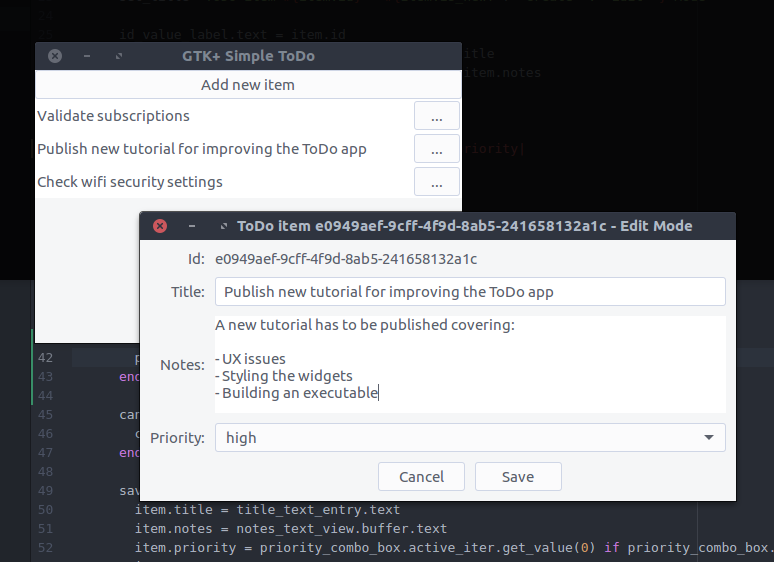
This is a detailed tutorial for creating a Linux desktop application with Ruby using the GTK+ bindings for the language. The article covers many aspects including usage guides for the Glade tool for building the user interface. The tutorial’s code is available on GitHub here.

Lately I was experimenting with GTK and its Ruby bindings and I decided to write a tutorial introducing this functionality. In this post we are going to create a simple ToDo application (something like what we created here with Ruby on Rails) using the gtk3 gem a.k.a. the GTK+ Ruby bindings.

Note: The code of the tutorial is available at GitHub.

What is GTK+

Quoting the toolkit’s page:

GTK+, or the GIMP Toolkit, is a multi-platform toolkit for creating graphical user interfaces. Offering a complete set of widgets, GTK+ is suitable for projects ranging from small one-off tools to complete application suites.

..and about its creation:

GTK+ was initially developed for and used by the GIMP, the GNU Image Manipulation Program. It is called the “The GIMP ToolKit” so that the origins of the project are remembered. Today it is more commonly known as GTK+ for short and is used by a large number of applications including the GNU project’s GNOME desktop.

Read more

Linux Mint 19 ‘Tara’ Cinnamon Will Be Faster

Is Linux Mint slow? Hell, no! The operating system is plenty fast. Speed is in the eye of the beholder, however, and the Mint developers apparently thought app-launching seemed slow when using the Cinnamon desktop environment. They didn’t have any proof, but they felt that both Mate and Xfce were faster in this regard.

Well, rather than allow their feelings to remain unproven, the Mint devs decided to come up with a speed test to see if they were correct. Guess what? They were! Windows build time was four times slower with Cinnamon compared to Metacity, while recovery time was nearly four times slower too. So yes, app-launching on Cinnamon — as of today — is slow comparatively. The big benefit to pinpointing a problem, however, is that it is the first step in solving it. And so, Linux Mint 19 Cinnamon will be faster as a result.

Read more at BetaNews

An Overview of Cryptocurrency Consensus Algorithms

As explained by TechTarget, “A consensus algorithm is a process in computer science used to achieve agreement on a single data value among distributed processes or systems. Consensus algorithms are designed to achieve reliability in a network involving multiple unreliable nodes. Solving that issue — known as the consensus problem — is important in distributed computing and multi-agent systems. To accommodate this reality, consensus algorithms necessarily assume that some processes and systems will be unavailable and that some communications will be lost. As a result, consensus algorithms must be fault-tolerant. They typically assume, for example, that only a portion of nodes will respond but require a response from that portion, such as 51%, at a minimum.”

In the context of cryptocurrencies, consensus algorithms are designed to ensure that transactions are valid and distributed across many participants to verify accuracy and resiliency through redundancy.

Read more at HackerNoon

How to Apply Systems Thinking in DevOps

Systems thinking is a holistic approach to problem-solving. It’s the opposite of analytical thinking, which separates a problem from the “bigger picture” to better understand it. Instead, systems thinking studies all the elements of a problem, along with the interactions between these elements. …

According to systems thinking, everything is a system: your body, your family, your neighborhood, your city, your company, and even the communities you belong to. These systems evolve organically; they are alive and fluid. The better you understand a system’s behavior, the better you can manage and leverage it. You become their change agent and are accountable for them.

Systems thinking and DevOps

All systems include properties that DevOps addresses through its practices and tools. Awareness of these properties helps us properly adapt to DevOps. Let’s look at the properties of a system and how DevOps relates to each one.

Read more at OpenSource.com

The Last Barrier To Ultra-Miniaturized Electronics Is Broken, Thanks To A New Type Of Inductor

In the race for ever-improving technology, there are two related technical capabilities that drive our world forward: speed and size. These are related, as the smaller a device is, the less distance the electrical signal driving your device has to travel. As we’ve been able to cut silicon thinner, print circuit elements smaller, and develop increasingly miniaturized transistors, gains in computing speed-and-power and decreases in device size have gone hand-in-hand. But at the same time these advances have comes in leaps and bounds, one fundamental circuit element — the inductor — has had its design remain exactly the same. Found in everything from televisions to laptops to smartphones to wireless chargers, radios, and transformers, it’s one of the most indispensable electronic components in existence.

Since their 1831 invention by Michael Faraday, their design has remained basically unchanged. Until last month, that is, when a UC Santa Barbara team led by Kaustav Banerjee demonstrated a fundamentally new type of inductorWithout the limitations of the original inductor design, it should allow a new breakthrough in miniaturization and speed, potentially paving the way for a more connected world.

Read more at Medium