Home Blog Page 534

Just Starting Out with Git and GitHub? It Gets Easier, Honest!

No doubt you have heard of Git or GitHub for source control, but what is source control?

This is a basic overview of source code control and the advantages of using it within a team environment or using it on your own, if you do a Google search for source code control you can read how Wikipedia defines Source control, as:

“Revision control (also known as version control, source control or (source) code management (SCM)) is the management of multiple revisions of the same unit of information.”

Read more at Dev.to

Choose Your Favorite Linux Hacker SBCs and Enter to Win a Free Board

It’s once again time for our annual reader survey of open-spec, Linux- or Android-ready single board computers priced under $200. In collaboration with LinuxGizmos, we have published freshly updated summaries of 98 SBCs, up from 81 boards in our 2016 survey and 53 boards in our 2015 survey.

You can now take our brief, 3-minute SurveyMonkey survey, where you can rank up to three of your favorite boards from our list.

 Take the survey!

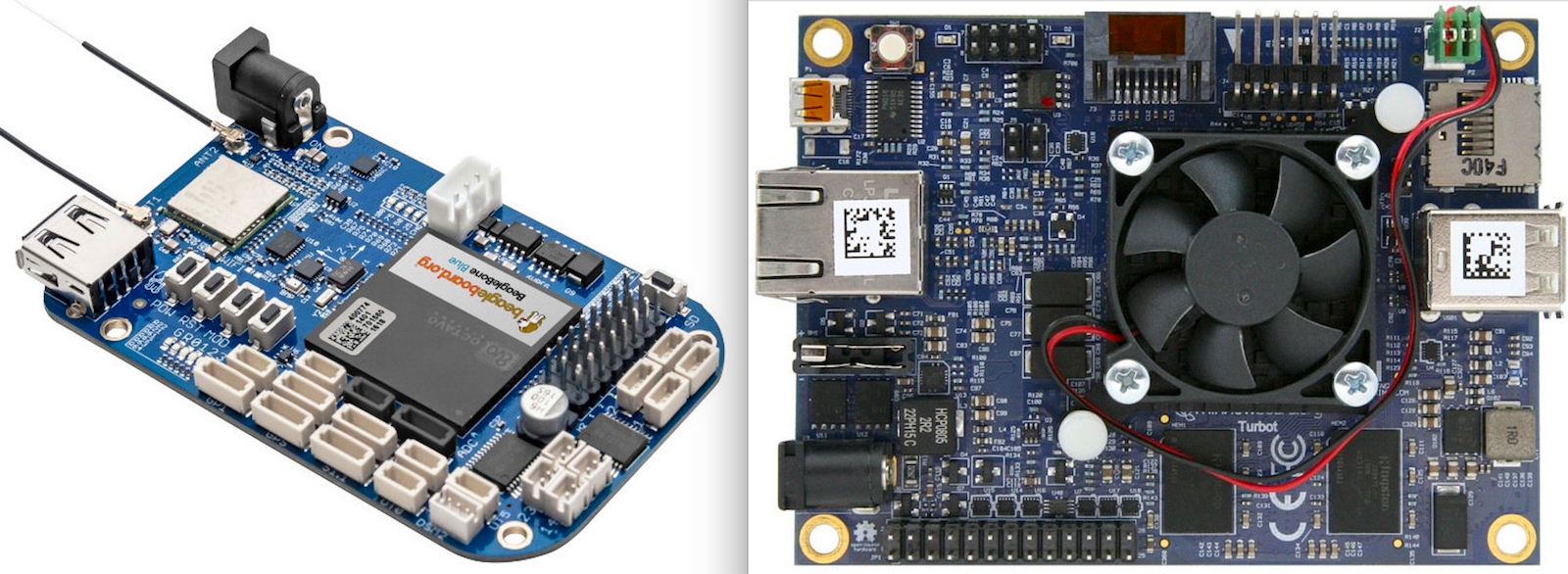
We also ask a handful of questions on key buying criteria and intended applications. Completing the survey earns you a chance to be among 27 randomly selected winners who will receive a free board from one of six SBC families. These include the Arduino Uno WiFi, BeagleBone and variants, DragonBoard 410C, MinnowBoard Turbot Quad-core, Gumstix Pepper DVI-D, and several UP boards including the new UP Squared.

Community-backed SBCs running Linux and Android are seeing increasing demand from makers, educators, researchers, and a growing number of embedded equipment manufacturers. Hacker boards are used as desktop replacements, media centers, and Internet of Things (IoT) devices, such as home or industrial automation gateways and gadgets. Other applications include robots, drones, smart city equipment, signage, and kiosks.

We’ve added dozens of new products since last year’s survey and trimmed a few others from our list. Newcomers include several new BeagleBone variants such as the robotics focused BeagleBone Blue, and a new Raspberry Pi Zero W board that adds wireless to the minimalist IoT-oriented Zero. There’s also the RPi-like, Rockchip-based Tinker Board from Asus, the first hacker board from a major PC manufacturer. Many of the new boards add to the low-cost Raspberry Pi imitating product lines from Shenzhen Xunlong (Orange Pi) and FriendlyElec (NanoPi). Other newcomers include the high-end, media-focused Khadas Vim and the Wandboard-like SavageBoard.

Recent trends include increased adoption of 64-bit ARMv8 SoCs, leading to a total of 20 such boards in our roundup. There are also several more tiny, stripped-down IoT boards like the Raspberry Pi Zero W, Orange Pi Zero, and NanoPi Neo. On the high end, we’ve seen new x86 boards like the UP board and UP Squared, as well as the Udoo x86 and MinnowBoard Turbot Quad-core. High-end ARM boards include the Firefly-RK3399 and the MediaTek X20 Development Board.

To be included in our survey, the SBCs must be supported with open Linux and/or Android stacks and be priced under $200 (not counting shipping), with promised shipment in July. They must also meet our relatively flexible selection criteria for open source compliance. The vast majority of the boards are offered with full schematics and extensive specs, and most include open source licensing. However, we also admit some less open source boards like the Raspberry Pi, especially if considerable attention has been given to providing suitable open source Linux and Android images, as well as community features such as forums, tutorials, and tech support.

For more details on selection criteria, as well as summaries and a comparison spreadsheet for the 98 boards, see the 2017 hacker board catalog posted at LinuxGizmos.com. To read more about product trends and fill out the survey to earn a chance to win prizes, see the 2017 hacker board survey page. The results of the survey and the lists of winners will be posted here in mid-June. Prizes should arrive in July.

What Is NoSQL?

NoSQL databases are one of those fun topics where people get all excited because it’s cool and new. But, they’re really not new, they’re different from SQL databases, and they have different use cases. NoSQL is not going to make world peace or give you your own private holodeck but, aside from those deficiencies, it is pretty cool.

What is NoSQL?

NoSQL is a fine multi-purpose term with multiple meanings, thanks to the incurable nerd habit of modifying everything and never being finished. NoSQL means non-SQL, non-relational, distributed, scalable, and not-only-SQL, because many support SQL-type queries. NoSQL-type databases have been around since the olden Unix days, although naturally some people act like they’re a brand-new awesome sauce Web 2.0 thingy. I don’t even know what Web 2.0 is, although I like it for not having blink tags. At any rate, NoSQL and SQL databases have some things in common, and some differences. NoSQL is not a replacement for SQL, and it is not better or worse, but is made for different tasks. The distinction between the two is blurring as they both evolve, and perhaps someday will not be very meaningful.

Traditional RDBMS

Some examples of traditional relational database management systems are MySQL, MariaDB, and PostgreSQL. We know and love these old-time RDBMS because they’re solid and reliable, are proven for ensuring data integrity, and we’re used to them.

But our beloved old-timers don’t fit well into our modern world of fabulously complex and high-speed datacenters. They have formal schema defining tables and field types, and may also have indexes, primary keys, triggers, and stored procedures. You have to start with designing your schema before you can start using your DB. Because of this rigid structure adding a new data type is a significant operation. They don’t scale, cluster, or replicate very easily, so while you can use them for your lovely cloud or distributed datacenter, many NoSQL DBs are designed for the fast-paced anarchic world of cloud and distributed computing.

NoSQL DBs also scale down nicely. When you don’t want all the complexity and overhead of MariaDB or PostgreSQL, or want an embedded DB, try CouchbaseLite, TinyDB, or good old Berkeley DB.

NoSQL Types

NoSQL DBs have flexible schema, which is both a lovely feature and a pitfall. It is easier than wrangling inflexible tables, although it doesn’t mean you don’t have to care about schema, because you do. Sensible design is always better than chaos.

There are over 200 NoSQL-type databases, and these fall into some general categories according to their data models.

Key:Value store uses a hash table of keys/value pairs.

Document-based store uses actual text documents.

Column-based store organizes your data in columns, and each storage block contains data from only one column.

Graph-based DBs are very fast at querying and retrieving diverse data.

Document store DBs include CouchDB, MongoDB, and SequoiaDB. Instead of tables, these use JSON-like field-value pair documents, actual text documents that you type and look at, and documents can be organized into collections. These examples show a little bit about how MongoDB organizes data.

{
   title: "MongoDB: The Definitive Guide",
   author: [ "Kristina Chodorow", "Mike Dirolf" ],
   published_date: ISODate("2010-09-24"),
   pages: 216,
   language: "English",
   publisher: {
              name: "O'Reilly Media",
              founded: 1980,
              location: "CA"
            }
}

There is not a rigid number of fields; you could omit any of the fields in the example, or add more. The publisher information is an embedded sub-document. If the publisher information is going to be re-used a lot, use a reference to make it available to multiple entries.

{
   _id: "oreilly",
   name: "O'Reilly Media",
   founded: 1980,
   location: "CA"
}

{
   _id: 123456789,
   title: "MongoDB: The Definitive Guide",
   author: [ "Kristina Chodorow", "Mike Dirolf" ],
   published_date: ISODate("2010-09-24"),
   pages: 216,
   language: "English",
   publisher_id: "oreilly"
}

Key:value NoSQLs include Redis, Riak, and our old friend Berkeley DB, which has been around since forever. Berkeley DB is the default back end for the Cyrus IMAP server, Exim, Evolution mail client, OpenLDAP, and Bogofilter.

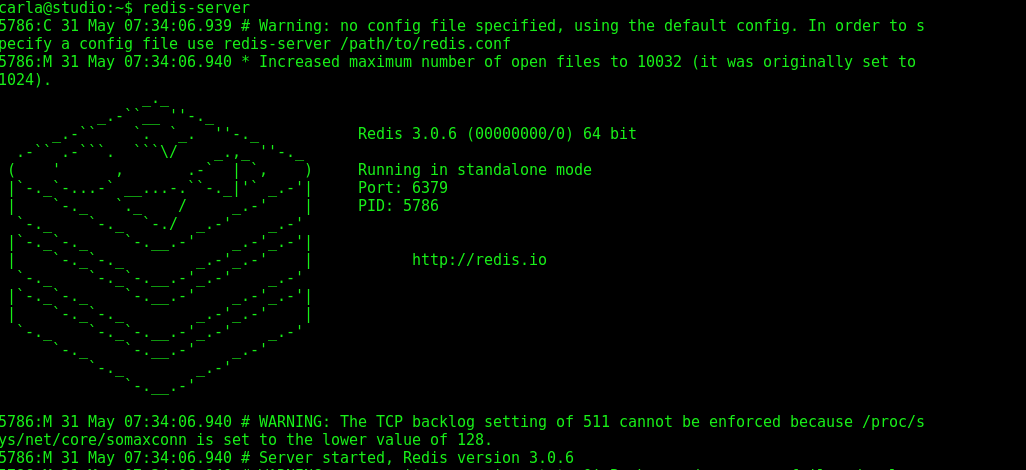
Redis also represents another type of NoSQL database, in-memory. It is very fast because it defaults to running in memory only, with a configurable write-to-disk option (which, of course, is much slower). Redis is replacing Memcached as a distributed memory caching object system on dynamic web sites. If running in memory sounds scary, consider the use case: dynamic web sites delivering all kinds of transient data. If Redis makes the user click an extra time, no biggie. Start it by running redis-server; this is how it looks after installation:

$ redis-server
5786:C 30 May 07:34:06.939 # Warning: no config file specified, using 
the default config. In order to specify a config file use redis-server 
/path/to/redis.conf
5786:M 30 May 07:34:06.940 * Increased maximum number of open files 
to 10032 (it was originally set to 1024).
                _._                                                  
           _.-``__ ''-._                                             
      _.-``    `.  `_.  ''-._           Redis 3.0.6 (00000000/0) 64 bit
  .-`` .-```.  ```/    _.,_ ''-._                                   
 (    '      ,       .-`  | `,    )     Running in standalone mode
 |`-._`-...-` __...-.``-._|'` _.-'|     Port: 6379
 |    `-._   `._    /     _.-'    |     PID: 5786
  `-._    `-._  `-./  _.-'    _.-'                                   
 |`-._`-._    `-.__.-'    _.-'_.-'|                                  
 |    `-._`-._        _.-'_.-'    |           http://redis.io        
  `-._    `-._`-.__.-'_.-'    _.-'                                   
 |`-._`-._    `-.__.-'    _.-'_.-'|                                  
 |    `-._`-._        _.-'_.-'    |                                  
  `-._    `-._`-.__.-'_.-'    _.-'                                   
      `-._    `-.__.-'    _.-'                                       
          `-._        _.-'                                           
              `-.__.-'            

Open a second terminal and run redis-cli. Commands in bold are what you type.

$ redis-cli
127.0.0.1:6379> SET my:name "carla schroder"
OK
127.0.0.1:6379> GET my:name
"carla schroder"
127.0.0.1:6379>

Type exit to quit. This is more like using a traditional RDBMS, because everything is done with commands and you don’t have nice text documents to look at.

Column Store Databases include Cassandra and Apache HBase. These store your data in a column format. Why does this matter, you ask? It makes queries and data aggregation easier. With document store and in-memory DBs you have to rely on good program logic to run queries and manipulate your data. Column-store DBs simplify your program logic.

When you see those “You may also be interested in…” links on a web site, they are most likely delivered from a graph-based DB. Graph-based DBs do not use SQL because it is too rigid for such fluid queries. There is not yet a standard query language, so each one is its own special flower. Some examples are InfiniteGraph, OrientDB, and Neo4J.

So, there you have it, another plethora of choices in an already-overloaded tech world. In a nutshell, NoSQL DBs are great for fast prototyping of new schema, raw speed, and scalability. If you want the most data integrity, such as for financial transactions, stick with RDBMS. Though, again, as the two evolve we’re going to see less-clear boundaries and perhaps someday One DB to Rule Them All.

Learn more about Linux through the free “Introduction to Linux” course from The Linux Foundation and edX.

Ops Engineer Explains Let’s Encrypt’s Automated TLS/SSL Certificate Issuance

Let’s Encrypt is a free, automated and open Certificate Authority issuing digital certificates for website encryption globally. Let’s Encrypt is a service provided by the Internet Security Research Group (ISRG), a public benefit organization with a mission to reduce financial, technological, and education barriers to secure communication over the Internet. Let’s Encrypt secures communication for more than 40 million websites.

Jillian Karner, operations engineer at Let’s Encrypt.
In an upcoming presentation at Open Source Summit Japan, Let’s Encrypt technical staff will provide a brief history of the organization’s development and how it has made considered decisions to enable a growing portion of the Web to benefit from the security provided by HTTPS. In this interview, Jillian Karner, operations engineer at Let’s Encrypt expands upon a key differentiator of Let’s Encrypt: its emphasis on automation.

Jillian is a full-time crypto enthusiast with a passion for a free, open, and secure Web.  She has worked for start-ups in the security field since her early college years at Arizona State University maintaining secure infrastructures and developing encrypted endpoint to endpoint applications. She is currently working with Let’s Encrypt and looks forward to a 100% encrypted Web.

Linux.com: Can you give our readers some background on Let’s Encrypt? Why was it developed?

Jillian Karner: Let’s Encrypt is a free, automated, and open source certificate authority. It provides websites and endpoints on the Web a TLS/SSL certificate allowing users to communicate to those sites through an encrypted Web session. By having a web server configured with a TLS/SSL certificate, users can reach a site over the HTTPS protocol and know the endpoint has been authenticated and that the communication is encrypted. Let’s Encrypt also worked to write the ACME spec, currently a work in progress draft through the Internet Engineering Task Force (IETF), which defines an automated method for issuing certificates. The spec will allow other certificate authorities to create their own ACME-based CA systems and allows the community to write clients that use these issuance system.

Let’s Encrypt and the related ACME spec were developed with the goal to help encrypt the entire Web. To achieve that, the project was started with the foundation that it needs to be free to reduce the complexity and make it accessible to everyone. And since certificate authorities rely on being trusted, Let’s Encrypt worked to be as transparent as possible from the get-go. The certificate authority software, Boulder, is open-sourced and all the certificates issued are logged to Certificate Transparency and are auditable.

Linux.com: How does automation play into Let’s Encrypt’s approach?

Karner: Automation is a significant part of the Let’s Encrypt ecosystem both in terms of the certificate issuance protocol and the infrastructure that keeps it running. If you’ve ever attempted to get a certificate before Let’s Encrypt entered the game, you know that every few years or so you had to recall the special commands and steps to issue/renew and deploy a certificate. Even the most proficient System Administrators would not look forward to renewing certificates. But the ACME protocol that the Let’s Encrypt certificate authority is developed on enables automatic issuance and renewal of certificates. It was designed to remove the human element of the process and make getting a certificate more accessible for anyone who needs one.

Our team of system administrators has automated most of the processes for maintaining and running Boulder and the related infrastructure. We’ve worked hard to make sure that the environment is available for users with high uptime by using automated checks, repeatable processes, and configuration management tools.

Linux.com: Where do you see automation making a big difference for your users?

Karner: In the case of Let’s Encrypt it makes all the difference. Acquiring certificates is understood to be a tedious task, but with the help of Let’s Encrypt, the intermediary steps are automated and it only requires setting up one of the many available clients to start the process. Once a cert is issued most clients don’t require any manual work for certificate renewal. Since the work of issuing and renewing is automated, it also enables Let’s Encrypt to offer certificates that are valid for 90 days, which improves security in the certificate ecosystem by preventing a compromised certificate from lasting very long, which is much more effective than techniques like certificate revocation. The automation also trickles down to the end users on the Web and improves security for the user because there will be no lapse in a valid certificate.

Linux.com: What are the greatest challenges you’ve faced in building and maintaining Let’s Encrypt?

Karner: The greatest challenge has been dealing with rapid growth. There are nearly 34 million active certificates issued by Let’s Encrypt, and we’re not even at two years of operations. We’re constantly working to improve our services and our operations that will keep downtime to a minimum. With so many users, including large integrators that rely on the service, we have to frequently evaluate our infrastructure usage and needs to make sure we stay ahead of the growth that we see.

Linux.com: What has been the most interesting or fulfilling aspect of working on Let’s Encrypt?

Karner: Let’s Encrypt has a great mission in wanting to encrypt the entire Web and enable better security for users. It’s incredible to be a part of that mission and watch the change happen. When the project started, Firefox Telemetry data showed that only 39% of all Web sessions were encrypted. Now, that number has surpassed 55% and is continuing to increase. It’s fulfilling that people like my parents who aren’t very technical can browse the Web securely because Websites have an easy, free option to get a cert and provide that for them.

View the full agenda of sessions happening this week at Open Source Summit Japan.

Toyota Uses Open-Source Software in New Approach to In-Car Tech

Toyota Motor Corp on Wednesday said the infotainment system of its revamped Camry sedan to be sold in the United States will run on a Linux-based, open-source technology platform as it tries to keep up with tech firms in developing software for cars.

With the Automotive Grade Linux (AGL) system in a mainstay model, Toyota aims to have the flexibility to customise its software, while it would also keep user data that could otherwise be captured by CarPlay from Apple Inc or Android Auto from Alphabet Inc’s Google – applications which enable users to access smartphone data through vehicle infotainment systems.

Read more at Reuters

Streamlining Kubernetes Development with Draft

Application containers have skyrocketed in popularity over the last few years. In recent months, Kubernetes has emerged as a popular solution for orchestrating these containers. While many turn to Kubernetes for its extensible architecture and vibrant open-source community, some still view Kubernetes as too difficult to use.

Today, my team is proud to announce Draft, a tool that streamlines application development and deployment into any Kubernetes cluster. Using two simple commands, developers can now begin hacking on container-based applications without requiring Docker or even installing Kubernetes themselves.

Draft in action

Draft targets the “inner loop” of a developer’s workflow – while developers write code and iterate, but before they commit changes to version control. Let’s see it in action.

Read more at Microsoft blog

7 Cool KDE Tweaks That Will Change Your Life

The great thing about KDE’s Plasma desktop is that it’s universally familiar enough for anybody to use, but it’s also got all the knobs and switches needed to become a power user. There’s no way to cover all the great options available in the customizable desktop environment here, but these seven tweaks can change your Plasma experience for the better.

These are based on KDE 5. Most of them also apply to KDE 4, although in some cases extra packages are needed, or the configuration options are in slightly different locations.


Read more at OpenSource.com

The SCION Internet Architecture

The Internet has been successful beyond even the most optimistic expectations. It permeates almost every aspect of our society and economy worldwide. This success has created universal dependence on communication, as many of the processes underpinning modern society would grind to a halt if it were unavailable. However, the state of the safety and availability of the Internet is far from commensurate with its importance.

This article describes SCION, or Scalability, Control, and Isolation On Next-generation networks, an inter-domain network architecture designed to address these issues, covering SCION’s goals, design, and functionality, as well as the results of six years of research we have conducted since our initial publication.

Read more at Communications of ACM 

CoreOS Brings Kubernetes-as-a-Service to Enterprise

CoreOS today said it added features to its enterprise container-orchestration platform that include Kubernetes-as-a-service.

The upcoming Tectonic 1.6.4 will allow enterprises to deploy and manage the latest version of upstream Kubernetes across bare metal, public-, private-, and hybrid-cloud environments. The container company says this gives enterprises the flexibility of running their applications on the cloud, without cloud vendor lock-in.

“With Kubernetes-as-a-service, you can update your cluster with no downtime, smart ordering, and either in one click or fully automated,” wrote CoreOS CEO Alex Polvi in a blog post.

Read more at SDxCentral

Patches Available for Linux sudo Vulnerability

Red Hat, Debian and other Linux distributions yesterday pushed out patches for a high-severity vulnerability in sudo that could be abused by a local attacker to gain root privileges.

Sudo is a program for Linux and UNIX systems that allows standard users to run specific commands as a superuser, such as adding users or performing system updates.

In this case, researchers at Qualys found a vulnerability in sudo’s get_process_ttyname function that allows a local attacker with sudo privileges to run commands as root or elevate privileges to root.

Read more at ThreatPost