Countless stories, comics, and television shows have driven home two very unpleasant stereotypes: the angry, unhelpful system administrator who can’t wait to say “no!” to a user request, and the clueless, clumsy user always a keystroke away from taking down the entire infrastructure. There is a kernel of truth to them. While both resource providers and resource users may want the same end result — the successful completion of computational tasks — they have conflicting priorities when it comes to achieving it.
System operators are tasked with keeping the resource available and performing for all users. This includes ensuring and enforcing proper resource allocation. It also means that any changes to the system have to be thoroughly vetted to ensure that they do not negatively impact the availability and performance of the resource.
As a part of its Technology Transfer program, NASA has released lots of free and open source software tools on its website. NASA says that these software are useful for professionals, entrepreneurs, small businesses, industry, and academia. You can visit NASA’s website to get the complete list of available tools and download the ones you desire.
What are the newest frontiers that open source software is conquering? Black Duck’s latest open source “Rookies of the Year” report, which highlights areas like blockchain and SDN, provides some interesting insights.
The report, which Black Duck published Monday, highlights what the company calls “the top new open source projects initiated in 2016.” It’s the ninth annual report of this type that Black Duck has issued.
Devised by psychologist Albert Maslow, the Hierarchy of Needs is a psychological theory to explain human motivation, comprising of multitier model of human needs, often depicted as hierarchical levels within a pyramid. …
This approach of describing needs is so fundamental that it has been applied to many other domains such as employee engagement, cloud computing, software development, DevOps, etc. So it would make sense to apply it to microservices too, as there is a clear list of needs that has to be satisfied in order to be successful in the microservices journey. So here it is:
So you finally surrendered to containers and discovered that they solve a lot of problems and have a lot of advantages:
First: Containers are immutable – The OS, library versions, configurations, folders, and application are all wrapped inside the container. You guarantee that the same image that was tested in QA will reach the production environment with the same behaviour.
Second: Containers are lightweight – The memory footprint of a container is small. Instead of hundreds or thousands of MBs, the container will only allocate the memory for the main process.
Third: Containers are fast – You can start a container as fast as a typical linux process takes to start. Instead of minutes, you can start a new container in few seconds.
This is the fifth in OSSBlog’s series of open source programming books. This compilation focuses on the JavaScript language with 18 solid recommendations. There are books here for beginner, intermediate, and advanced programmers alike. All of the texts are released under an open source license.
JavaScript is possibly one of the easiest language to get up and running with. But to truly master the language requires a firm foundation of its intricacies. This compilation of books ticks all the boxes.
Firefox is easily the most popular Linux web browser. In the recent LinuxQuestions survey, Firefox took first place with 51.7 percent of the vote. Chrome came in second with a mere 15.67 percent. The other browsers all had, at most, scores in single percentages. But is Firefox really the fastest browser? I put them them to the test, and here’s what I found.
To put Linux’s web browsers to the test, I put them through their paces on Ubuntu 16.04, the current long-term support of the popular Linux desktop distribution. This ran on my older Asus CM6730 desktop PC. This has a third-generation 3.4GHz Intel Core i7-3770 processor, an NVIDIA GeForce GT 620 graphics card, 8GB of RAM, and a 1TB hard drive. This four-year-old PC has horsepower, but it’s no powerhouse.
Women in Open Source will kick off a webinar series that will discuss cultivating more diverse viewpoints and voices in open source, including both inspirational ideas and practical tips the community can immediately put into action. The first webinar, “From Abstract to Presentation: How To Develop a Winning Speaking Submission” will be held Thursday, March 9, 2017, at 8 a.m. Pacific Time.
Register todayfor this free webinar, brought to you by Women in Open Source.
In this webinar, Deb Nicholson, FOSS policy and community advocate, will discuss how to write a winning abstract for a CFP to become a speaker. From picking interesting topics and writing a compelling proposal to the best style and format and how to get the biggest audience once chosen, Deb will summarize the most important factors to consider. And she’ll spend time answering your questions. So mark your calendars and join us!
Deb is community outreach director for the Open Invention Network, the largest patent non-aggression community in history and supports freedom of action in Linux as a key element of open source software. She’s won the O’Reilly Open Source Award, one of the most recognized awards in the FLOSS world, for her work on GNU MediaGoblin and OpenHatch.
For news on future Women in Open Source events and initiatives, join the Women in Open Source email list and Slack channel. Please send a request to join via email to sconway@linuxfoundation.org.
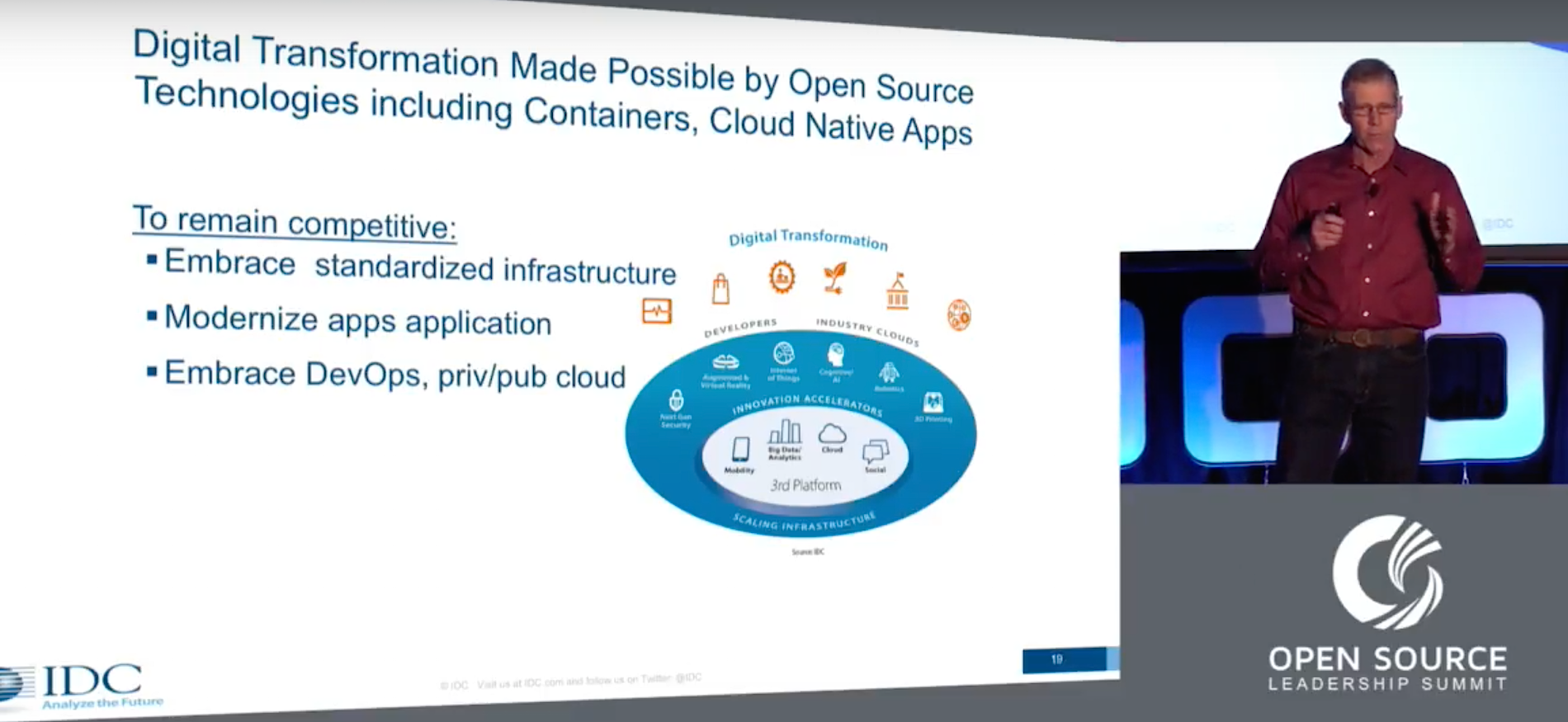
With the rapid growth of virtualized infrastructure and containerization, open source software and especially Linux are leading the way into a new era of software development. That was the message Al Gillen, vice president of the software and open source group at IDC, told the crowd at the Open Source Leadership Summit in Lake Tahoe in February. In his talk, Gillen charted the growth of Linux and other open source initiatives from 2001 to the present. The picture his data painted was a positive one for the open source community.
“The future is all about open source, and we see very much open source becoming the standardization layer that enables everything else we do in the industry,” Gillen said.
Linux has seen rapid grown in recent years because the majority of cloud servers being spun up in places like Amazon S3 and Google Cloud are based on Linux, Gillen said. That standardization of infrastructure has led to the environment we’re currently in, where containerization and reusable code are coming into their own.
“The notion of having reusable code segments that are actually truly portable, that’s really great stuff,” Gillen said. “We’re moving to this model where we’ve got more and more platform independence, and that’s wonderful.”
Cloud Native at the Forefront
Gillen said when he and his team speak to IDC’s customers about their future plans, containerization and cloud native applications are at the forefront of their strategy.
“Cloud native apps, they really become the entry point for this new battleground, and we see pretty much every vendor in the industry, if they’re going to be relevant for the next 10 years, they need to have a cloud native strategy,” Gillen said. “They have to have a way of building the lifecycle for these applications, and they have to make sure they’re able to present opportunities for these applications to be successful.
“When we talk to customers, they very much see this as being their future, they want to be doing cloud native applications,” he said. Gillen said the skills gap is inside those major corporations is the major barrier to adoption right now.
“I think that continues to be the number one problem that many organizations have for adopting whatever the most exciting and current open source initiatives might be,” Gillen said.
As a result, commercially supported implementations of open source software are as popular as ever. A few enterprise companies are willing to take on community-supported open source projects, but most are looking for the certainty that commercial support brings.
“That commercial ecosystem I think, is as essential to the long-term viability of open source software as the community that does the development is,” Gillen said. “It’s a two-sided thing, and there is really value associated from having commercializers — vendors who commercialize open source products and make them consumable for the masses.”
Gillen said that installed or legacy software is not becoming extinct, but it also is not going to be rewritten for the cloud. Instead, new software that sits along side or on top of those applications will lift that data into cloud native applications so it becomes usable for the new business climate.
“It’s going to consume the business value, the intelligence, the data, that sits inside those [legacy] applications and make that usable for the modern cloud native application products that are being built,” Gillen said.
Learn how successful companies gain a business advantage in our online, self-paced Fundamentals of Professional Open Source Management course. Download a free sample chapter now!
Communication is one of the seven essential elements to ensure the success of open source license compliance activities. And it’s not enough to communicate compliance policies and processes with executive leadership, managers, engineers, and other employees. Companies must also develop external messaging for the developer communities of the open source projects they use in their products.
Below are some recommendations, based on The Linux Foundation’s e-book Open Source Compliance in the Enterprise, for some of the best ways to communicate open source license compliance both internally and externally.
Internal Communication
Companies need internal compliance communication to ensure that employees are aware of what is involved when they include open source in a commercial software portfolio. You also want to ensure that employees are educated about the company’s compliance policies, processes, and guidelines. Internal communications can take any of several forms:
Email communication providing executive support and of open source compliance activities
Formal training mandated for all employees working with open source software
Brown-bag open source and compliance seminars to bring additional compliance awareness and promote active discussion
An internal open source portal to host the company’s compliance policies and procedures, open source related publications and presentations, mailing lists, and a discussion forum related to open source and compliance
A company-wide open source newsletter, usually sent every other month or on quarterly basis, to raise awareness of open source compliance
External Communication
Companies also need external compliance communications to ensure that the open source community is aware of their efforts to meet the license obligations of the open source software they are using in their products.
External communications can take several forms:
• Website dedicated to distributing open source software for the purpose of compliance
• Outreach and support of open source organizations which help the company build relationships with open source organizations, understand the roles of these organizations, and contribute to their efforts where it makes sense
• Participation in open source events and conferences. This can be at various levels ranging from sponsoring an event, to contributing presentations and publications, or simply sending developers to attend and meet open source developers and foster new relationships with open source community members.