The IT world is turning to containers, but to control them you need container management programs. That’s where Kubernetes, Mesosphere, and Docker Swarm step in.
Containers, a lightweight way to virtualize applications, are an important element of any DevOps plan. But how are you going to manage all of those containers? Container orchestration programs—Kubernetes, Mesosphere Marathon, and Docker Swarm—make it possible to manage containers without tearing your hair out.
Before jumping into those, let’s review the basics. Containers, according to 451 Research, are the fastest growing cloud-enabling technology. The reason for their appeal is that they use far fewer system resources than do virtual machines (VMs). After all, a VM runs not merely an operating system, but also a virtual copy of all the hardware that the OS needs to run. In contrast, containers demand just enough operating system and system resources for an application instance to run.
… To be fair, all enterprise solutions will, by default, create a lock-in as once they are deployed they are very difficult to replace. The benefit of open source is not that it removes lock-in altogether; instead of being wed to single vendor and a single technology, one is connected to a platform / API. While the open source solution may be driven by a single organization, there are a wider range of technology choices underneath.
Two large open source organizations, the Open Networking Foundation and ON.LAB are merging, signaling that they understand the business need for a more fully baked open source solution instead of just projects. The idea that “If we build it, they will come” is stepping aside, being replaced by the realization that “We can build it, but if we don’t make it easy and interoperable, they won’t come.”
Books are very personal and subjective possessions. And programming books are no exception. But regardless of their style, focus, or pace, good C++ programming books take the reader on a compelling journey, opening eyes to the capabilities of the language, and showing how it can be used to build just about anything.
I have carefully selected C++ books which all share the virtue of being compelling to read. I recommend 9 books which are released under public copyright licenses. Before doing so, I’ll give a brief introduction to C++.
Ubuntu 16.04LTS was released by Canonical back in April last year. Among some of the key new features it brought, one was a new packaging format dubbed Snap. To refresh, here’s an excerpt from our Ubuntu 16.04 overview tutorial that explains the what and why of Snap:
So, why Snap? Well, this new packaging system is aimed at making package installation
 and maintenance easier. For example, unlike the existing system, wherein it’s on you to
 resolve all version-related conflicts of dependencies for a software being installed, Snaps
 allow developers to put in everything on which their software depends in the package
itself, effectively making them self-contained and independent of the system on
which they are being installed.
After Microsoft fell in love with Linux (what has popularly come to be known as “Microsoft Loves Linux”), PowerShell which was originally a Windows-only component, was open-sourced and made cross-platform on 18 August 2016, available on Linux and Mac OS.
PowerShell is a task automation and configuration management system developed by Microsoft. It is made up of a command language interpreter (shell) and scripting language built on the .NET Framework. It offers complete access to COM (Component Object Model) and WMI (Windows Management Instrumentation), thereby allowing system administrators to carry out administrative tasks on both local and remote Windows systems
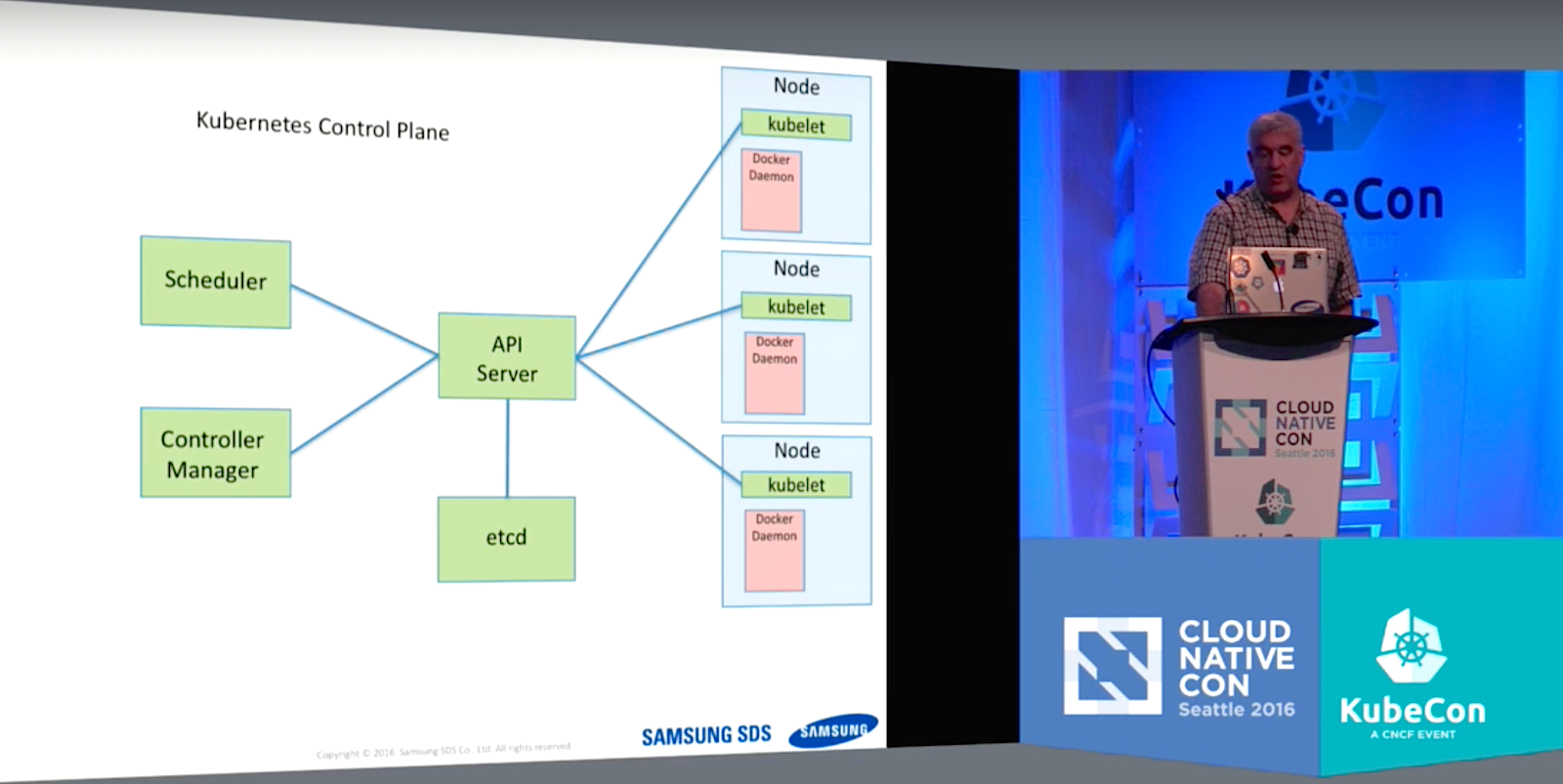
If you’re interested in running a complex Kubernetes system across several different cloud environments, you should check out what Bob Wise and his team at Samsung SDS call “Control Plane Engineering.”
Wise, during his keynote at CloudNativeCon last year, explained the concept of building a system that sits on top of the server nodes to ensure better uptime and performance across multiple clouds, creates a deployment that’s easily scaled by the ClusterOps team, and covers long-running cluster requirements.
“[If you believe] the notion of Kubernetes as a great way to run the same systems on multiple clouds, multiple public clouds, and multiple kinds of private clouds is really important, and if you care about that, you care about control plane engineering,” Wise said.
By focusing on that layer, and sharing configuration and performance information with the Kubernetes community, Wise said larger Kubernetes deployments can become easier and more manageable.
”One of the things we’re trying to foster, trying to build some tooling and make some contribution around is a way for members of the community to grab their cluster configuration, what they have including things like setting of cluster, be able to grab that, dump that, and capture that and export it for sharing, and also to take performance information from that cluster and do the same,” Wise said. “The goal here is, across a wide range of circumstances, to be able to start compare notes across the community.”
For the work Wise and his team have done, the Control Plane involves four separate parts that sit atop the nodes to make sure things work optimally despite occasional machine failure and broken nodes.
The Control Plane includes:
An API Server on the front end through which all the components interact,
A Scheduler to assign pods to nodes,
The ETCD, a distributed database system where cluster state is maintained, and
A Controller Manager, which is the home for embedded control loops like replica sets, deployments, jobs, etc.
The best way to run the system so that it has some level of allocation automation is through Kubernetes self-hosting, Wise said. But that requires some “tricky bootstrapping” to build it. In the end, it’s worth it if you’re running a large cluster, however.
“The idea here is it’s a system entirely running as Kubernetes objects,” he said. “You have this common operation set. It’s going to make scaling … and HA easier.”
One piece that is perhaps better not to try to build on your own is a load balancer for the API Server, which can get bogged down because it’s a bottleneck into the system. Wise said using a cloud provider’s load balancer is the easiest, and in the end, probably best solution.
“This load balancer, this is a very key part to the overall system performance and availability,” Wise said. “The public cloud providers have put enormous investment into really great solutions here. Use them and to be happy.
“It’s worth the configuration drift that happens between multiple deployments,” Wise continued. “I’d also say again, if you have on premises and you’re trying to do deployments and you already have these load balancers then they work well, they’re pretty simple to configure usually. The configurations that Kubernetes requires for support are not especially complicated. If you have them, use them, be happy but I wouldn’t recommend going and buying those appliances new.”
Watch the complete presentation below:
Want to learn more about Kubernetes? Get unlimited access to the new Kubernetes Fundamentals training course for one year for $199. Sign up now!
Scripting languages (aka Very High-Level Languages or VHLLs), such as Python, PHP, and JavaScript are commonly used in desktop, server, and web development. And, their powerful built-in functionality lets you develop small useful applications with little time and effort, says Paul Sokolovsky, IoT engineer at Linaro. However, using VHLLs for deeply embedded development is a relatively recent twist in IoT.
Paul Sokolovsky, IoT engineer at Linaro
At the upcoming Embedded Linux Conference + OpenIoT Summit, Sokolovsky will discuss the challenges of using VHLLs in embedded development and compare different approaches, based on the examples of MicroPython and JerryScript + Zephyr.js projects. We talked with Sokolovsky to get more information.
Linux.com: Can you please give our readers some background on VHLLs?
Paul Sokolovsky: Very High Level Languages have been a part of the computer science and information technologies landscape for several decades now. Perhaps the first popular scripting language was a Unix shell (sh), although it’s rarely considered a VHLL, but rather a domain-specific language, due to its modest feature set. However, the first truly record-breaker VHLLs were Perl (1987) and Tcl (1988), soon followed by Python (1991), Ruby (1995), PHP (1995), JavaScript (1995), and many others.
The distinctive features of VHLLs are their interpreted nature (from the user’s point of view, there may be sophisticated compilers inside), built-in availability of powerful data types like arbitrary-sized lists and mappings, sizable standard library, and external modules system allowing users to access even larger third-party libraries. All that is coupled with a general easy feel (less typing, no build times, etc.) and an easy learning curve.
Linux.com: What are the benefits of these languages for development?
Sokolovsky: The benefits stem from the features described above. One can start with a scripting language quite easily and learn it quickly. Many VHLLs offer a powerful interactive mode, so you don’t need to read thick manuals to get started but can explore and experiment right away. Powerful built-in functionality allows you to develop small useful applications — scripts — with little time and effort (that’s where the “scripting languages” name came from). Moving to larger applications, vast third-party libraries and an easy-to-use module system make developing them also streamlined and productive.
Linux.com: How does scripting for embedded platforms differ from development for other platforms?
Sokolovsky: With all the exciting capabilities of VHLLs discussed above, there’s an idea — why we can’t enjoy all (or at least some) benefits of them when developing for embedded devices? And by “embedded devices” I mean here not just small Linux systems with 8-32MB of RAM, but deeply embedded systems running on microcontrollers (MCUs) with mere kilobytes of memory. Small, and sometimes really scarce, resources definitely add complexity to this idea. Another issue is device access and interaction. Embedded devices usually don’t have displays and keyboards, but fortunately the answer is known for decades thanks to Unix — just use a terminal connection over a serial (UART). Of course, on a host side, it can be hidden behind a graphical IDE, which some users prefer.
So, with all the differences the embedded devices have, the idea is to provide as familiar a working environment as possible. That’s on one side of the spectrum and, on the other, the idea is to make it as scaled down as possible to accommodate even the smallest of devices. These conflicting aims require embedded VHLLs implementations to be highly configurable, to adjust for the needs of different projects and hardware.
Linux.com: What are the specific challenges of using these languages for IoT? How do you address memory constraints, for example?
Sokolovsky: It’s definitely true that the interpreter consumes scarce hardware resources. But nowadays the most precious resource is the human time. Whether you are an R&D engineer, a maker with only a few hours on weekend, a support engineer overwhelmed with bugs and security issues, or a project manager planning a product — you likely don’t have extra time on your hands. The idea is to deliver the productivity of VHLLs into the hands of embedded engineers.
Nowadays, the state of art is very enabling of this. It’s fair to say that, even of microcontroller units (MCUs), an average now is 16-32KB RAM and 128-256K ROM. That’s just enough to host a core interpreter, a no-nonsense subset of standard library types, some hardware drivers, and a small — but still useful — user application. If you go slightly above the middle line, capabilities raise rapidly — it’s actually a well-known trick from 1970s that using custom bytecode/pcode lets you achieve greater code/feature density than the raw machine code.
There are a lot of challenges on that road, scarcity of RAM being the main one. I write these words on a laptop with 16GB of RAM (and there’re still slowdowns due to swapping), and the 16KB mentioned above is a million times less! And yet, by using carefully chosen algorithms and coding techniques, it’s possible to implement a scripting language that can execute simple applications in that amount of RAM, and fairly complex ones in 128-256K.
There are many technical challenges to address (and which are being successfully addressed), and there wouldn’t be a space to cover them here. Instead, my presentation at OpenIoT Summit will cover experiences and achievements of two embedded scripting languages: MicroPython (Python3 language subset) and Zephyr.js (JavaScript/Node.js subset), both running on top of The Linux Foundation’s Zephyr RTOS, which is expected to do for the IoT industry what Linux did for the mobile and server industries. (The slides will be available afterwards for people who can’t attend OpenIoT Summit.)
Linux.com: Can you give us some examples of applications for which VHLLs are most appropriate? And for which they are inappropriate?
Sokolovsky: Above are many bright prospects for VHLLs, fairly speaking; in embedded, there’s a lot of wishful thinking in that (or hopefully, self-fulfilling prophecy). Where VHLLs in embedded can deliver right now are: rapid prototyping, and educational/maker markets where easy learnability and usage is a must. There are pioneers that use VHLLs in other areas, but generally, it requires more investment into infrastructure and tools. It’s important that such investment be guided by open source principles and be shared, or otherwise it undermines the idea that VHLLs can save their users time and effort.
With that in mind, embedded VHLLs are full-fledged (“Turing complete”) languages suitable for any type of application, subject to hardware constraints. For example, if an MCU is below the thresholds stated above, of a legacy 8-bit micro, good old C is the only choice you can enjoy. Another limit is when you really want to get the most out of the hardware — C or Assembler is the right choice. But, here’s a surprise — the developers of embedded VHLLs thought about that, too, and, for example, MicroPython allows you to combine Python and Assembler in one application.
Where embedded VHLLs excel is configurability and (re)programmability, coupled with flexible connectivity support. That’s exactly what IoT and smart devices are all about, and many IoT applications don’t have to be complex to be useful. Consider, for example, a smart button you can stick anywhere to do any task. But, what if you need to adjust the double-click time? With a scripting language, you can. Maybe you didn’t think about triple-clicks at all, but now find that even four clicks would be useful in some cases. With a scripting language you can change that — easily.
Embedded Linux Conference + OpenIoT Summit North America will be held on February 21 – 23, 2017 in Portland, Oregon. Check out over 130 sessions on the Linux kernel, embedded development & systems, and the latest on the open Internet of Things.
Linux.com readers can register now with the discount code, LINUXRD5, for 5% off the attendee registration price. Register now>>
Large, high-performance and reliable Kubernetes clusters require engineering the control plane components for demands beyond the defaults. This talk covers the relationship between the various components that make up the Kubernetes control plane and how to design and size those components.
Education and communication are two essential building blocks in any open source software compliance program. Both help ensure that employees, as well as others outside the organization, possess a good understanding of the organization’s policies governing the use of open source software.
Employee training serves as a venue to publicize and promote the compliance policy and processes within the organization and to foster a culture of compliance.
While clear and consistent messaging — whether it is internally to your employees or externally toward the developer communities of the open source projects you use in your product/software stack — help explain the company’s goals and concerns around open source.
Compliance Training
The goal of providing open source and compliance training — formally or informally — is to raise awareness of open source policies and strategies and to build a common understanding around the issues and facts of open source licensing. It also addresses the business and legal risks of incorporating open source software in products and/or software portfolios.
Such training can follow a formal or informal format, depending on the organization’s needs.
Formal Training
Depending on the size of the company and the extent to which open source is included in its commercial offerings, the company can mandate that employees working with open source take formal instructor-led courses, possibly culminating in actual exams.
Informal Training
Informal training channels may include any or all of the following:
• Brown bag seminars: Brown bag seminars are usually presentations made during lunchtime by a company employee or an invited speaker. The goal of these seminars is to present and evoke discussions of the various aspects of incorporating open source in a commercial product or an enterprise software portfolio. These sessions can also include discussions of the company’s compliance program, policies, and processes.
• New employee orientation: In some instances, the Compliance Officer presents on the company’s compliance efforts, rules, policies, and processes to new employees as part of employee orientation, supplying new employees with necessary open source management information: who to talk to, what internal website to visit, how to sign-up for open source and compliance training, etc.
Web presence
A website or online portal focused on a company’s open source management program helps tie together employee training with internal and external messaging and make it easily accessible.
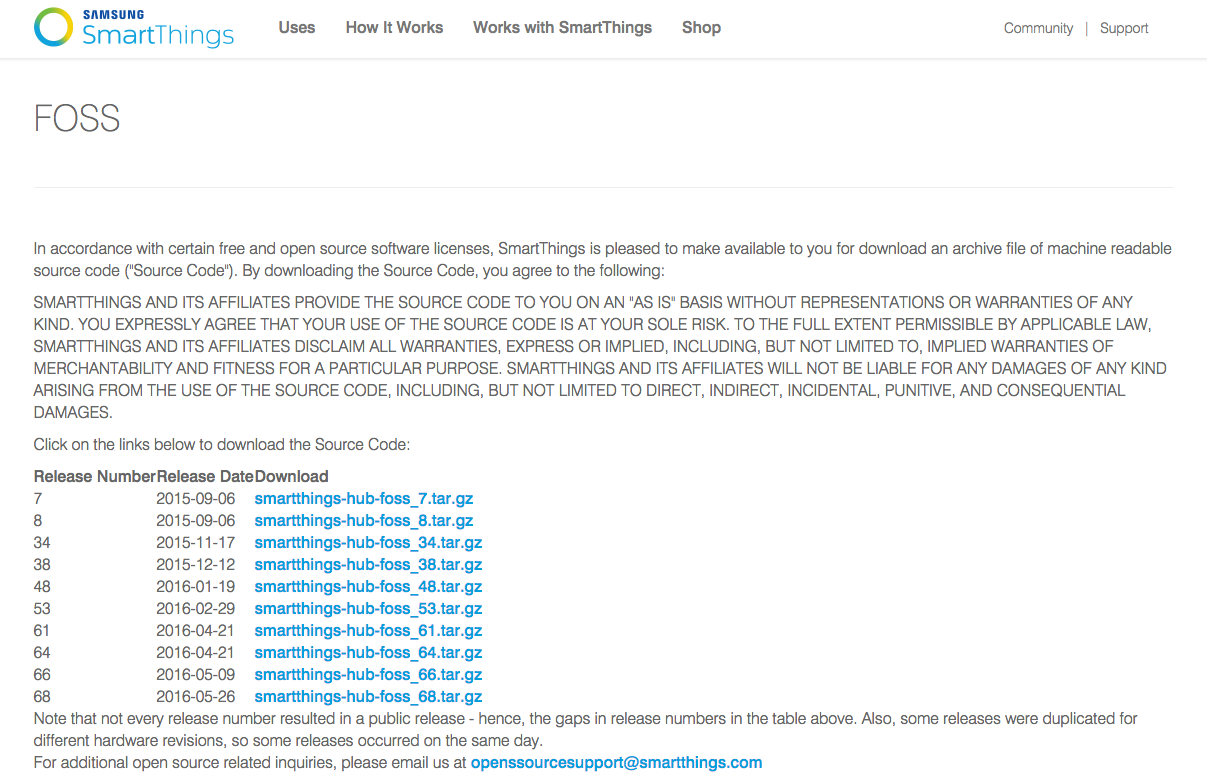
Companies use portals in two directions: inwards, inside the company; and outwards, as a window to the world and the open source community. The internal portalhosts the compliance policies, guidelines, documents, training, announcements, and access to mailing lists. The external portaloffers a public platform for the world and the open source community, as well as a venue to post source code of open source packages, acknowledgements, and other disclosures, in fulfillment of license obligations.
We’ve now covered all seven essential elements of an open source management program, from strategy and process, to staffing and tools, and more. In the next few posts we’ll discuss some common challenges to establishing an open source management program and provide some recommendations on how to overcome these challenges.
Get the open source compliance training you need. Take the free “Compliance Basics for Developers” course from The Linux Foundation. Sign up now!