Home Blog Page 623

Long-term Embedded Linux Maintenance Made Easier

The good old days when security breaches only happened to Windows folk are fading fast. Malware hackers and denial of service specialists are increasingly targeting out of date embedded Linux devices, and fixing Linux security vulnerabilities was the topic of several presentations at the Embedded Linux Conference Europe (ELCE) in October.

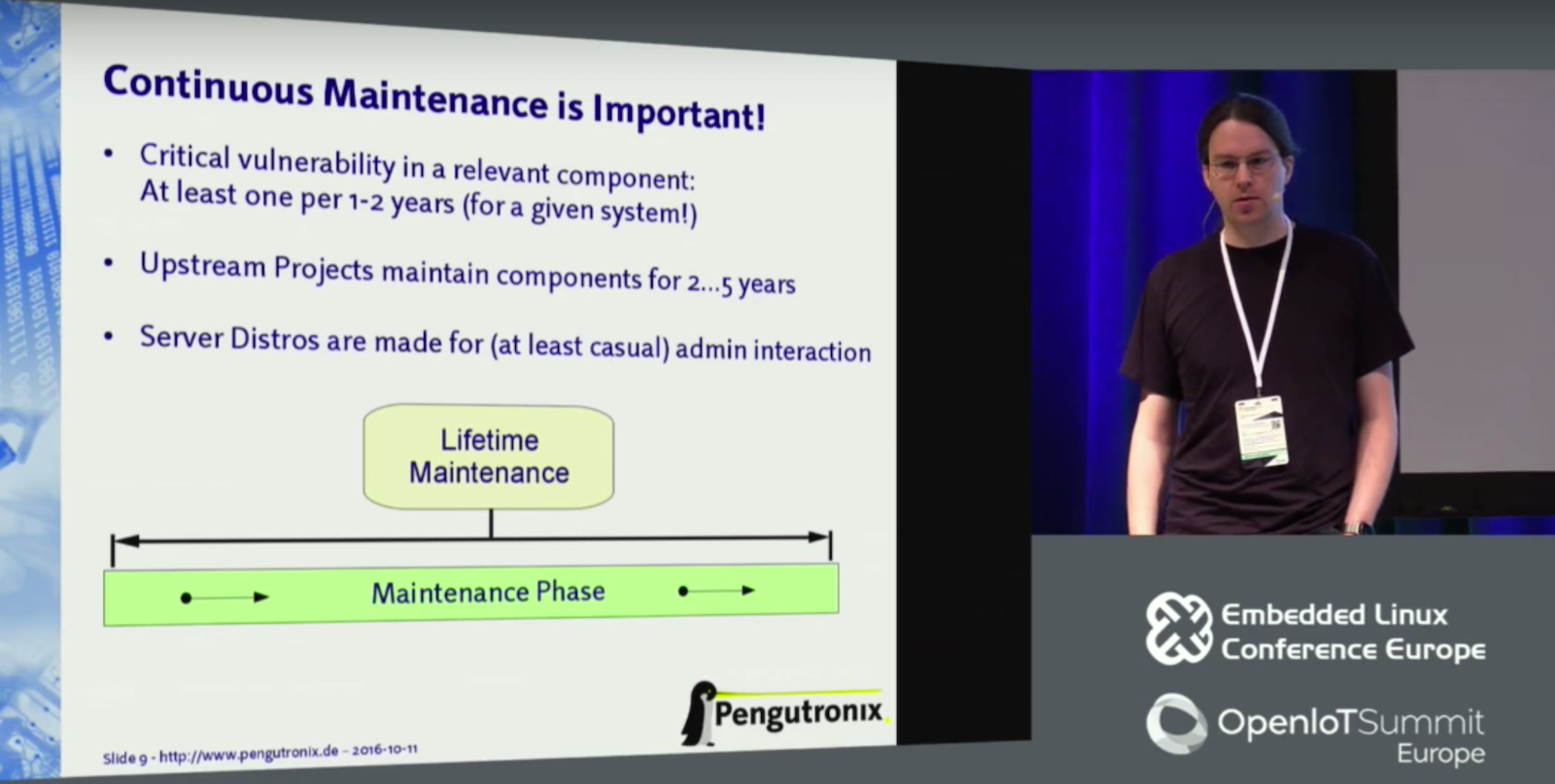
One of the best attended was “Long-Term Maintenance, or How to (Mis-)Manage Embedded Systems for 10+ Years” by Pengutronix kernel hacker Jan Lübbe. After summarizing the growing security threats in embedded Linux, Lübbe laid out a plan to keep long-life devices secure and fully functional. “We need to move to newer, more stable kernels and do continuous maintenance to fix critical vulnerabilities,” said Lübbe. “We need to do the upstreaming and automate processes, and put in place a sustainable workflow. We don’t have any more excuses for leaving systems in the field with outdated software.”

As Linux devices grow older, traditional lifecycle procedures are no longer up to the job. “Typically, you would take a kernel from a SoC vendor or mainline, take a build system, and add user space,” said Lübbe. “You customize that and add an application, and do some testing and you’re done. But then there’s a maintenance phase for 15 years, and you better hope you have no platform changes, or want to add new features, or need to apply regulatory changes.”

All these changes increasingly expose your system to new errors, and require massive updates to keep in sync with upstream software. “But it’s not always unintentional errors that occur in the kernel that lead to problems,” said Lübbe. “These vendor kernels never went through the mainline community review process,” he added, noting the backdoor found last year in an Allwinner kernel.

“You cannot trust that your vendor will do the correct thing,” continued Lübbe. “Maybe only one or two engineers looked at that backdoor code. That would never happen if the patch was posted on a Linux kernel mailing list. Somebody would notice. Hardware vendors don’t care about security or maintenance. Maybe you get an update after one or two years, but even then it usually takes years between the time they start developing based on one fixed version to the point they declare it stable. If you then start developing on that base, you add maybe another half a year, and it’s even more obsolete.”

Increasingly, embedded developers working with long-life products build on Long Term Stable (LTS) kernels. But that doesn’t mean your work is done. “After a product is released, people don’t often follow the stable release chain anymore, so they don’t apply the security patches,” said Lübbe. “You’re getting the worst of both worlds: an obsolete kernel and no security. You don’t get the benefit of testing by many people.”

Lübbe noted that Pengutronix customers that used server-oriented distributions like Red Hat often ran into problems due to the rapid rate of customizations, as well as deployment and update systems that assume a sysadmin is on duty.

“The updates can work for some things, especially if they are x86, but each project is basically on its own to build infrastructure to update to new releases.”

Many developers choose backporting as a solution for updating long-life products. “It’s easy in the beginning, but once you are no longer in the project’s maintenance window, they don’t tell you if the version you use is affected by a bug, so it becomes much more difficult to find out if a fix is relevant,” said Lübbe. “So you pile up patches and changes and the bugs accumulate, and you have to maintain them yourself because no one else is using those patches. The benefits of using open source software are lost.”

Follow Upstream Projects

The best solution, argues Lübbe, is to follow releases maintained by upstream projects. “We’ve mostly focused on mainline based development, so we have as little difference as possible between the product and the mainstream kernel and other upstream projects. Long-term systems are well supported in mainline. Most systems that don’t use 3D graphics can run very few patches. Newer kernel versions also have lots of new hardening features that reduce the impact of vulnerabilities.”

Following mainline seems daunting to many developers, but it’s relatively easy if you implement procedures from the start, and then stick to them, said Lübbe. “You need to develop processes for everything you do on the system,” he said. “You always need to know what software is running, which is easier when you use a good build system. Each software release should define the complete system so you can update everything in the field. If you don’t know what’s there, you can’t fix it. You also want to have automated testing and automated deployment of updates.”

To “save an update cycle,” Lübbe recommends using the most recent Linux kernel when you start developing, and only moving to a stable kernel when you enter testing. After that, he suggests updating all the software in the system, including kernel, build system, user space, glibc, and components like OpenSSL every year, to versions that are supported by the upstream projects for the rest of the year.

“Just because you update at that point doesn’t mean you need to deploy,” said Lübbe. “If you see no security vulnerabilities, you can just put the patch on the shelf and have it ready if you need it.”

Finally, Lübbe recommends looking at release announcements every month, and checking out security announcements on CVE and mainline lists every week. You only need to respond “if the security announcement actually affects you,” he added. “If your kernel is current enough, it’s not too much work. You don’t want to get feedback on your product by seeing your device in the news.”

Embedded Linux Conference + OpenIoT Summit North America will be held on February 21 – 23, 2017 in Portland, Oregon. Check out over 130 sessions on the Linux kernel, embedded development & systems, and the latest on the open Internet of Things.

Linux.com readers can register now with the discount code, LINUXRD5, for 5% off the attendee registration price. Register now>>

4 Common Open Source License Compliance Failures and How to Avoid Them

The following is adapted from Open Source Compliance in the Enterprise by Ibrahim Haddad, PhD.

Companies or organizations that don’t have a strong open source compliance program often suffer from errors and limitations in processes throughout the software development cycle that can lead to open source compliance failures.

The previous article in this series covered common intellectual property failures. This time, we’ll discuss the four common open source license compliance failures and how to avoid them.

License compliance problems are typically less damaging than intellectual property problems, as they don’t have the side effect of forcing you to release your proprietary source code under an open source license. But license compliance failures may still have serious consequences including:

  • An injunction preventing a company from shipping a product until source code is released.

  • Support or customer service headaches as a result of version mismatches (as a result of people calling or emailing the support hotline and inquiring about source code releases).

  • Embarrassment and/or bad publicity with customers and open source community.

4 Common OS License Compliance Failures

Problem #1: Failure to publish or make available source code packages as part of meeting license obligations

How to avoid it: Follow a detailed compliance checklist to ensure that all compliance action items have been completed when a given product, application, or software stack is released into the market.

Problem #2: Failure to provide correct version of the source code corresponding to the shipped binaries.

How to avoid it: Add a verification step into the compliance process to ensure that you’re publishing the version of source code that exactly corresponds to the distributed binary version.

Problem #3: Failure to release modifications that were introduced to the open source software being incorporated into the shipping product.

How to avoid it:

  • Use a bill of material (BOM) difference tool that allows the identification of software components that change across releases

  • Re-introduce the newer version of the software component in the compliance process

  • Add the “compute diffs” of any modified source code (eligible for open source distribution) to the checklist item before releasing open source used in the product.

Problem #4: Failure to mark open source code that has been changed or to include a description of the changes.

How to avoid it:

  • Add source code marking as checklist item before releasing source code to ensure you flag all the source code introduced to the original copy you downloaded

  • Conduct source code inspections before releasing the source code

  • Add a milestone in the compliance process to verify modified source code has been marked as such

  • Offer training to staff to ensure they update the change logs of source code files as part of the development process.

The most important outcome of non-compliance cases has been that the companies involved ultimately had to comply with the terms of the license(s) in question, and the costs of addressing the problem after the fact has categorically exceeded those of basic compliance.

Therefore, it is really a smart idea to ensure compliance before a product ships or a service launches. In part 6 of this series, we’ll cover some of the top lessons learned in achieving open source compliance that open source professionals need to know.

Download the free e-book, Open Source Compliance in the Enterprise, for a complete guide to creating compliance processes and policies for your organization.

Read the other articles in this series:

An Introduction to Open Source Compliance in the Enterprise

Open Compliance in the Enterprise: Why Have an Open Source Compliance Program?

Open Source Compliance in the Enterprise: Benefits and Risks

3 Common Open Source IP Compliance Failures and How to Avoid Them

4 Common Open Source License Compliance Failures and How to Avoid Them

Top Lessons For Open Source Pros From License Compliance Failures

openSUSE Package Management Cheat Sheet

Debian/Ubuntu have long been my primary Linux distributions, although like all good Linux users I have used Fedora, CentOS, Gentoo, Red Hat, Slackware, Arch Linux, Mageia, and other Linux distributions because why not? It is a feast of riches and the best playground there is.

I became a SUSE employee recently, so naturally I’ve been spending more time with openSUSE. openSUSE is sponsored by SUSE, and it is an independent community project. There are two openSUSE flavors: Tumbleweed and Leap. Tumbleweed is a bleeding-edge rolling release, containing the latest software versions. Leap is more conservative, and it incorporates core code from SUSE Linux Enterprise Server (SLES) 12. Both are plenty good for everyday use.

openSUSE is an RPM-based distro so you can use your favorite RPM commands. YaST (Yet another Setup Tool) is one of the most famous, or infamous, SUSE tools. YaST supports nearly every aspect of systems administration: hardware configuration, server management, software management, networking, user management, virtualization, security…you name it, it’s probably in YaST. YaST has both a graphical and console interface. YaST is vast.

I prefer less monolithic apps, and openSUSE has another tool for package and software repository management, zypper. I like zypper. It’s fast and does the job. zypper is command-line only so you have only one interface to learn, which is something I highly approve of. Many of zypper's commands have easy-to-remember shortcuts such as se for search, in for install, and rm for remove.

Help

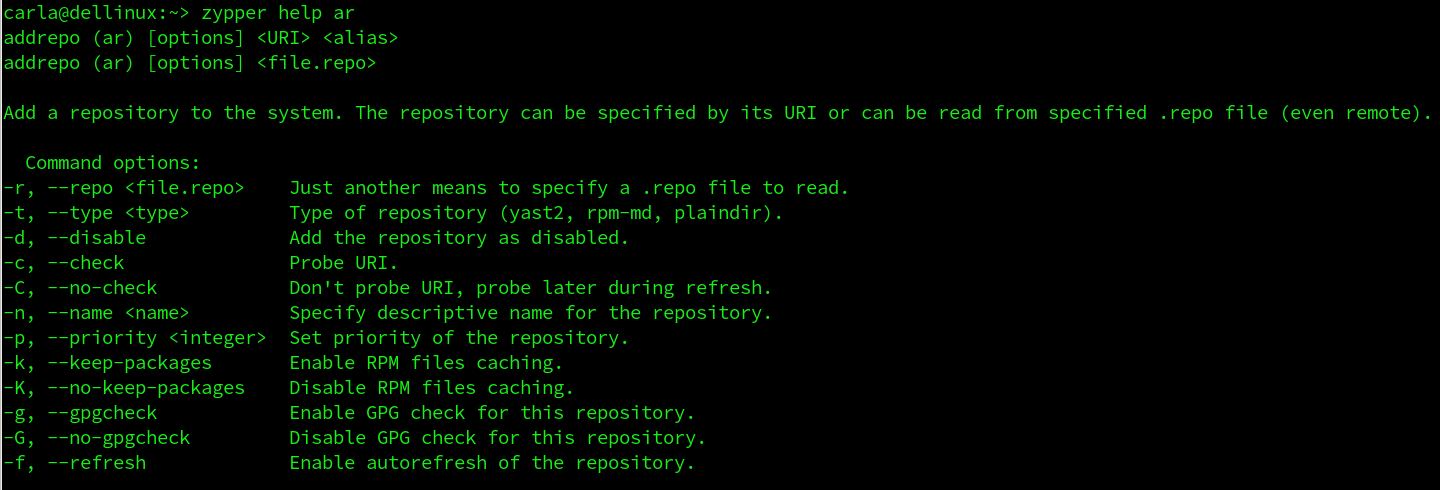
Run zypper help for a command listing, zypper help [command name] to get additional information on any command, and man zypper for detailed help.

Run zypper help for a command listing.

Repository Management

Remember the olden days of distro-only repositories, with few third-party repos to choose from? If your particular Linux distribution did not package an application that you wanted, or did not maintain an up-to-date version your only option was compiling from source code. When Ubuntu created Personal Package Archives (PPAs) the floodgates opened and now third-party and special-purpose repos are everywhere.

openSUSE ships with a batch of configured repositories (see Package repositories for lists of official and third-party repos). Not all of them are enabled. You can see a table with enabled/disabled status, and also generate a table with additional information such as the repository URLs:

zypper lr
zypper lr -d

Enable and disable an installed repo, without removing it:

zypper mr -e repo-debug
zypper mr -d repo-debug

Remove and add a repo:

zypper rr repo-debug
zypper ar -name "repo-debug" http://download.opensuse.org/debug/distribution/leap/42.2/repo/oss/

The --name is required and arbitrary, so you call it anything you want. You can refresh all repositories, or selected repos:

zypper refresh
zypper refresh openSUSE-Leap-4.2-Update

Generate a table of all packages in a repo, and their installed status:

zypper se --repo openSUSE-Leap-4.2-Update

zypper won’t list the files in installed packages, but good old rpm will, like this example for python:

rpm -qi python

Clear your local package cache to force fresh package downloads:

zypper clean

Search For Packages

zypper's search function is fast and easy. You can run a simple name search, see version, architecture, and repository, and search for installed and uninstalled only, like these examples for tiff:

zypper se tiff
zypper se -s tiff
zypper se -i tiff
zypper se -u tiff

You can search for the exact package name, which is great for excluding giant listings of libraries and plugins:

zypper se -x tiff

Name specific repositories to search in:

zypper se --repo openSUSE-Leap-4.2-Update tiff

Install Packages

Installing packages is easy peasey, so let’s install digiKam:

zypper in digikam

Install digiKam from a special repository:

zypper in --repo myspecialrepo digikam

Do a dry-run before installation:

zypper in -D --repo myspecialrepo digikam

Download the package without installing it:

zypper in -d --repo myspecialrepo digikam

Remove Packages

Getting rid of packages is just as easy. We don’t want digiKam anymore (which is silly, because everyone wants digiKam):

zypper rm digikam

Do a dry-run first:

zypper rm -D digikam

Remember when there were flamewars over dependency-resolving package managers like apt-get, Yum, and zypper, like having automatic dependency-resolution was a bad thing? We sure were weird back then. See Using Zypper for more help and some advanced usage.

Learn more about Linux through the free “Introduction to Linux” course from The Linux Foundation and edX.

Set Up a Simple CI Pipeline to Build Docker Images for ARM

Recently I did an experiment: Can we build Docker images for ARM on ordinary cloud CI services that only provide Intel CPU’s?

The idea was to get rid of self hosted CI build agents that you have to care for. If you want to provide an ARM Docker image for an open source project your task is to build it and not to setup and maintain a whole pipeline for it.

We at Hypriot have created several Dockerfiles for open source tools like MySQL, Træfɪk or Node.js to make them available as Docker images for your ARM devices.

Read more at Hypriot

Distributed Fabric: A New Architecture for Container-Based Applications

There’s a palpable sense of excitement in the application development world around container technology. Containers bring a new level of agility and speed to app development, giving developers the ability to break large monolithic apps into small, manageable microservices that can talk to one another, be more easily tested and deployed, and operate more efficiently as a full application. However, containers also demand a new architecture for the application services managing these microservices and apps, particularly in regards to service discovery — locating and consuming the services of those microservices.

Read more at The New Stack

npm Best Practices – Node.js at Scale

With our new series, called Node.js at Scale, we are creating a collection of articles focusing on the needs of companies with bigger Node.js installations, and developers who already learned the basics of Node.

In the first chapter of Node.js at Scale you are going to learn the best practices on using npm as well as tips and tricks that can save you a lot of time on a daily basis.

Read more at Rising Stack

Intel’s BigDL Deep Learning Framework Snubs GPUs for CPUs

Last week Intel unveiled BigDL, a Spark-powered framework for distributed deep learning, available as an open source project. With most major IT vendors releasing machine learning frameworks, why not the CPU giant, too?

What matters most about Intel’s project may not be what it offers people building deep learning solutions on Spark clusters, but what it says about Intel’s ambitions to promote hardware that competes with GPUs for those applications. BigDL is aimed at those who want to apply machine learning to data already available through Spark or Hadoop clusters, …

Read more at InfoWorld

Davos 2017: China Unites 25 Countries to Establish Global Blockchain Business Council

…The national representatives provided their progress in blockchain research in detail and reached initial consensus in the fields of global blockchain teaching, business cooperation, standard synergy, and governmental communications on the first conference of GBBC.

In industry, the layout of blockchain ecosystem is of integrity. From infrastructure to enterprise application, many excellent blockchain and fintech companies like Tai Cloud Corporation, Dian Rong, Oklink are able to compete with the best blockchain companies in the world. Many areas, such as Beijing, Shanghai, Shenzhen, Hangzhou, Ningbo, Ganzhou (Jiangxi) are actively deploying the layout of blockchain industry. It is the first time that the China Blockchain Representatives Team appeared on the World Economic Forum, which marks the efforts by the Chinese blockchain industry to join the global efforts relating to the research of blockchain technology with most positive attitude and action.

Read more at EconoTimes

The Linux Foundation Brings 3 New Open Source Events to China

LinuxCon, ContainerCon, and CloudOpen will be held in China this year for the first time, The Linux Foundation announced this week.

After the success of other Linux Foundation events in the country, including MesosCon Asia and Cloud Foundry Summit Asia, The Linux Foundation decided to offer its flagship LinuxCon, ContainerCon and CloudOpen events in China as well, said Linux Foundation Executive Director Jim Zemlin.

“Chinese developers and businesses have strongly embraced open source and are contributing significant amounts of code to a wide variety of projects,” Zemlin said. “We have heard the call to bring more open source events to China.”

The flagship event, also known as LC3, will be held June 19-20, 2017 at the China National Convention Center in Beijing. As it was in previous years, the event will also be held in North America and Europe this year under a new name, Open Source Summit.

LC3 will cover many of the hottest topics in open source, including open networking, Blockchain, compliance issues and the business and professionalization of open source.

Attendees will have access to the content of all three events with one registration. Activities will include 70+ educational sessions, keynotes from industry leaders, an exhibit hall for demonstrations and networking, hackathons, social events, and more.

  • LinuxCon is where the leading maintainers, developers and project leads in the Linux community and from around the world gather together for updates, education, collaboration and problem-solving to further the Linux ecosystem.

  • ContainerCon is the place to learn how to best take advantage of container technology, which is revolutionizing the way we automate, deploy and scale workloads; from hardware virtualization to storage to software defined networking, containers are helping to drive a cloud native approach.

  • CloudOpen gathers top professionals to discuss cloud platforms, automation and management tools, DevOps, virtualization, software-defined networking, storage and filesystems, Big Data tools and platforms, open source best practices, and much more.

The conference is designed to enable attendees to collaborate, share information and learn about the newest and most interesting open source technologies, including Linux, containers, cloud technologies, networking, microservices and more. It also provides insight into how to navigate and lead in the open source community.

Speaking proposals are being accepted through March 18. Submit your proposal now!

Registration for the event will be open in the coming weeks.

How Disney Is Realizing the Multi-Cloud Promise of Kubernetes

The Walt Disney Company is famous for “making magic happen,” and their cross-cloud, enterprise level Kubernetes implementation is no different. In a brief but information-packed lightning talk at CloudNativeCon in Seattle in November, Disney senior cloud engineer Blake White laid out a few of the struggles and solutions in making Kubernetes work across clouds.

“Kubernetes does a lot of the heavy lifting for you but when you need to think about an enterprise and all of its needs, maybe you need to think a little bit outside of it,” White said. “Get your hands dirty, don’t rely on all the magic, make some of the magic happen for yourself.”

With an enterprise the size of Disney, there are a lot of development, QA, and engineering teams working on many different projects, and each one will have their own cloud environment. White said Kubernetes can handle that just fine, but it takes some adjustment to make everything work.

The first considerations are connectivity and data:

  • Does the project need to reach code repos, artifacts, or other services in your corporate network?

  • Is there data that needs to follow certain privacy standards?

  • How much latency is tolerable?

  • Do you need to interconnect between cloud accounts?

Both Amazon and Google have services that allow for connections across cloud accounts, and both can get a cluster up and running quickly, but neither system works flawlessly with Kubernetes, so White suggests not relying on an out-of-the-box solution if your project is complicated.

There are automated ways to bring up Kubernetes clusters; White mentioned both Kube-up.sh and kops as excellent options, but neither were as configurable as Disney needed, so they built their own bespoke system.

“We ended up building things our own and the main reason for that was because we needed our [virtual public cloud] to be connected back to our corporate network,” White said. The trickiest part with their build was setting up the DNS, he continued.

“We moved from sky DNS to kube DNS; that helped the cluster a lot, but in AWS things just weren’t working,” White explained. “Basically, our DHCP set for the VPC was skipping the Amazon internal and pointing just back to our corporate network, which was what we needed, but Kubernetes was unhappy because it couldn’t find all of the notes. We set up a bind server, pointed that at the AWS internal for internal stuff, and back to our corporate network for everything else… Everything started working again.”

White touched on logging at the tail end of his talk, giving tips on how not to incur unwanted expenses by shipping everything to a central repository, and therefore paying for egress. His solution was to keep everything next to the cluster and query only what you need, he said.

“We set up an ELK stack (Elasticsearch, Logstash and Kibana),” White said. “Be careful where you put your dashboards or else you’ll be shipping much more than you thought, and that works really well. Set up tribe nodes above it, and you can query across multiple clouds. It’s not the only solution but it’s a good solution.”

Watch the complete presentation below.

Do you need training to prepare for the upcoming Kubernetes certification? Pre-enroll today to save 50% on Kubernetes Fundamentals (LFS258), a self-paced, online training course from The Linux Foundation. Learn More >>