
Home Blog Page 625

OpenStack Swift by Christian Schwede, Red Hat

In his LinuxCon Europe talk, Christian Schwede from Red Hat talked about how Swift is deployed at large enterprise companies with many of these deployments operating on a scale of multiple petabytes.
Mobile Edge Computing Creates ‘Tiny Data Centers’ at the Edge

One key element of 5G is likely to be Mobile Edge Computing (MEC), an emerging standard that extends virtualized infrastructure into the radio access network (RAN). ETSI has created a separate working group for it — the ETSI MEC ISG — with about 80 companies involved. 

“MEC uses a lot of NFV infrastructure to create a small cloud at the edge,” says Saguna CEO Lior Fite. Saguna has created its own product, the Open-RAN MEC and is involved with ETSI MEC ISG. Fite says the ETSI group is creating a set of APIs to define “a tiny data center at the edge.”

Saguna’s own MEC technology comprises two main components. The first is a multi-access compute element, and the second is a management element.

Read more at SDx Central

Google Infrastructure Security Design Overview

This document gives an overview of how security is designed into Google’s technical infrastructure. This global scale infrastructure is designed to provide security through the entire information processing lifecycle at Google. This infrastructure provides secure deployment of services, secure storage of data with end user privacy safeguards, secure communications between services, secure and private communication with customers over the internet, and safe operation by administrators.

Google uses this infrastructure to build its internet services, including both consumer services such as Search, Gmail, and Photos, and enterprise services such as G Suite and Google Cloud Platform.

Read more at Google Cloud Platform

Exploring OpenStack’s Trove DBaaS Cloud Service

DBaaS moves the database service to the cloud, promising a new database instance at the click of a mouse.

You can install databases such as MySQL, PostgreSQL, or even MongoDB very quickly thanks to package management, but the installation is not even half the battle. A functioning database also needs user accounts and several configuration steps for better performance and security.

This need for additional configuration poses challenges in cloud environments. You can always manually install a virtual machine in traditional settings, but cloud users want to generate an entire virtual environment from a template. Manual intervention is difficult or sometimes even impossible.

Read more at ADMIN Magazine

‘You are Not Expected to Understand This’: An Explainer on Unix’s Most Notorious Code Comment

The phrase “You are Not Expected to Understand This” is probably the most famous comment in the history of Unix.

And last month, at the Systems We Love conference in San Francisco, systems researcher Arun Thomas explained to an audience exactly what it was that they weren’t supposed to understand.

Computer science teacher Ozan Onay, who was in the audience, called it “one of my favorite talks of the day,” writing on his blog that “Nothing should be a black box, even when Dennis Ritchie says it’s ok!”

Read more at The New Stack

7 Awesome Open Source Web Performance Software For Linux

Web performance is nothing but the speed in which web pages are downloaded and displayed on the user’s web browser. Faster website speeds have been shown to increase sales or increase visitor loyalty including user satisfaction. Particularly useful for those use slow internet connections or on mobile phones/tablets.

In short, one can increase the time it takes for pages to render using multi-layered cache and asynchronous communication with server-side components. In this post, I will list my favorite open source software based TCP/HTTP load balancer and proxying solution for web performance under a Linux operating system.

Read more: nixCraft

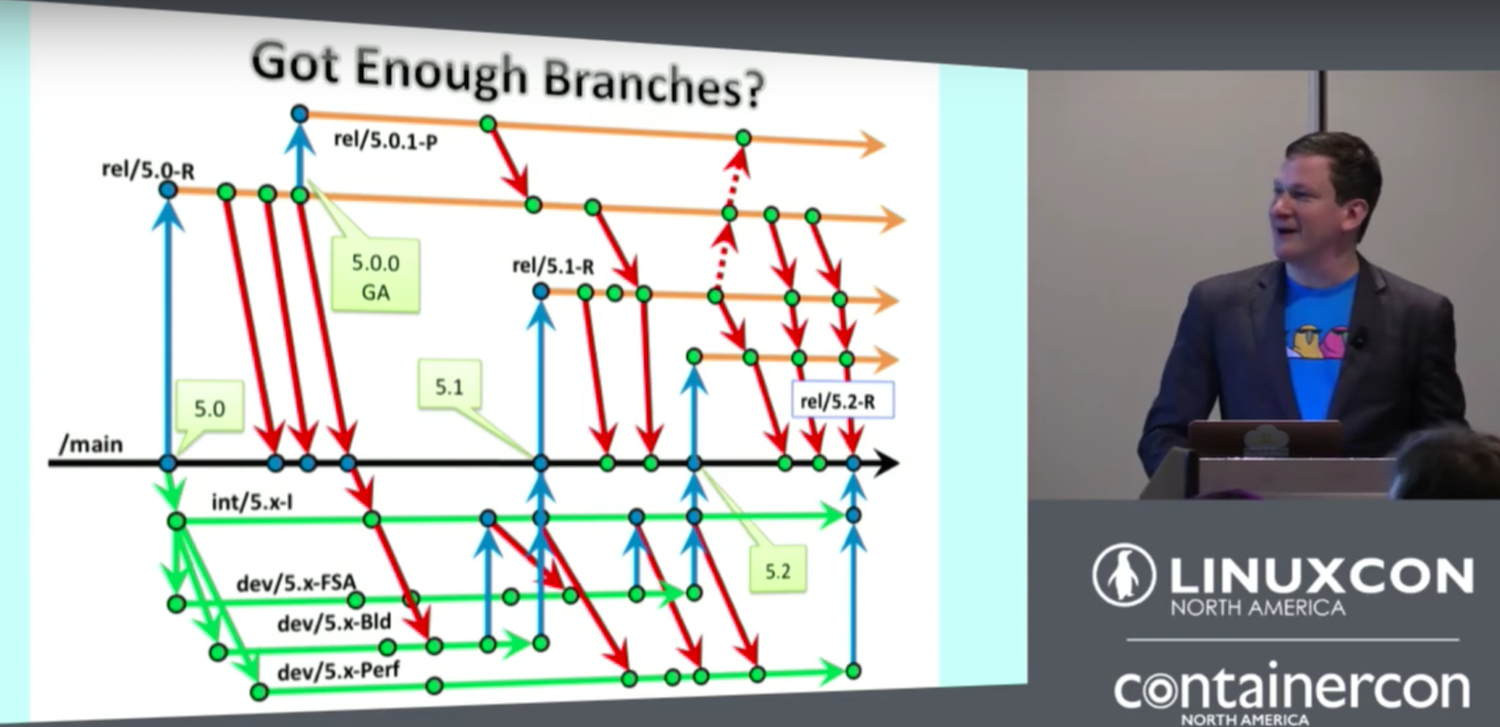
Terrible Ideas in Git by Corey Quinn, FutureAdvisor


In this presentation at LinuxCon, Corey Quinn takes you on a magical tour through the (mis)use of Git to do things its creators never intended. 

Terrible Ideas in Git

“Git does let you do some extraordinarily powerful things. Powerful, of course, in this talk, is a polite euphemism for stupid,” says Corey Quinn of FutureAdvisor at LinuxCon North America. Who hasn’t experienced at least one moment of feeling like a complete dunce when using Git? Sure, Git is wonderful, everyone uses it, and you can do most of your work with a few basic commands. But it also has mighty powers to make us feel like we have no idea what we’re doing.

But that’s really not being fair to ourselves. Nobody knows everything, and everyone knows something different. Quinn reminds us, “During the Q and A section for some of my talks, people sometimes raise their hand and say, “Well, I have a really dumb question,” and you see people in there are, “Yeah! That’s a really dumb question”. But when they get an answer, those people are taking an awful lot of notes.”

Quinn starts his talk with some fun demonstrations of terrible things you can do with Git such as messing up an entire project by rebasing master and then making a forced push, mis-typing commands and getting scolded by Git, and committing large binaries. Then he demonstrates how to make these terrible things less terrible, such as managing large binaries more sanely. “You can commit large binaries. You can commit atrocities in Git. If you wind up needing to store large binaries, there are two tools out there that tend to really speed up loads. One is git-annex, which was was created by Joey Hess, a Debian developer, and git-lfs, which is supported by GitHub”.

Do you keep making the same typo, like typing “git stitis” when you want “git status”? Quinn has an answer for this: “Git does have built-in support for aliases, so you can use relatively long, complex things and alias it to a short Git command.” You can also use shell aliases.

Quinn says, “We’ve all heard about rebasing master, and then doing a forced push, a hilarious prank to all of your co-workers. What that does is it changes history, so that suddenly what happened before is not what people are actually working on, and everyone else winds up getting screwed in the process. A group of whales is called a ‘pod’, a group of crows is called a ‘murder’, and a group of developers is called a ‘merge conflict’…On a more serious note, if someone does do something like this, you do have a few options.” These include restoring master from a known good backup, revert commits, or “Hurl the person responsible, screaming, from the roof of your office.” Or, take a dose of prevention and use a little-known Git feature called branch protection. When you enable branch protection, branches cannot be deleted or force-pushed, and pull requests must have at least one review before acceptance.

Quinn demonstrates several more wonderfully useful tools to make Git more efficient and foolproof such as mr, vcsh, and customized shell prompts. You can see these in the complete video (below), and enjoy more silly jokes.

LinuxCon videos

Linus Torvalds Announces Fourth Linux 4.10 Kernel Release Candidate, Get It Now

One more week has passed in our lives, but the development of the Linux kernel never stops, and we’re now seeing the release of fourth RC (Release Candidate) build of Linux kernel 4.10, which appears to be fairly normal, yet again, bringing only a collection of assorted bug fixes and improvements from last week.

Not surprising at all, but the patch consists of mostly drivers; this time GPU, USB, sound, and networking ones stand out. The rest are the usual x86 architecture updates, multiple fixes for the Btrfs, XFS, and VFS filesystems, some tooling (mostly perf) changes, and the usual core kernel and mm changes.

Read more at Softpedia

TripleO QuickStart HA & CEPH Deployment on Fedora 25 Server VIRTHOST

The most recent commits in  https://github.com/openstack/tripleo-quickstart
allow to use Fedora 25 Server  (32 GB) as target VIRTHOST for TripleO
Quickstart HA Deployments  and benefit from QEMU’s  (2.7.1) && Libvirt’s (2.2.0) 
the most recent KVM virtualization features coming with last Fedora release.

Prior to deployment on VIRTHOST install KSM and enable ksm.service  :-

# dnf -y install python2-dnf ksm libselinux-python
# systemctl start ksm
# systemctl enable ksm

Complete text maybe seen here http://dbaxps.blogspot.com/2017/01/tripleo-quickstart-ha-deployment-on.html