With 2016 behind us, we can reflect on a landmark year where open source migrated up the stack. As a result a new breed of open service orchestration projects were announced, including ECOMP, OSM, OpenBaton, and The Linux Foundation project OPEN-O, among them. While the scope varies between orchestrating Virtualized Network Functions (VNFs) in a Cloud Data Center, and more comprehensive end-to-end service delivery platforms, the new open service orchestration initiatives enable carriers and cable operators to automate end-to-end service delivery, ultimately minimizing the software development required for new services.
Open orchestration was propelled into the limelight as major operators have gained considerable experience over the past years with open source platforms, such as OpenStack and OpenDaylight. Many operators have announced ambitious network virtualization strategies, that are moving from proofs of concept (PoCs) into the field, including AT&T (Domain 2.0), Deutsche Telekom (TeraStream), Vodafone (Ocean), Telefonica (Unica), NTT Communications (O3), China Mobile (NovoNet), China Telecom (CTNet2025), among them.
Traditional Standards Development Organizations (SDOs) and open source projects have paved the way for the emergence of open orchestration. For instance, OPNFV (open NFV reference platform) expanded its charter to address NFV Management and Orchestration (MANO). Similarly, MEF is pursuing the Lifecycle Services Orchestration (LSO) initiative to standardize service orchestration, and intends to accelerate deployment with the OpenLSO open reference platform. Other efforts such as the TMForum Zero-touch Orchestration, Operations and Management (ZOOM) project area addressing the operational aspects as well.
Standards efforts are guiding the open source orchestration projects, which set the stage for 2017 to become The Year of Orchestration.
One notable example is the OPEN-O project, which delivered its initial release less than six months from the project formation. OPEN-O enables operators to deliver end-to-end composite services over NFV Infrastructure along with SDN and legacy networks. In addition to addressing the NFV MANO, OPEN-O integrates a model-driven automation framework, service design front-end, and connectivity services orchestration.
OPEN-O is backed by some of the world’s largest and innovative SDN/NFV market leaders, including China Mobile, China Telecom, Ericsson, Huawei, Intel, and VMware among them. The project is also breaking new ground in evolving how open source can be successfully adopted for large scale, carrier-grade platforms.
To learn more about OPEN-O and rapidly evolving open orchestration landscape, please join us for our upcoming Webinar:
Title:Introduction to Open Orchestration and OPEN-O
Date/Time: Tue January 17, 2017 10:00a – 11:00a PST
Presenter: Marc Cohn, Executive Director, OPEN-O
Register today to save your spot in this engaging and interactive webinar. Can’t make it on the 17th? Registering will also ensure you get a copy of the recording via email after the presentation is over.
There is nothing a hacker likes more than a tasty Linux machine available on the Internet. In my recent Linux Foundation webinar I shared tactics, tools, and methods hackers use to invade your space.
In this blog series, we’ll cover the five easiest ways to keep hackers out and know if they have made it in. Want more information? Watch thefree webinar on-demand.
Easy Linux Security Tip #1
If you are not using Secure Shell, you should be.
This has been a thing for a very, very long time. Telnet is insecure. rLogin is insecure. There are still services out there that require those services but they shouldn’t be exposed to the Internet. If you don’t have SSH just turn off your Internet connection. As we always say: use SSH keys.
Rule No. 1 of SSH: Don’t use password authentication. The second rule of SSH is: Don’t use password authentication. This is really, really important.
If you have a Linux machine on the Internet for any period of time, you are going to get brute forced. It is just going to happen. The brute force is scripted. Scanners see port 22 open to the Internet and they have to hammer it hard.
The other thing you can do is you can move SSH off of the standard port which many of us do. That works to prevent a small number of brute force attacks but, in general, just don’t use password authentication and you’ll be safe.
The third rule of SSH is: All keys have passphrases. A no-passphrase key may as well not be a key at all. I realize that makes services hard to deal with if you are trying to log into something automatically or trying to automate stuff but all keys should have passphrases.
My favorite thing to do is to compromise a host and find home directories with private keys. As soon as I have private keys, it’s game over. I can log into anything that the public key provides access to.
If you provide a passphrase or even a password, it doesn’t have to be a long passphrase on your keys, then it makes my life much, much more difficult.
Easy Linux Security Tip #2
Install Fail2ban.
Those brute force attacks that I was talking about? This helps dramatically. It will automatically activate iptables rules to block repeated attempts to SSH into your machine. Be sure to configure it in such a way that it doesn’t lock you out or doesn’t take up too many resources. But use it, love it, and watch it.
It has its own logs so make sure to watch them and check to see if it’s actually functioning. That’s a really important thing as well.
Start exploring Essentials of OpenStack Administration by downloading the free sample chapter today. DOWNLOAD NOW
DevStack is a GitHub-based deployment of OpenStack, provided by OpenStack.org, that allows for easy testing of new features. This tutorial, the last in our series from The Linux Foundation’s Essentials of OpenStack Administration course, will cover how to install and configure DevStack.
While DevStack is easy to deploy, it should not be considered for production use. There may be several configuration choices for new or untested code used by developers, which would not be appropriate for production.
DevStack is meant for developers, and uses a bash shell installation script instead of a package-based installation. The stack.sh script runs as a non-root user. You can change the default values by creating a local.conf file.
Should you make a mistake or want to test a new feature, you can easily unstack, clean, and stack again quickly. This makes learning and experimenting easier than rebuilding the entire system.
Setting up the Lab
One of the difficulties of learning OpenStack is that it’s tricky to install, configure and troubleshoot. And when you mess up your instance it’s usually painful to fix or reinstall it.
That’s why Linux Foundation Training introduced on-demand labs which offer a pre-configured virtual environment. Anyone enrolled in the course can click to open the exercise and then click to open a fully functional OpenStack server environment to run the exercise. If you mess it up, simply reset it. Each session is then available for up to 24 hours. It’s that easy.
Access to the lab environment is only possible for those enrolled in the course. However, you can still try this tutorial by first setting up your own AWS instance with the following specifications:
Deploy an Ubuntu Server 14.04 LTS (HVM), SSD Volume Type – ami-d732f0b7
with a m4.large (2 vcpus, 8GiB ram) instance type, increase the root disk to 20G, and open up all the network ports.
Once you are able to log into the environment verify some information:
1. To view and run some commands we may need root privilege. Use sudo to become root:
ubuntu@devstack-cc:~$ sudo -i
2. Verify the Ubuntu user has full sudo access in order to install the software:
    root@devstack-cc:~# grep ubuntu /etc/sudoers.d/*

    /etc/sudoers.d/90-cloud-init-users:# User rules for ubuntu

    /etc/sudoers.d/90-cloud-init-users:ubuntu ALL=(ALL) NOPASSWD:ALL
3. We are using a network attached to eth2 for our cloud connections. You will need the public IP, eth0, to access the OpenStack administrative web page after installing DevStack. From the output find the inet line and make note of the IP Address. In the following example the IP address to write down would be: 166.78.151.57 Your IP address will be different. If you restart the lab the IP address may change.
 root@devstack-cc:~# ip addr show eth0

    2: eth0: <BROADCAST,MULTICAST,UP,LOWER_UP> mtu 1500 qdisc pfifo_fast state UP group default qlen 1000

        link/ether bc:76:4e:04:b5:9b brd ff:ff:ff:ff:ff:ff

        inet 166.78.151.57/24 brd 166.78.151.255 scope global eth0

           valid_lft forever preferred_lft forever

        inet6 2001:4800:7812:514:be76:4eff:fe04:b59b/64 scope global

           valid_lft forever preferred_lft forever

        inet6 fe80::be76:4eff:fe04:b59b/64 scope link

           valid_lft forever preferred_lft forever


     root@devstack-cc:~# ip addr show eth2

    4: eth2: <BROADCAST,MULTICAST,UP,LOWER_UP> mtu 1500 qdisc pfifo_fast state UP group default qlen 1000

        link/ether bc:76:4e:06:10:32 brd ff:ff:ff:ff:ff:ff

        inet 192.168.97.1/24 brd 192.168.97.255 scope global eth2

           valid_lft forever preferred_lft forever

        inet6 fe80::be76:4eff:fe06:1032/64 scope link

           valid_lft forever preferred_lft forever
Public IP eth0
Internal IP eth2
4. When the previous command finishes return to being the Ubuntu user:
DevStack is not typically considered safe for production, but can be useful for testing and learning. It is easy to configure and reconfigure. While other distributions may be more stable they tend to be difficult to reconfigure, with a fresh installation being the easiest option. DevStack can be rebuilt in place with just a few commands.
DevStack is under active development. What you download could be different from a download made just minutes later. While most updates are benign, there is a chance that a new version could render a system difficult or impossible to use. Never deploy DevStack on an otherwise production machine.
1. Before we can download the software we will need to update the package information and install a version control system command, git.
    ubuntu@devstack-cc:~$ sudo apt-get update

    <output_omitted>

    ubuntu@devstack-cc:~$ sudo apt-get install git

    <output_omitted>

    After this operation, 21.6 MB of additional disk space will be used.

    Do you want to continue? [Y/n] y

    <output_omitted>
3. The newly installed software can be found in a new sub-directory named devstack. Installation of the script is by a shell script called stack.sh. Take a look at the file:
    ubuntu@devstack-cc:~$ cd devstack

    ubuntu@devstack-cc:~/devstack$ less stack.sh
4. There are several files and scripts to investigate. If you have issues during installation and configuration you can use theunstack.sh and clean.sh script to (usually) return the system to the starting point:
    ubuntu@devstack-cc:~/devstack$ less unstack.sh

    ubuntu@devstack-cc:~/devstack$ less clean.sh
5. We will need to create a configuration file for the installation script. A sample has been provided to review. Use the contents of the file to answer the following question.
ubuntu@devstack-cc:~/devstack$ less samples/local.conf
6. What is the location of script output logs? _____________
7. There are several test and exercise scripts available, found in sub-directories of the same name. A good, general test is the run_ tests.sh script.
Due to the constantly changing nature of DevStack these tests are not always useful or consistent. You can expect to see errors but be able to use OpenStack without issue. For example missing software should be installed by the upcoming stack.sh script.
Keep the output of the tests and refer back to it as a place to start troubleshooting if you encounter an issue.
ubuntu@devstack-cc:~/devstack$ ./run_tests.sh
While there are many possible options we will do a simple OpenStack deployment. Create a ~/devstack/local.conf file. Parameters not found in this file will use default values, ask for input at the command line or generate a random value.
Create a local.conf file
1. We will create a basic configuration file. In our labs we use eth2 for inter-node traffic. Use eth2 and it’s IP address when you create the following file.
    ubuntu@devstack-cc:~devstack$ vi local.conf

    [[local|localrc]]

    HOST_IP=192.168.97.1

    FLAT_INTERFACE=eth2

    FIXED_RANGE=10.10.128.0/20 #Range for private IPs

    FIXED_NETWORK_SIZE=4096

    FLOATING_RANGE=192.168.100.128/25 #Range for public IPs

    MULTI_HOST=1

    LOGFILE=/opt/stack/logs/stack.sh.log

    ADMIN_PASSWORD=openstack

    MYSQL_PASSWORD=DB-secret

    RABBIT_PASSWORD=MQ-secret

    SERVICE_PASSWORD=SERVICE-secret

    SERVICE_TOKEN=ALongStringUsuallyHere

    enable_service rabbit mysql key
Install and Configure OpenStack
The following command will generate a lot of output to the terminal window. The stack.sh script will run for 15 to 20 minutes.
2. View the directory where various logs have been made. If the logs are not present you may have an issue with the syntax of the local.conf file:
ubuntu@devstack-cc:~devstack$ ls -l /opt/stack/logs
3. Review the output from the stack.sh script:
ubuntu@devstack-cc:~devstack$ less /opt/stack/logs/stack.sh.log
DevStack runs under a user account. There used to be a rejoin.sh script can be used to attach to the ongoing screen session after a reboot. DevStack is not meant to be durable, so the script was removed late in the Liberty release. Due to lab environment issues if you reboot the node you may have to start the lab again.
Log into the OpenStack Browser User Interface
The Horizon software produces a web page for management. By logging into this Browser User Interface (BUI) we can configure almost everything in OpenStack. The look and feel may be different than what you see in the book. The project and vendor updates change often.
1. Open a web browser on your local system. Using the output of the ip command, find the IP address of the eth0 interface on your devstack-cc node. Type that IP into your browser URL.
    ubuntu@devstack-cc:~devstack$ ip addr show eth0

    ...

    inet 104.22.81.13

    ...
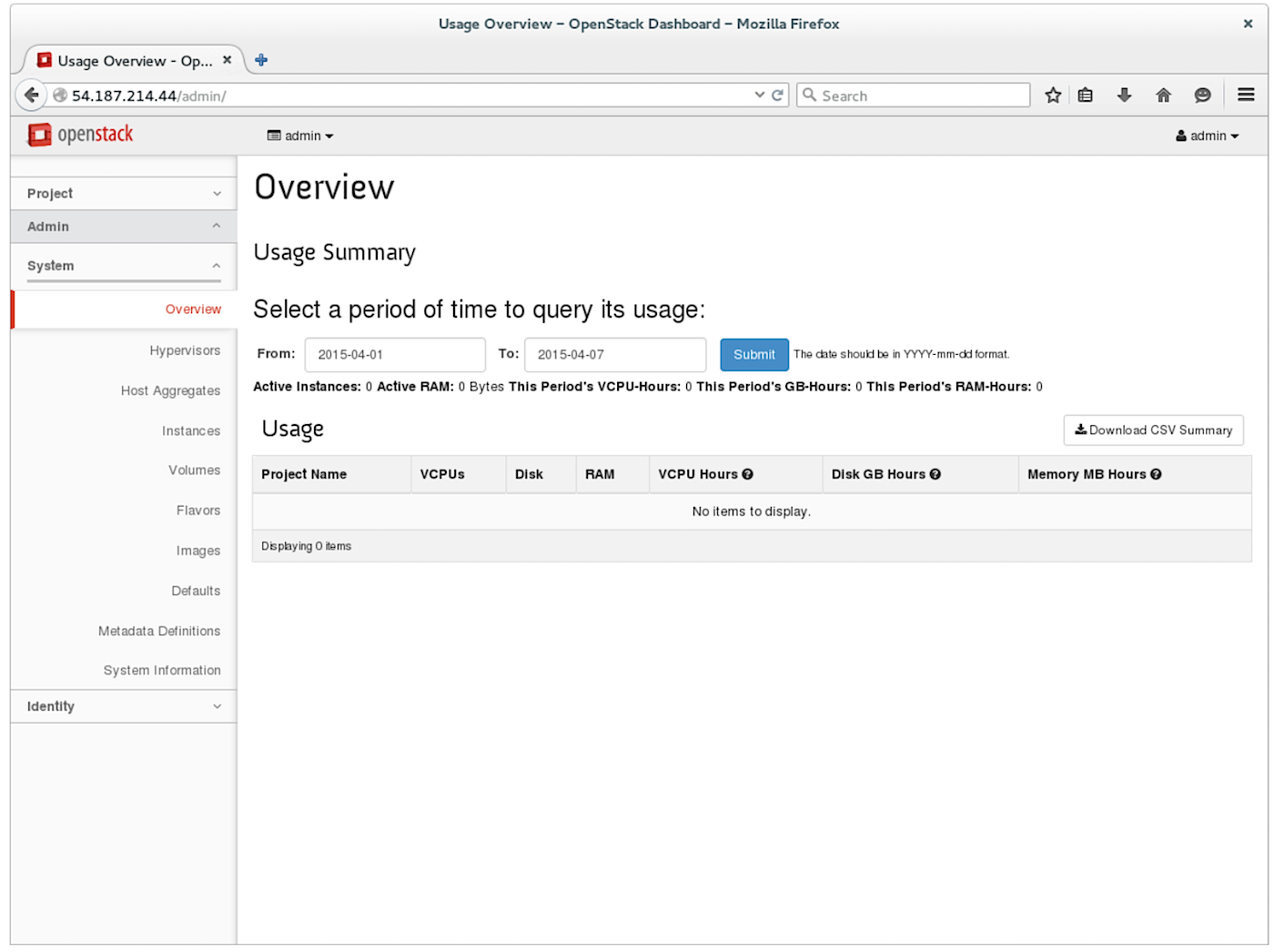
2. Log into the BUI with a username of admin and a password of openstack.You should be viewing the Overview and Usage Summary page. It should look something like the following:
Browser Use Interface
3. Navigate to the System -> Hypervisors page. Use the Hypervisor and Compute Host sub-tabs to answer the following questions. a. How many hypervisors are there?
b. How many VCPUs are used?
c. How many VCPUs total?
d. How many compute hosts are there?
e. What is its state?
4. Navigate to the System -> Instances page.
a. How many instances are there currently?
5. Navigate to the Identity -> Projects page.
a. How many projects exist currently?
6. Navigate through the other tabs and subtabs to become familiar with the BUI.
Solutions
Task 2
6. $DEST/logs/stack.sh.log
Task 5
3. a. 1 b. 0 c. 2 d. 1 e. up
4. a. 0 5. a. 6
The Essentials of OpenStack Administration course teaches you everything you need to know to create and manage private and public clouds with OpenStack. Download a sample chapter today!
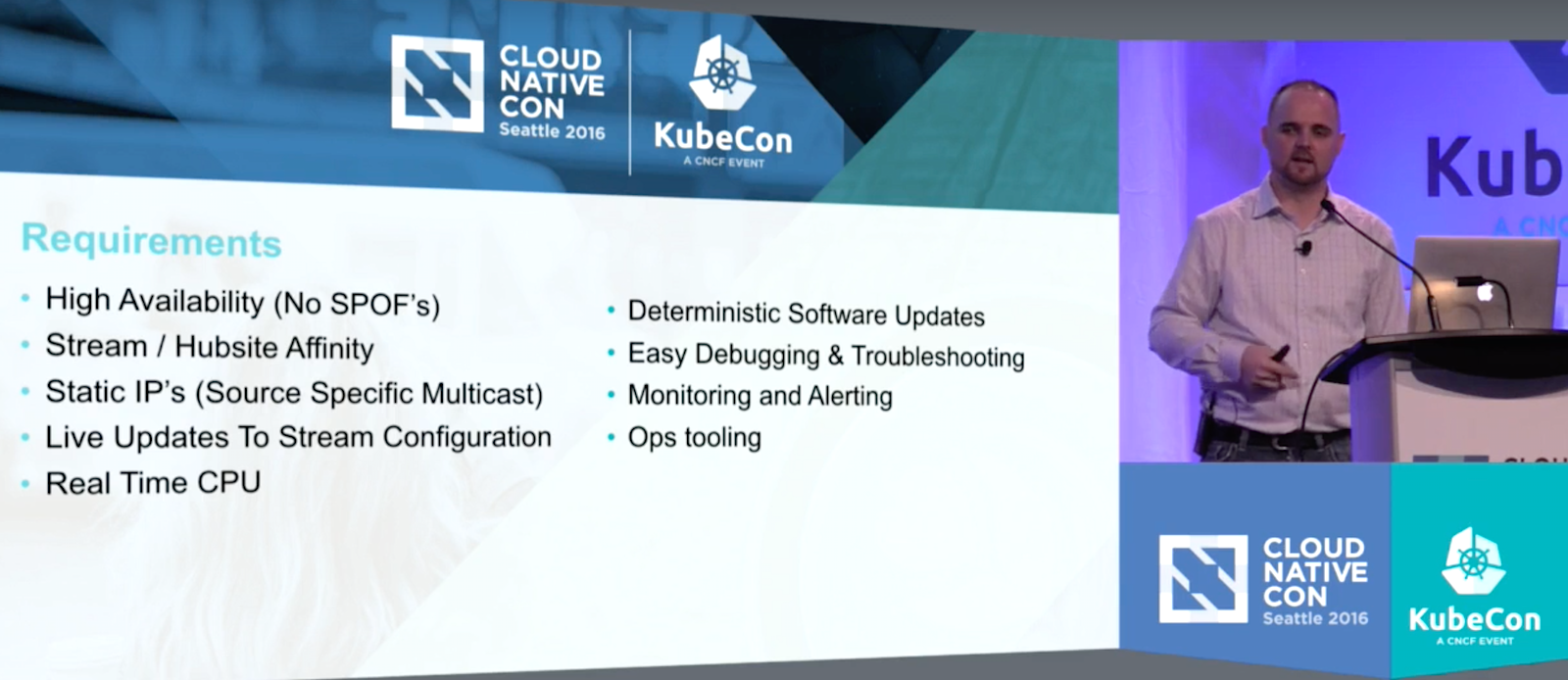
Comcast cable is undergoing a major technical shift. The company is moving away from an always-on transmission of every single channel to every single customer, with the signal converted on either end by a piece of proprietary hardware, which is how cable has worked for decades. The new system is IP-based, on-demand streaming model where channel signal is sent only when requested by the user, explained Erik St. Martin, a systems architect at Comcast, at CloudNativeCon in November.
The change will save an enormous amount of bandwidth for Comcast, improving signal quality and allowing the transmission of several different formats and device-specific tailored signals.
Simple, right? Turns out, it’s not so simple, especially when you consider the shift must happen while keeping 99.999 percent uptime so customers don’t freak out.
Out of the Box
St. Martin is part of the team building Comcast’s new widely distributed and intensely fault tolerant broadcast system. The list of requirements is daunting, he said, and was difficult to face at the start. Then, he found Kubernetes, and out of the box many of the tricky technical obstacles were addressed.
“Can you imagine trying to design a system like this from scratch? … it’d be a massive effort and it’d have a ton of edge cases,” St. Martin said. “It probably comes as no surprise, standing here talking to you at a Kubernetes conference, the Kubernetes has actually solved most of these problems for us.”
The Kubernetes platform for dealing with applications clusters is very well suited to help Comcast update to an IP-based streaming system, said St. Martin; the system of labels and notations works perfectly for different channel streams thanks to its flexibility and simplicity. Teams tasked with managing streams needn’t worry about hardware; hardware teams needn’t worry about bandwidth.
“This is a huge shift from the way things currently work,” he said. “Today, the video engineering team needs to know about every single one of those [signal transmission and translation] devices. They maintain spreadsheets of these things and log into them by IP address … sometimes it even comes down to physically moving hardware or cables.”
There are still many facets that need to be built through Comcast’s Kubernetes implementation, with plenty of tricky engineering problems to keep everyone up at night. But the Kubernetes platform — and the community — has already made a significant dent in what seemed like an impossible task.
“All in all, these are tiny issues in comparison to the complexity and edge cases of the system we would’ve had to create from scratch,” St. Martin said. “With each release of Kubernetes, there seems to be less work for our own components to do. There’s no doubt that Kubernetes has changed the way we deploy and manage applications.
“Kubernetes can be just as impactful as a framework for building your own applications,” he said. “You can save yourself complexity and development time by leveraging functionality in tools that already exist. We can also create clean abstractions between teams by writing our own resource types and controllers. It’s a beautifully abstracted system. Each component, with a distinct role, making it effortless to replace components or customize them to fit our use cases, and even use cases that are at their surface may not seem particularly suited for Kubernetes.”
Watch the complete video below:
Do you need training to prepare for the upcoming Kubernetes certification? Pre-enroll today to save 50% on Kubernetes Fundamentals (LFS258), a self-paced, online training course from The Linux Foundation. Learn More >>
The Kubernetes platform for dealing with applications clusters is very well suited to help Comcast update to an IP-based streaming system, said Erik St. Martin at CloudNativeCon.
Before considering what it means to have application security testing integrated into the DevOps Continuous Integration/Continuous Delivery (CI/CD) pipeline, it is worth asking why it is valuable to integrate application security testing into these pipelines in the first place. A fundamental tenet of DevOps and the reason for having CI/CD pipelines for software builds is to allow teams to have up-to-the-minute feedback on the status of their development efforts so that they know if a build is ready to push to production. This involves testing quality, performance and other characteristics of the system. And it should include security as well.
By integrating security into the CI/CD pipeline, security vulnerabilities are found quickly and reported to developers in the tools they’re already using.
In an interview, SUSE’s new CTO, Dr. Thomas Di Giacomo told us that there are many customers who are running legacy systems but they want to migrate to modern technologies over time. Today, if you want to start from scratch, you will start with containers. “We want to make sure that companies that have legacy infrastructure and legacy applications can move to modern technologies, where container as a service is offered through that OS itself,” said “Dr. T” (as he is known in SUSE circles). That’s what CaaSP with MicroOS is being designed to do.
This blog post is about how Stack Overflow and the rest of the Stack Exchange network approaches DNS:
By bench-marking different DNS providers and how we chose between them
By implementing multiple DNS providers
By deliberately breaking DNS to measure its impact
By validating our assumptions and testing implementations of the DNS standard
The good stuff in this post is in the middle, so feel free to scroll down to “The Dyn Attack” if you want to get straight into the meat and potatoes of this blog post.
It’s been almost three months since we last heard something from TheeMahn, the developer of the Ultimate Edition (formerly Ubuntu Ultimate Edition) operating system, a fork of Ubuntu and Linux Mint, but we’ve been tipped by one of our readers about the availability of Ultimate Edition 5.0 Gamers.
The goal of the Ultimate Edition project is to offer users a complete, out-of-the-box Ubuntu-based computer operating system for desktops, which is easy to install or upgrade with the click of a button. It usually ships with 3D effects, support for the latest Wi-Fi and Bluetooth devices, and a huge collection of open-source applications.
There are several editions of Ultimate Edition that are maintained even to this day, and while Ultimate Edition 5.0 shipped last year in September, based on Ubuntu 16.04 LTS (Xenial Xerus), it’s time for the Ultimate Edition Gamers to get a new release. As such, we’d like to tell you all about Ultimate Edition 5.0 Gamers.