
If you want to learn about the technical
Click to Read More at Oracle Linux Kernel Development

If you want to learn about the technical
Click to Read More at Oracle Linux Kernel Development
Learn how Flatpak and Toolbx make Red Hat Enterprise Linux (RHEL) 8 and 9 both fun to use and capable of handling the serious stuff.
Read More at Enable Sysadmin
Set up identity and access management for command-line interface (CLI) applications with the Keycloak open source tool.
Read More at Enable Sysadmin
The power of a story. I first wrote about this 7 years ago in a series I titled Lessons from a Two Year Old. But it is a reality as old as time itself – humans are wired for stories. We enjoy listening to them, telling them, and they help us to relate to others and to remember things.
And everyone has a story to tell – many of which haven’t been told yet.
Our own Mark Miller is working on sharing the previously untold stories of the people in open source. He has a unique gift for pulling stories out of people and showcasing what made each person who they are today and how their journey resulted in some of the top open source projects of all time. Each person is making a positive difference in our world, and each one has their own unique journey.
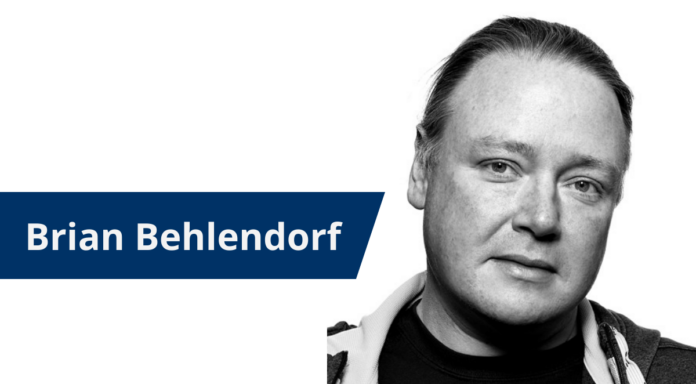
Mark will be sharing these stories in our upcoming, aptly named podcast, The Untold Stories of Open Source. It will be formally launched at the Open Source Summit North America and OpenSSF Day in June, but you are in luck and he has soft-launched with his first episode, telling the story of Brian Behlendorf, General Manager of the OpenSSF. But, Brian had quite the journey before his role at OpenSSF and that story is now being told.
Like myself, Brian was coming of age when PCs were being introduced to the world, Oregon Trail was the game of choice (okay, it was about the only game), and the Internet was still a project at the National Science Foundation. Brian’s parents worked in the science and technology field – they even met at IBM. His father was a COBOL programmer, which gave Brian a look into the world of programming. Imagining a life of coding in basements, away from people, is why he decided against majoring in computer science. I can relate – we both started college in the fall of 1991, and, I too, decided against majoring in computer science because I envisioned a future of myself, a computer, a pot of coffee, and little social interaction.
The Internet was just getting introduced to the world in 1991 – and Brian, like all incoming freshmen at the University of California – Berkeley, received an email address. With this, he connected with others who shared a common interest in R.E.M. and 4AD and the rave scene around San Francisco. He built a mailing list around this shared interest. Yada…yada… The first issue of Wired magazine mesmerizes Brian in 1993.
Turns out one of the friends Brian met in his music community was working at Wired to get it – well wired. It started as a print newsletter (ironically). His friend, Jonathan, reached out and hired Brian for $100/week to help them get back issues online. Unlike today’s iconic, stunning design, it was black text on a white background.
Besides just digitizing previously published content, Brian helped produce digital-only content. A unique approach back then. It was one of the first ad-supported websites – hotwired.com. Brian jokes, “I like to say I put the first ad-banner on the web, and I have been apologizing for it ever since.”
As Brian worked on the content, he had a vision of publishing books online. But, turns out, back then publishers didn’t have the budgets to devote to web content. But bigger brands, looking to advertise on Hotwired, did, and they needed to have a website to point to. So he joined Organic, a web design firm, as CTO at the ripe age of 22. They build the websites for some of the first advertisers on Hotwired like Club Med, Volvo, Saturn cars, Levis, Nike, and others.
Back then, Wired and the sites Organic built all ran on a web server software developed by students at the University of Illinois, in the same lab that developed the NCSA Mosaic browser. Long before the term open source was coined, software running the web almost always included the source code. Brian notes there was an unwritten code (pun intended) that if you find a bug, you were morally obligated to fix it and push the code upline so that everyone had it. He and a group of students started working on further developing the browser. Netscape bought the software, which halted ongoing student support for the browser. Although the code remains open. Brain and others kept updating the code, and they decided to change the name since it was a new project. Because it was a group of patches, they chose the name Apache Web Server (get it – a patchy server). It now runs an estimated 60% of all web servers in the world.
As interesting as Brian’s story is to this point – I really just scratched the surface. Mark’s first episode of the podcast shares the rest, from founding Collab.net to a medical records system in Rwanda to working at the White House to his roles at Hyperledger and now OpenSSF and more.
Okay – I have said too much. No real spoilers. You can listen to the full episode now on Spotify. (more platforms coming soon).
Mark has been recording and stitching together episodes all year. I look forward to listening. Look for the formal launch, and several new episodes, at Open Source Summit North America and OpenSSF Day on June 20, 2022.
The post Linux Foundation Podcast Series: “The Untold Stories of Open Source” appeared first on Linux Foundation.
This article originally appeared on the LF Training Blog. You can access all of the LF Training resources and courses, including Kubernetes certifications, at here.
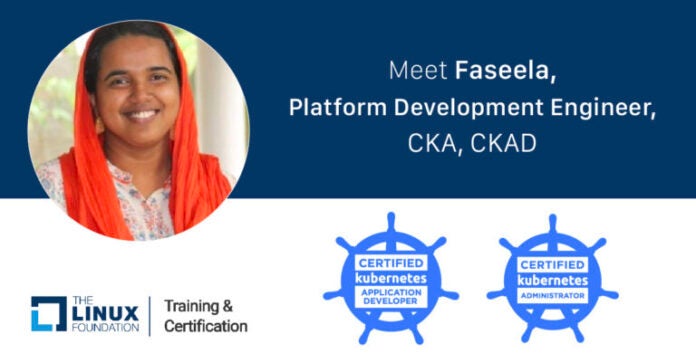
Faseela K. is a platform development engineer with a background in open source networking. As she saw the use of containers growing more than the VMs she was working with, she began studying Kubernetes and eventually decided to pursue a Certified Kubernetes Administrator (CKA). We spoke to her about her experience.
Linux Foundation: What was the experience like taking the CKA exam?
Faseela K: I was actually nervous, as this was the first online certification exam I was taking from home, so there was some uncertainty going in. Would the proctor turn up on time? Will the cloud platform where we are taking the exam get stuck? Will I be able to finish the exam on time? Those and several other such questions ran through my mind. But I turned down all my concerns, had a very smooth exam experience, and was able to finish it without any difficulties.
LF: How did you prepare for the exam?
FK: I am a person who uses Kubernetes in my day to day work, so the topics in the syllabus were familiar to me. On top of that I did some practice tests and online courses. Preparing for the exam made so many of my day to day work related tasks much easier, and my level of expertise on K8s increased considerably.
LF: How did preparing for and taking CKA help you improve your skills?
FK: Though I work on K8s regularly, the range of concepts and capabilities I was using were minimal. Preparing for CKA helped me touch upon all areas of K8s, and the experience which I already had helped me get a complete end to end view of things. I can troubleshoot Kubernetes issues in a better way now, and go deep into each problem to find a solution.
LF: Tell us more about your current job role. What types of activities are you engaged in and how has the CKA helped with them?
FK: I currently work as a platform development engineer at Cisco, where we develop and maintain an enterprise Kubernetes platform. Troubleshooting, upgrading, networking, and system management of containerized platforms are part of our daily tasks, and CKA has helped me master all these areas with perfection. The training which I took to prepare for the CKA phenomenally transformed my perspective about Kubernetes administration, and this has helped me attain an end to end view of the product. Debugging any issues in the platform has become easier than ever, and the certification has given me even more confidence with fixing issues in a time sensitive manner.
LF: You mentioned to us previously you’d like to take the Certified Kubernetes Application Developer (CKAD) next; what appeals to you about that certification?
FK: I am planning to go deeper into containerized application development in my career, and hence CKAD was appealing to me. In fact, I already completed CKAD and became CKAD certified within less than a month of achieving my CKA certification. The confidence I gained after CKA helped me try the second one also faster.
LF: Tell us about your experience working on the OpenDaylight project. What prompted you to move from focusing on SDN to Kubernetes?
FK: I was previously a member of the Technical Steering Committee of the OpenDaylight project at The Linux Foundation, and made a lot of contributions to OpenDaylight. Working in open source has been the most amazing experience I have ever had in my life, and OpenDaylight gave me exposure to the various activities under LF Networking, while being a part of The Linux Foundation generally helped me engage with some of the top notch brains across organizations.
Coming together from across the globe during various conferences and DDFs, and working together across the company boundaries to solve common SDN problems has given me so much satisfaction. Over a period of time, containers were gaining traction over VMs, and I wanted to get more involved with containerization and platform development, where Kubernetes looked more promising.
LF: What are your future career goals?
FK: I intend to learn more about K8s internal implementation, and also to get involved with projects like istio, servicemesh and networkservicemesh in the future. My dream is to become a cloud native software developer, who promotes containerized application development in a cloud native way.
LF: What technology are you most interested in studying next?
FK: I am currently pursuing a course on the golang programming language. I also plan to take the Certified Kubernetes Security Specialist (CKS) exam if time permits.
The post Success Story: Preparing for Kubernetes Certification Improves a Platform Development Engineer’s Skills appeared first on Linux Foundation.

Last week I had the privilege of participating in the Open Source Software Security Summit II in Washington, DC. The Linux Foundation and OpenSSF gathered around 100 participants from enterprise, the U.S. government, and the open source community to agree on an action plan to help increase the security of open source software.
If you were to look at the attendee list, you would likely be struck by the amount of collaboration among competitors on this issue. But, it isn’t a surprise to the open source community. Security is an excellent example of why organizations participate in open source software projects.
This is organizations coming together on a joint solution to a common problem so they can focus on innovating.
A question I often receive when I tell people where I work is, Why would for-profit companies want to participate in open source projects? There are lots of reasons, of course, but it boils down to organizations coming together on a joint solution to a common problem so they can focus on innovating. For instance, film studios coming together around software for saving video files or color management or the finance industry improving trader’s desktops or web companies supporting the languages and tools that make the web possible. And these are just a handful of examples.
Security is everyone’s concern and solutions benefit everyone. As one summit participant noted, “My direct competitors are in the room, but this is not an area where we compete. We all want to protect our customers, shareholders, and employees. . . 99% of the time we’re working on the same problems and trying to solve them in a smarter way.”
99% of the time we’re working on the same problems and trying to solve them in a smarter way.
Everyone is better off by sharing vulnerabilities and solutions and working together towards a common goal of a more resilient ecosystem. No company is immune, everyone relies on multiple open source software packages to run their organization’s software. It is no surprise that competitors are working together on this – it is what the open source community does.
As we gathered in DC, my colleague Mark Miller talked to participants about their expectations and their perspectives on the meeting. When asked what he hoped to accomplish during the two day summit, Brian Fox of Sonatype said, “The world is asking for a response to make open source better. We are bringing together the government, vendors, competitors, [and] open source ecosystems to see what we can collectively do to raise the bar in open source security.”
We are bringing together the government, vendors, competitors, [and] open source ecosystems to see what we can collectively do to raise the bar in open source security.
Another participant painted a picture which I find especially helpful, “I remember the old saying, we built the Internet on sand. I thought about that, underscoring the fact that sand is a part of concrete. This process means that we have an opportunity to shore up a lot of the foundation that we built the Internet on, the code that we’re developing. It is an opportunity to improve upon what we currently have, which is a mixture of sand and concrete. How do we get it all to concrete?”
Enterprise companies and community representatives were at the summit, as well as key U.S. government decision makers. The high-level government officials were there the entire day, participating in the meeting, and listening to the discussions. Their level of participation was striking to me. I have worked in and around government at the policy level for 25 years – and it is more common than not – for government officials to be invited to speak, come and speak, and then leave right after they deliver their remarks. To see them there one year after implementing the Executive Order on Improving the Nation’s Cybersecurity and engaged signals the importance they place on solving this problem and the respect they have for the group that gathered last week Kudos to Anne Neuberger, her team, and the others who joined from around the U.S. government.
By the end of the first day, agreement was reached on a plan, comprised of 10 key initiatives:
Security Education Deliver baseline secure software development education and certification to all.
Risk Assessment Establish a public, vendor-neutral, objective-metrics-based risk assessment dashboard for the top 10,000 (or more) OSS components.
Digital Signatures Accelerate the adoption of digital signatures on software releases.
Memory Safety Eliminate root causes of many vulnerabilities through replacement of non-memory-safe languages.
Incident Response Establish the OpenSSF Open Source Security Incident Response Team, security experts who can step in to assist open source projects during critical times when responding to a vulnerability.
Better Scanning Accelerate discovery of new vulnerabilities by maintainers and experts through advanced security tools and expert guidance.
Code Audits Conduct third-party code reviews (and any necessary remediation work) of up to 200 of the most-critical OSS components once per year.
Data Sharing Coordinate industry-wide data sharing to improve the research that helps determine the most critical OSS components.
SBOMs Everywhere Improve SBOM tooling and training to drive adoption.
Improved Supply Chains Enhance the 10 most critical OSS build systems, package managers, and distribution systems with better supply chain security tools and best practices.
The full document, The Open Source Software Security Mobilization Plan, is available for you to review and download.
Of course, a plan without action isn’t worth much. Thankfully, organizations are investing resources. On the day it was delivered, already $30 million was pledged to implement the plan. Organizations are also setting aside staff to support the project:
Google announced its “new ‘Open Source Maintenance Crew’, a dedicated staff of Google engineers who will work closely with upstream maintainers on improving the security of critical open source projects.”
Amazon Web Services committed $10 million in funding in addition to engineering resources, “we will continue and increase our existing commitments of direct engineering contributions to critical open source projects.
Intel is increasing its investment: “Intel has a long history of leadership and investment in open source software and secure computing. Over the last five years, Intel has invested over $250M in advancing open source software security. As we approach the next phase of Open Ecosystem initiatives, Intel is growing its pledge to support the Linux Foundation by double digit percentages.”
Microsoft is adding $5 million in additional funding because, “Open source software is core to nearly every company’s tech strategy. Collaboration and investment across the ecosystem strengthens and sustains security for everyone.”
These investments are the start of an initiative to raise $150M toward implementation of the project.
Last week’s meeting and the plan mark the beginning of a new and critical pooling of resources – knowledge, staff, and money – to further shore up the world’s digital infrastructure, all built upon a foundation of open source software. It is the next step (well, really several steps) in the journey.
If you want to join the efforts, start at the OpenSSF.
The post Open Source Software Security: Turning Sand into Concrete appeared first on Linux Foundation.
Secure Boot uses digital key pairs to check that SystemTap and other startup code hasn’t been altered by a rootkit or similar mechanism.
Read More at Enable Sysadmin
How well do you know Java? Discover something new about one of the great platforms of modern computing.
Read More at Enable Sysadmin

This article originally appeared on the Open Mainframe Project’s blog. It is written by Earl Dixon, Principal Client Services Management at Broadcom.
After watching the first Making Our Strong Community Stronger panel on “How Personal Experiences Shape Corporate Inclusion,” I was very interested in the topic and engaged my management team to see what I could do to help in the effort. As a result, I was given the opportunity to participate in the second panel discussion focused on UNMASKING in the work place. I was very eager to participate as I felt the panel would be a great way for me to share my experiences.
As we started to discuss the structure and questions, I did get a little nervous. I would be going from “not unmasking at work” to “unmasking” for my peers, management, and others in the industry. We had a dry run for the panel, and I left that being even more nervous. The other panelists (outside of my peers) were executives and managers who were white and had no issue with unmasking at work. It was intimidating, but as I talked with Dr. Chance about my feelings, she made me feel more comfortable about moving forward. As the days wound down closer to the event, I actually grew nervously excited. Once that day came, I wanted to make sure that my story would be told the way that I needed it to be told. I wanted my story to be real and give an understanding of what it is like being a black man coming up in a white dominated field.
Much to my surprise, the panel went very well, and immediately after doing it, I felt a great sense of relief. It was as if a weight had been lifted off my shoulders. The experience was very therapeutic for me. The next day, the Making Our Strong Community Stronger initiative hosted a Town Hall for webinar attendees that had attended the panel discussion live and wanted to ask questions or provide feedback. I felt even more confident in answering the questions posed by the audience, and it actually made me feel even better that I had been involved.
For the next few days, I received numerous emails, LinkedIn notes, and friend requests from individuals who applauded the webinar and the conversation we were able to have. I also heard stories from others who had similar experiences. Someone even asked me to discuss how my experiences could help him better understand how to support his diverse workforce.
In fact, I met with some of my own management team to discuss what they could be doing better from a DEI perspective. Having leaders from my company ask me questions and listen to what I had to say gave me a sense of appreciation that what we did in our panel was not only being heard, but real action was also occurring to help others coming into this mainframe space to work.
Overall, I am proud of the fact that I was able to participate in the DEI panel and look forward to doing more to help with DEI in the future. It was a pleasure to work with Dr. Chance and her team in this effort to bring awareness to the truly important DEI issues that go unnoticed in the industry.
Red Hat Enterprise Linux (RHEL) celebrated its 20th anniversary days before RHEL 9 was released. See how some of our top authors evolved from “what’s this?” to power users.
Read More at Enable Sysadmin