Managing and making sense of these new, cloud-native architectures is something that the Cloud Native Computing Foundation (CNCF) aims to help make easier for developers worldwide. On today’s episode of The New Stack Makers podcast, we talk with CNCF Executive Director Dan Kohn and CNCF Chief Operating Officer Chris Aniszczyk about the direction of the CNCF and cloud-native computing as a whole. The interview took place at KubeCon/CloudNativeCon, which took place last month in Seattle.
CNCF has introduced …a new category of earlier stage project for developers to submit to, called the ‘inception stage.’ “What it does is it allows less mature projects to join CNCF at an earlier stage, but unlike the incubation process where if they’re in they’re basically in, the inception stage requires a new TOC vote every 12 months.”
Industry standard servers have played a big role in reducing the cost of networking across the enterprise. But there is a fair amount of nuance that needs to be appreciated to understand how to achieve that goal. One of the best examples is the way Amazon Web Services offloads network services from industry standard servers.
AWS has the largest amount of x86 server infrastructure on the planet. But even with all that infrastructure, AWS spent several million dollars developing its own network infrastructure to offload networking functions from those servers. At the recent AWS re:invent 2016 conference, James Hamilton, vice president and distinguished engineer for AWS, described how AWS is employing custom 25G routers and 10G network interface controller (NIC) cards based on commodity processors to scale networking services in the cloud.
I am honored to join The Linux Foundation this month as General Manager of Open Source Networking & Orchestration. As I look at the last three decades, we (networking geeks) have always stepped up to stay ahead of major technology disruptions. Now we are at the next big revolution: open networking, fueled by open source communities.
Through open source projects such as The Linux Foundation’s OpenDaylight, OPNFV, OPEN-O, FD.io, Open vSwitch, OpenSwitch, IO Visor, ON.Lab, CORD and ONOS, hundreds of developers, DevOps professionals and business executives from around the world are working together to undertake a massive transition and to change an industry.
Such rapid transformation is exhilarating. However, if you are an enterprise, carrier, cloud provider, or creator of the networking ecosystem, it can also be mind-boggling. The choices and options to provide services to your customers in this new open source ecosystem are limitless and leave many questions.
How do we harmonize all the open initiatives across the entire stack and industry?
How can I participate in the ‘Open Revolution’, saving potentially millions of dollars and providing a head-start to my core competency?
How has networking had a profound impact on adjacent “hot” industries like Cloud, Big Data, IOT, Analytics, Security, Intelligence, and others?
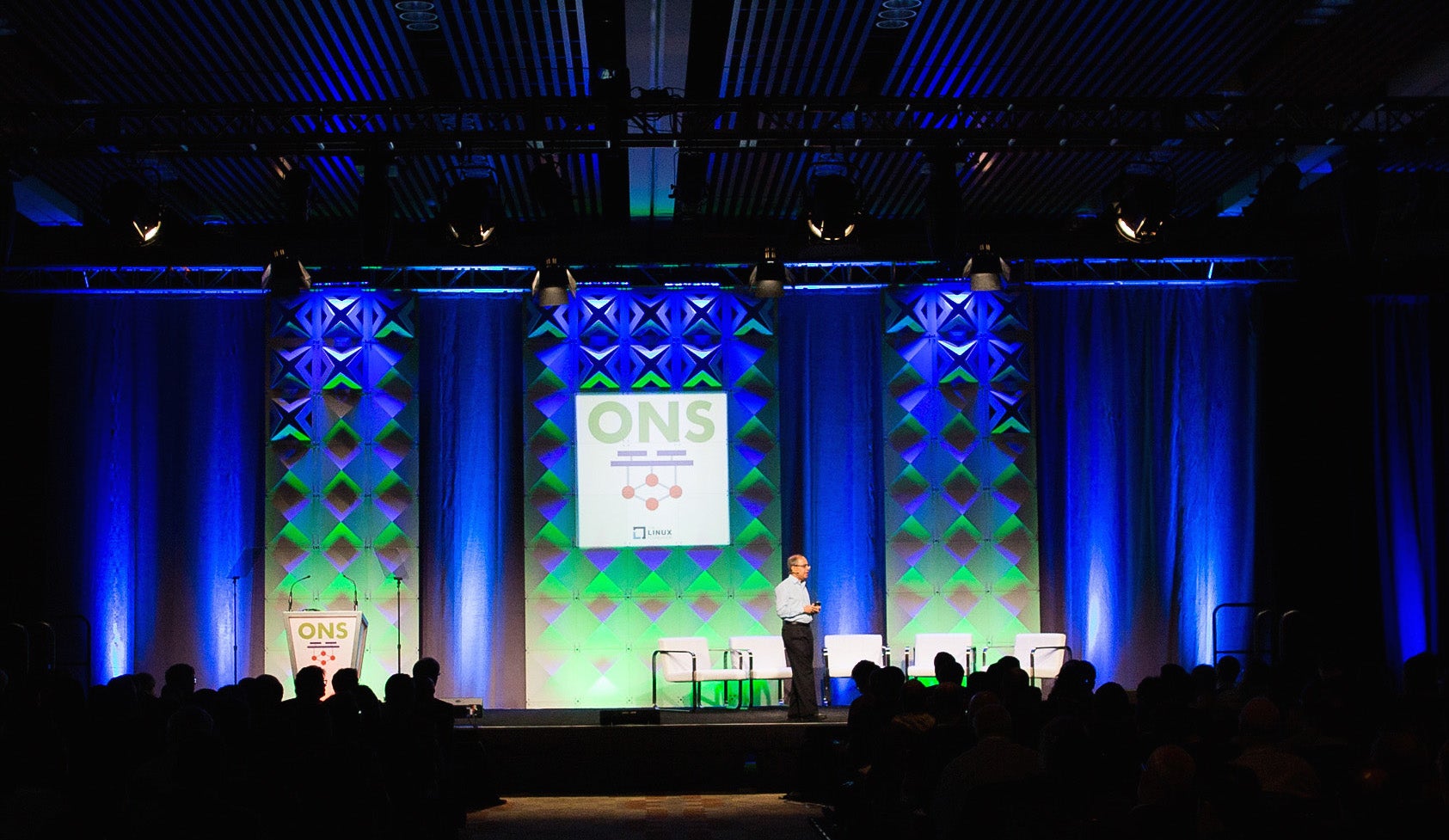
Open Networking Summit (ONS) 2017 is the place to find the answers to these questions, and more. Developing a formal strategy around the next wave of open networking will be an integral theme at next year’s event.
ONS2017 will be even better than ever before! We have taken your feedback and set the stage for the largest, most comprehensive and most innovative Networking and Orchestration event of 2017 in Silicon Valley on April 3-6, 2017 at the Santa Clara Convention Center. This is the only industry event where you can:
Hear from industry visionaries and leaders on the future of Networking beyond SDN/NFV
Attend deep technical tracks on topics that are here today, tomorrow and on the horizon
Learn from the use cases of your peers as consumption of Open Source Networking is the “new norm” and mandated by most Enterprise CIOs, Carrier CTOs and Cloud Executives.
Join the leading Enterprises, Carriers and Cloud Service providers in moving the Networking industry forward. Submit a proposal to speak in one of our five new tracks for 2017 and share your vision and expertise. The deadline for submissions is Jan. 21, 2017.
Register now with the discount code, LINUXRD5, for 5% off the attendee registration price. And don’t miss the chance to save over $850 with early-bird registration through Feb. 19.
Arpit Joshipura is GM, Networking & Orchestration at The Linux Foundation. Joshipura has served as CMO/VP in startups and larger enterprises such as Prevoty, Dell/Force10, Ericsson/Redback, ONI/CIENA and BNR/Nortel leading strategy, product management, marketing, engineering and technology standards functions.
The Linux Foundation is proud to support this year’s State of the Developer Nation Survey run by our friends at VisionMobile. This is the 12th developer survey, focusing on a 360 view of developer tools, skills, and salaries.
The survey features questions on topics like programming languages, platforms, app categories, new technologies, revenue models, IoT verticals — and of course — tools. It’s a survey made by developers, so the questions will be relevant, plus you will get to learn something new. It only takes 15 minutes!
Once you complete the survey, you’ll get to find out what kind of character you’d be in a fantasy world, based on your responses: A mage? A fighter? A dragon slayer? Take the survey and find out!
Participants can win prizes including a MeccaNoid G15 KS, an Apple Watch Series 2, an Oculus Rift headset, a Pixel Phone, Udemy courses, and more.
VisionMobile will show you how your responses compare to other developers’ in your country. You’ll also be the first to receive the State of the Developer Nation report (due out February 2017) based on key survey findings.
Key findings from last year’s survey include:
47 percent of professional developers now consider Android their primary platform.
Developers that primarily target Linux or Mac OS on the desktop are extremely unlikely to use C# on the server. Just 2 percent of Linux-first developers and 3 percent of those who prefer macOS are primarily using C# for their backend.
Smart Home is not just the biggest IoT vertical in terms of developer interest, with 48% targeting it, but also the fastest growing – up 6 percentage points in the last year.
New release of open-source Kubernetes container orchestration system adds initial support for Microsoft Windows Server and previews beta stateful application capabilities. The open-source Kubernetes container management system is moving forward with the release of Kubernetes 1.5 on December 15, bringing the platform to Microsoft Windows Server for the first time. The Kubernetes 1.5 milestone is the last major release of Kubernetes in 2016 and follows the 1.4 release that debuted on September 26.
The Kubernetes project is part of the Linux Foundation’s Cloud Native Computing Foundation (CNCF), and is supported by multiple vendors that are building and contributing code.
It’s time to patch your Linux servers and PCs again. The good news is developers are looking very closely at Linux’s core code for possible security holes. The bad news is they’re finding them.
At least the best news is that they’re fixing them as soon as they’re uncovered.
The latest three kernel vulnerabilities are designated CVE-2016-8655, CVE-2016-6480, and CVE-2016-6828. Of these, CVE-2016-8655 is the worst of the bunch. It enables local users, which can include remote users with virtual and cloud-based Linux instances, to crash the system or run arbitrary code as root.
Selecting DevOps tools to support cloud applications requires planning and expertise around the app architecture and the deployment model — one provider, hybrid or multicloud — supporting it.
Complexity created during application deployment translates into increased costs and disruptive errors in production operations. The primary goal of the modern DevOps model has always been to automate deployment and operations lifecycle management for applications, thereby shrinking complexity and its ill effects….
DevOps tools unite very different constituencies, a change which creates technical divergence and organizational tension. Many development personnel think DevOps hinders control of applications; many operations staffers think DevOps gives developers too much influence over live production IT.
One of the questions we often get when we talk about Sysdig Falco is “How does it compare to other tools like SELinux, AppArmor, Auditd, etc. that also have security policies?” To help answer some of those questions, we thought we’d present a summary of other related security products and how they compare to Sysdig Falco.
Specifically, we’ll look at the following tools:
Basic sandboxing: seccomp
Sandboxing with policies: seccomp-bpf
Mandatory access control systems: SELinux, AppArmor
Over the last week we have had the opportunity to work with an interesting set of data collected by Anchore (full disclosure: Anchore is a RedMonk client). Anchore collected this data by means of a user survey ran in conjunction with DevOps.com. While the number of respondents is relatively small, at 338, there are some interesting questions asked, and a number of data points which support wider trends we are seeing around container usage. With any data set of this nature, it is important to state that survey results strictly reflect the members of the DevOps.com community.
The data set covered a number areas including container usage and plans, orchestration tools, operating system choices, CI tools and security. For this post we will be focusing on the data around containers and CI.
One of the core tenets of DevOps is learning and sharing, said John Willis, co-author of the DevOps Handbook in an interview on Linux.com. “Individuals who are passionate about the health and performance of their organization find these patterns personally fulfilling,” he said.
Willis, who has been a leader in the DevOps movement from the beginning, will share his insights in an upcoming “Introduction to DevOps” webinar series hosted by The Linux Foundation. According to Willis, a primary advantage of DevOps is that it can help organizations go faster while being more reliable. And organizations that deploy faster and deliver services more quickly are better at resolving issues.
In this multi-webinar series which starts next week, Willis will help guide participants through the free Introduction to DevOps: Transforming and Improving Operations training course, which is available from edX.org. In each webinar, Willis — the course author — will provide a quick chapter summary, leaving plenty of time to answer your questions.
Join us Tuesday, December 13, 2016 at 10:00 a.m. Pacific for the first webinar session in which Willis provides a brief overview of the complete course, explaining the topics to be covered and describing the rationale for the course.