
Home Blog Page 721

Linux at 25: Changing the World with Code

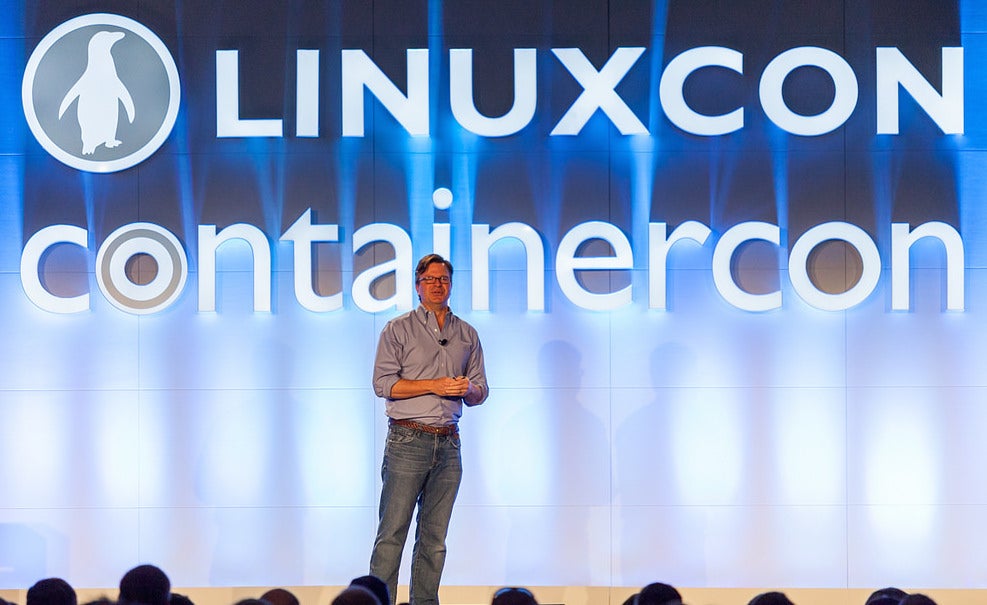
“You can better yourself while bettering others at the same time.” That was the theme of Jim Zemlin’s morning keynote address opening the LinuxCon North America conference in Toronto.

Zemlin, Executive Director of The Linux Foundation, began with a reminder that this week marks the 25th anniversary of Linux, and special events will be held throughout the conference to celebrate — including a black-tie gala on Wednesday night.

“Linux at 25 is a big thing, “ Zemlin said, noting that Linux today is the most successful software project in history.

Zemlin described the impressive progress of the world’s most dominant operating system, which runs the global economy and the vast majority of the Internet. Every day, 10,800 lines of code are added, 5,300 lines of code are removed, and 1,875 lines of code are modified. The Linux Kernel Development report, released today by The Linux Foundation, states, “the ability to sustain this rate of change for years is unprecedented in any previous public software project.”

According to Zemlin, however, the success of Linux boils down to the principles of open source and his statement that “You can better yourself while bettering others at the same time.” That is what really matters, and that is the magic of Linux and open source, he said.

That principle is also what needs to be sustained for the work ahead. For the first 25 years, open source companies mainly emulated the past, but now they’re defining the future. This work is about embracing open source to redesign the modern network and about making software more secure. And, Zemlin said, it’s about building the greatest shared technology asset in the history of computing.

Changing the Future While Changing Ourselves

Dr. Ainissa Ramirez, who spoke next, built on this theme of change in her talk titled “How Technology Shapes Us.”  Ramirez, a science evangelist and author, discussed the dynamic that exists between humans and their inventions and how technology changes human behavior. If you want to change the world, she said, do it with code.

Ramirez cited the telegraph as one example. The 10-word restriction of telegraph messages, similar to the modern restrictions of tweeting or texting, changed people’s writing style from long and descriptive to short and terse. Technology, she said, has the power to rewire our brains. But, of course, with power comes responsibility.

Ramirez suggested thinking about how this power can be used to solve bigger problems: to address climate change, for example, to reduce human suffering, to eradicate abuses, and generally to improve the human condition. “Think about the impact of your work,” she advised, and write aspirational technology that can make a better world. “It’s not easy but changing the world never is.”

Container Innovation

In the final morning talk, Dr. Ying Xiong, Chief Architect, Cloud Platform, Huawei Technologies, described how container technology can drive innovation. In the talk titled, “Unleashing the Full Power of Container with Orchestration & Management Platform,” he said companies are past the stage of “why use containers.” They’ve moved on now to when and how.

In China, he said, container adoption has reached 23 percent in development and testing and 14 percent in production. Fifty percent of companies using containers, however, manage them manually, while 42 percent use an orchestration platform. The functionality that an orchestration platform provides, such as scheduling, cluster management, monitoring, and scaling, is not new, he noted, but when these features are applied to containers, innovation occurs.

You won’t want to miss the stellar lineup of keynotes, 185+ sessions and plenty of extracurricular events for networking at LinuxCon + ContainerCon Europe in Berlin. Secure your spot before it’s too late! Register now.
The Top 10 Developers and Companies Contributing to the Linux Kernel in 2015-2016

The Linux kernel community came close this year to setting a new record for the number of changes merged in a single release, according to the latest Linux Kernel Development report released today by The Linux Foundation.

Kernel version 4.6 saw an astounding 13,517 patches merged in 63 days — just shy of the record set by version 3.15 at 13,722 patches on June 8, 2014.

But, changes to the kernel kept up their breakneck pace over the past 15 months, with more than 3 million lines of code added to the Linux kernel at a rate of 7.8 changes per hour.

“The ability to sustain this rate of change for years is unprecedented in any previous public software project,” according to the report.

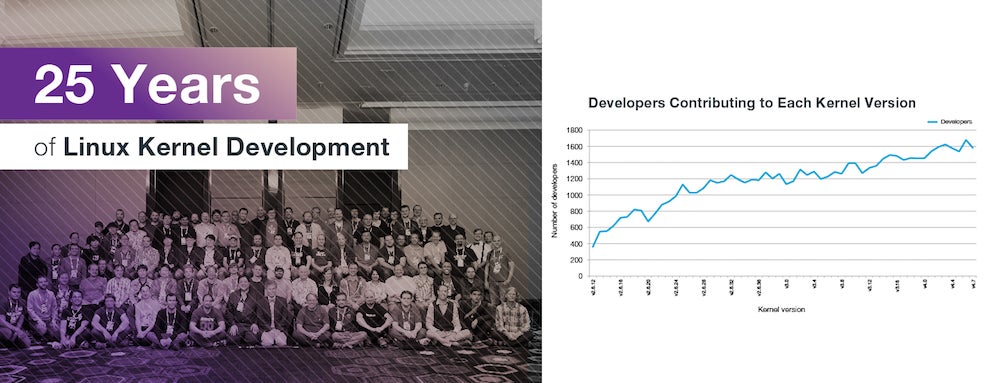
The seventh edition of this report details the developers contributing to the kernel, the companies they work for, and the most significant changes made to the code and the development process since kernel version 3.18. The data mostly covers development since the last report was released in March 2015 — versions 3.19 to 4.7 — but some statistics go back to 2005 when development moved to the Git repository, and even back to Linus Torvalds’ first release in 1991.  

Celebrating the 25th Anniversary of Linux

This year the report also reflects on 25 years of Linux kernel development as the Linux and open source community gathers at LinuxCon North America in Toronto Wednesday night for a gala celebration commemorating the day Linus Torvalds first released Linux on Aug. 25, 1991.

At almost 22 million lines of code and a new release happening every 9-10 weeks, the Linux kernel is one of the largest, fastest moving open source projects in the history of technology. It’s also one of the most important as the core of the Linux operating system, which runs most of modern technology — from Android phones and Chromebooks, to nuclear submarines, the space station, global stock exchanges, and much more.

What started as Torvalds’ passion project has evolved over the past 25 years into a collective effort to build and maintain the code by thousands of developers employed by hundreds of companies.

“Clearly, the kernel developers are doing something right,” reads the report. “This report provides an update on what those developers have been doing and why they continue to be successful.”

Here are some of the highlights from the report, compiled from Git and analyzed by LWN Editor Jon Corbet and Linux kernel maintainer and Linux Foundation Fellow Greg Kroah-Hartman. Download the full report for more in-depth data and analysis.

2015-2016 Linux Kernel Development Highlights

From the report:

  • Almost 115,000 changesets have been merged since the 3.18 release on Dec. 7, 2014.

  • Contributions came from 5,062 individual developers representing nearly 500 corporations.  

  • 2,355 of those developers were first-time contributors

  • New features include support for live patching of the kernel, support for persistent-memory devices, encrypted storage for the ext4 filesystem, numerous networking enhancements with a focus on IPv6 and data-center improvements, and much more.

  • The “zero-day build and boot robot” testing system found nearly 400 bugs (all of which were fixed).

  • The busiest development cycle was kernel 4.6 with 13,517 patches merged — just shy of the record set by version 3.15 at 13,722 patches.

The top 10 developers contributing changes to the kernel were:

Name                         Number of changes
H Hartley Sweeten            1,456
Geert Uytterhoeven           1,036
Arnd Bergmann                  877
Al Viro                        782
Takashi Iwai                   735
Lars-Peter Clausen             729
Mauro Carvalho Chehab          714
Ville Syrjälä                  707
Linus Walleij                  661
Dan Carpenter                  631

The top 10 companies, which employ kernel developers to contribute to the Linux kernel, make up nearly 57 percent of the total changes to the kernel. The category “none,” which represents volunteer developers who aren’t paid by any company, fell to the No. 3 spot this year from No. 1 in the last report issued in 2015. And Renesas moved up in the rankings from No. 13, replacing Texas Instruments at No. 10.  A large portion of development continues to be developers of unknown corporate affiliation, who typically contribute 10 or fewer changes.

Company                Changes    Percent of total
Intel                  14,384     12.9%
Red Hat                 8,987      8.0%
None                    8,571      7.7%
Unknown                 7,582      6.8%
Linaro                  4,515      4.0%
Samsung                 4,338      3.9%
SUSE                    3,619      3.2%
IBM                     2,995      2.7%
Consultants             2,938      2.6%
Renesas Electronics     2,239      2.0%


Download the full report: “Linux Kernel Development: How Fast It is Going, Who is Doing It, What They Are Doing and Who is Sponsoring the Work”

LinuxCon to Showcase Linux at 25 and How It’s Evolved

Linux users are set to assemble for the annual LinuxCon event, this time celebrating the 25th anniversary of the technology and how it’s changed.

The first time I met Jim Zemlin in person was 10 years ago, when he spoke in front of a small audience at the LinuxWorld Canada event in April 2006. At the time, Zemlin was the executive director of the Free Standards Group (FSG), a predecessor organization to the Linux Foundation, which Zemlin now runs. Zemlin is returning to Toronto from Aug. 22-25 for the LinuxCon North America 2016 event and the celebration of the 25th anniversary of Linux.

Somewhat coincidentally, the big 20th anniversary celebration gala for Linux was also held in Canada, with the LinuxCon 2010 event hosted in Victoria, B.C. Among the big keynotes at the 2010 event was one from Red Hat CEO Jim Whitehurst, and as luck would have it, Whitehurst is back for the 2016 event in Toronto and set to deliver another keynote.

Read more at eWeek

Linux at 25: An Ecosystem, Not Only an OS

InfoWorld celebrates the 25th birthday of Linux — and the new generation of open source projects Linux enabled. Today Linux has expanded far beyond its conquest of the server market. If you include Android, which is built around the Linux kernel, not to mention embedded Linux devices from TVs to network switches, you’re talking billions of instances.

Over the years, Linux has grown in another way: The sheer scale of its community development operation. Jim Zemlin, executive director of the Linux Foundation, recently offered me some awe-inspiring stats:

There are 53,000 source files in the Linux kernel, 21 million lines of code. There are 3,900 developers from all around the globe, 10,800 lines of code are added, 5300 lines of code are removed and 1,800 lines of code are modified every single day in the Linux kernel. It changes seven, eight times an hour on average, every day, 365 days a year. That is a prolific, tremendous scale that is just unparalleled in the history of software development.

That’s the kernel alone. Zemlin reminds us that the versioning and repository system Git, on which GitHub is based, was created by Torvalds to help manage this massive development effort.

Read more at InfoWorld

Containers and Immutable Deployments (The DevOps 2.0 Toolkit)

The third part in the DevOps Toolkit series looks at further ways to solve infrastructure problems beyond configuration management by turning to everyone’s favorite whale…

Even though CM alleviated some of the infrastructure problems, it did not make them go away. The problem is still there, only in a smaller measure. Even though it is now defined as code and automated, infrastructure hell continues to haunt us. Too many often conflicting dependencies quickly become a nightmare to manage. As a result, we tend to define standards. You can use only JDK7. The web server must be JBoss. These are the mandatory libraries. And so on, and so forth. The problem with such standards is that they are an innovation killer. They prevent us from trying new things (at least during working hours).

Read more at DZone

Monitoring Open Source Software Key for DevOps Shops

Monitoring open source software is crucial, as enterprise IT shops increasingly fold it into application development and use it to automate application deployment.  It was once rare to monitoropen source software, as enterprises would frequently place a blanket ban on software under General Public License (GPL). Nowadays, such a ban amounts to saying, “We’re not looking for ways to save money and be flexible,” said Jay Lyman, analyst at 451 Research.

Open source software has risen from also-ran to prominence as the DevOps movement grows. Manypopular tools used in DevOps pipelines — such as Chef, Puppet, Ansible, Salt, Jenkins, Travis, Docker, Kubernetes and Mesos, to name a few — are open source.

Read more at TechTarget

Context Aware MySQL Pools via HAProxy

At GitHub we use MySQL as our main datastore. While repository data lies in git, metadata is stored in MySQL. This includes Issues, Pull Requests, Comments etc. We also auth against MySQL via a custom git proxy (babeld). To be able to serve under the high load GitHub operates at, we use MySQL replication to scale out read load.

We have different clusters to provide with different types of services, but the single-writer-multiple-readers design applies to them all. Depending on growth of traffic, on application demand, on operational tasks or other constraints, we take replicas in or out of our pools. Depending on workloads some replicas may lag more than others.

Displaying up-to-date data is important. We have tooling that helps us ensure we keep replication lag at a minimum, and typically it doesn’t exceed 1 second. However sometimes lags do happen, and when they do, we want to put aside those lagging replicas, let them catch their breath, and avoid sending traffic their way until they are caught up.

Read more at GitHub Engineering

Emulation Triple0 QuickStart HA Controller’s Cluster failover

Procedure bellow identify Controller which has RouterDSA in active state and
shutdown/startup  this Controller ( controller-1 in particular case).
Then  log into conntroller-1 and restart pcs cluster on particular  Controller,
afterwards  runs `pacemaker resource cleanup` for several resources what
results bringing back cluster nodes in proper status

Complete text maybe seen here: – 

http://bderzhavets.blogspot.com/2016/08/emulation-rdo-triple0-quickstart-ha.html


Linus Torvalds Announces a Fairly Small Third Linux Kernel 4.8 Release Candidate

Yes, it’s Sunday, and yes, Linus Torvalds has just announced the availability of a new RC (Release Candidate) development milestone towards the upcoming Linux 4.8 kernel series. According to Linus Torvalds, the third Release Candidate build of Linux kernel 4.8 consists of approximately 60% updated drivers for things like USB, GPU, networking, and EDAC, core networking improvements, various improvements to the XFS file systems, minor arch updates, and other small documentation and scheduler fixes.

“After last weeks somewhat unusual patch statistics (only 1/6th drivers), we’re not back to the normal programming with rc3, and we have the usual situation with roughly ~60% of the patch being driver updates. It’s spread out, but most of it tends to be networking, GPU, USB and a new EDAC driver,” says Linus Torvalds in today’s announcement. “But all of it is fairly small.”

Read more at Softpedia

Take the Kubernetes API for a Spin

For anyone who is fascinated by distributed computing, Kubernetes provides an ultimate playground. Its one of best implementations of cluster management software of our times. Google must be appreciated for not only open sourcing Kubernetes, but also simplifying it, and making it accessible to the developers.

At the heart of Kubernetes is an application programming interface (API). In fact, everything and anything in the platform is treated as an API object. Tasks such as the creation and deletion of pods, services, and replica sets are all translated into appropriate REST API calls.

This article discovers the hidden gems of Kubernetes API along with a detailed walkthrough. To get more from this tutorial, you are advised to spin up a cluster for yourself.


Read more on The New Stack