Home Blog Page 731

KDE Kirigami UI Framework Makes First Debut

The previously talked about KDE Kirigami UI framework has now experienced its first public release. 


The Kirigami UI framework is designed for mobile and convergent applications written in Qt. Today’s announcement explains, “Kirigami is not just a set of components, it is also a philosophy that defines precise UI/UX patterns. It allows developers to quickly develop intuitive and consistent apps that provide a great user experience…The Kirigami Components for smartphones are optimized to allow easy navigation and interaction with just one hand, making it ideal for using applications casually “on the move.”

Read more at Phoronix 


A Brief Introduction to Linux Containers and Image Signing

Fundamentally, all major software, even open source, was designed before image-based containers. This means that putting software inside of containers is fundamentally a platform migration. This also means that some programs are easy to migrate into containers, while others are more difficult.

a container shipI started working with image-based containers nearly 3.5 years ago. In this time I have containerized a ton of applications. I have learned what’s real, and what is superstition. Today, I’d like to give a brief introduction to how Linux containers are designed and talk briefly about image signing.

Read more at OpenSource.com

SUSE Offers RHEL Support for Mirantis OpenStack, While Red Hat Demurs

Mirantis and SUSE are joining forces to offer seamless support for running the Mirantis OpenStack distribution not only on SUSE Linux Enterprise Server (SLES) but, surprisingly, Red Hat Enterprise Linux (RHEL) and CentOS as well.

Many of our larger customers run two or three different Linux flavors. Now OpenStack users can get support for their major Linux distributions in one place from Mirantis, said Mirantis co-founder and Chief Marketing Officer Boris Renski. The two companies announced the partnership at the OpenStack Silicon Valley 2016 conference, taking place this week in Mountain View, California.

Mirantis will offer full support for SLES on Mirantis OpenStack. Previously, Mirantis OpenStack has not been certified/supported to run on SUSE Linux Enterprise Server. This means a SUSE customer who selected Mirantis has needed to introduce another Linux, said Michael Miller,  SUSE president of strategy, alliances and marketing.

Customers can now run Mirantis OpenStack on SLES thats supported by both companies.  This means they maintain SUSE Linux Enterprise Server as their strategic platform for mission-critical workloads and OpenStack private cloud.

Read more at The New Stack

Zero to Continuous Delivery with Google Cloud Platform

I recently gave a talk at a local Docker meetup based in Manchester, UK. This blog accompanies that talk. Over the course of this article I hope to give the reader instructions for creating a continuous delivery pipeline that utilises Google Cloud Platform (GCP) and specifically Google Container Engine (GKE).

The tutorial will provide detail for creating your GKE cluster, utilisingKubernetes (k8s) and Docker to spin up a Jenkins container, using k8s to spin up Jenkins build agents, defining the build pipeline as code, creating aspring boot app as a docker container and finally deploying the application with k8s. Phew there is a lot to get through…so buckle in we’re in for the long haul. To help with adoption and helping people play with GCP, the tutorial also outlines GCP project creation and user creation. The only assumption I’ve made is that you’ve signed up to GCP and can access the GCP console.

Read more at James Heggs’ Blog

Advice for Building a Career in Open Source

Back in 1998 when I discovered Linux and open source, I never would have believed that I would make a career out of this. Back in those days I didn’t have a clue about what I wanted to do, but I knew I wanted it to involve technology in some way.

Since those dim distant days filled with teenage inexperience and … well, hair … I have learned so many things about what works and what doesn’t in building a career in open source. So here are some broader principles I have learned that may be handy for those of you starting out on your journey. Irrespective of whether you want to be a programmer, community leader, documentation writer, entrepreneur, or something else, I think these principles will help in setting you up for success and differentiating you from the pack.

Read more at OpenSource.com

The Next Generation of Open Source Blockchains

Never before has any open source project generated as much attention on the international stage as Bitcoin.

But Bitcoin, a cryptocurrency platform void of allegiance to any nation or financial institution, is just the first of an expanding and more sophisticated class of open source blockchains expected to revolutionize the exchange of all digital assets — money, real estate, music and intellectual property —  in future commerce.

The Bitcoin Foundation continues to develop its peer-to-peer payment network under an MIT license. The value of Bitcoins has fluctuated up and down, and while some naysayers have already pronounced its death, backers saw an upswing after Brexit.

However Bitcoin pays off, inherent in its survival is growing acceptance of blockchain platforms and their open source roots — and the notion that no financial company, merchant or government should control the technology platforms or the transactions.

“The only way a blockchain can work is to have open APIs and open source approach,” said Judith Hurwitz, owner of Hurwitz & Associates, pointing to investments by IBM and SAP in blockchains, also often referred to as Distributed Ledger Technology.

Loyyal Corp, of New York, is developing a rewards platform on multiple blockchain platforms.

“I personally see the blockchain industry as a free market of commoditized trust …commoditized for the first time ever in human history [and] a blockchain is the interface for the customization of that commoditized trust for each consumer’s needs,” said Loyyal CEO Greg Simon. “What matters is the users trust the code enough to use the platform and the transparency of open source reduces the cost of trusting the platform.”

The second generation of open source blockchain projects – Ethereum, Hyperledger Project,  MultiChain, Eris, and Ripple  — illustrate how platforms are evolving in different directions to support distributed transactions and contracts of all types.

“Bitcoin is an application of a distributed ledger like PowerPoint is to Windows. Hyperledger is a distributed ledger, like raw Windows, and a much broader range of contracts is possible,” said Sam Ramji, CEO of Cloud Foundry, who also points out that openness is core since the platform is designed for digital trust and settlement.  

“There is a need for a commons to support civil utilities like Linux, Apache, Hadoop and Cloud Foundry — we’re in a moment where every company depends on software as much as they depend on electricity or cash,” Ramji added. “A distributed ledger for everyone on the planet is just such a project.”

And the explosion of these open source projects — from Ethereum to Hyperledger to Ripple, illustrates the rapid pace of adoption and experimentation.

“We expect blockchain technology to well and truly break out of its FinTech niche in 2016,” wrote Duncan Johnston-Witt, CEO of Cloudsoft and a member of the Hyperledger Project.

Last month, for example, ATB Financial announced its collaboration with SAP and Ripple has already paid off with the launch of an international blockchain payment system from Canada to Germany.

What is a blockchain?

The blockchain consists of a series of interconnected storage blocks, distributed across servers throughout the globe, each with time-stamped batches of transactions that are highly secure.

“A blockchain is a distributed, decentralized database that is specialized in storing transactions [and] it is architectured to be secure even if one or more of the nodes running are compromised,” said Gilles Gravier, Director and Senior Advisor of Global Open Source Practice,  Wipro Limited. “Transactions processed and stored are immutable. They can’t be rolled back or modified after the fact. Blockchains can be shared publicly (permissionless) or shared among a limited, selected, group of entities (permissioned).”

There are many platform forks derived from Bitcoin, including, most notably, Ethereum, which delivered its first platform in July of 2015.    

Ethereum, dubbed Bitcoin 2.0 and founded by an original developer of Bitcoin, is a public blockchain offering smart contract features that contains a virtual machine executing peer-to-peer contracts using a cryptocurrency known as Ether. Formally established in Zug, Switzerland in June 2014, the Ethereum Foundation has support from Microsoft, Deloitte and Touche, IBM, and JPMorgan Chase.

Ethereum software-as-a-service is now certified to run on Microsoft’s Azure cloud platform, for instance.  

“Ethereum is a decentralized platform that runs smart contracts: applications that run exactly as programmed without any possibility of downtime, censorship, fraud, or third party interference,” according to the project web site, noting that the platform can be used to crowd fund to sell products or auction off items. “These applications run on a custom built blockchain, an enormously powerful shared global infrastructure that can move value around and represent the ownership of property .. all without a middleman or counterparty risk.”

Blockchain project differences

One core differentiation from one platform to another is whether they are permission-less, like Bitcoin and Ethereum, in which anyone can join or create blocks, or permissioned platforms such as Hyperledger, MultiChain, and Eris. MultiChain is backwards compatible with Bitcoin but is a private blockchain platform, said Gideon Greenspan, CEO and founder of Coin Sciences, developer of MultiChain, which is in alpha testing.

The Hyperledger Project, announced by The Linux Foundation last December and backed by IBM, Intel, Cisco, JPMorgan, Wells Fargo, the London Stock Exchange, Red Hat, and Swift, is at work on its 1.0 release of Fabric.  

The Fabric codebase, based on IBM’s Open Blockchain, was “built specifically to focus on permissioned chains – chains where the nodes are not anonymous to each other but are known and permitted by mutual consent,” explained Brian Behlendorf, executive director of the Hyperledger Project and founder of the Apache Software Foundation.

“This means there is no anonymous participation in the chain. However, it allows for a much simpler form of consensus … and it also means that you can set a much higher transaction volume than that defined by Bitcoin or Ethereum.”

Eris and HydraChain are forks of Ethereum yet have been retooled as permissioned blockchains. Unlike cryptocurrencies, permission blockchains are often demanded by enterprises and financial institutions that require consensus of participating parties.

Another distinction, notes Luxoft Technology Strategist Vasiliy Suvorov, is how transaction data is submitted and validated on a ledger.

Suvorov, whose company, like Ethereum, is based in Zug (known as Crypto-Valley), said token-based blockchains, such as Bitcoin, and Smart Contract-based blockchains such as Ethereum, Tendermint, and Eris, appeal to different classes of users but no doubt the second generation platforms are gaining more traction.

“As of late, many are considering switching to Ethereum. Scalability issues with Bitcoin and lack of support for more complex logic drive popularity of Ethereum and the price of Ether higher,” Suvorov claimed, noting that many enterprises are developing prototypes on Ethereum. “Hyperledger and Microsoft Bletchley [an architecture and set of tools proposed by Microsoft that will allow different DLT to run on its Azure cloud] will be a great alternative and will gain popularity when ready.”

Blockchain adoption on the rise

The R3 Project, for instance, connects more than 40 banks to distributed ledgers of Ethereum, Chain.com, Eris Industries, Intel, and IBM running on Microsoft Azure. In January, R3 CEV launched its distributed ledger experiment with Barclays, BMO Financial Group, Credit Suisse, Commonwealth Bank of Australia, HSBC, Natixis, Royal Bank of Scotland, TD Bank, UBS, UniCredit and Wells Fargo. As part of that, the banks were connected on an R3-managed private peer-to-peer distributed ledger, based on the Ethereum technology and hosted on a virtual private network in Microsoft Azure.

The Moscow Stock Exchange is moving forward on Hyperledger.  In a public statement last month, Sergei Poliakoff, CIO of Moscow Exchange, which recently became a member of Hyperledger, said “we believe in the future impact of distributed ledger technologies for the whole financial industry. Our team has been exploring possible applications of Blockchain in trading, clearing and settlement.”

Most of the industry’s players are very optimistic about the market prospects for public and private blockchains but it’s clear that it will take a little time to evolve, at least outside of the financial services industry.

The CEO of MultiChain maintains his private blockchain — and many other private blockchains under development — will appeal to many industry sectors outside of finance including insurance, healthcare, distribution, manufacturing and IT — in time.  

“It will take many years to become mainstream , or at least to reach its full market potential because right now the products are very new and not yet mature,” said Greenspan.

“It’s not too outlandish to think that in five years time, every Fortune 500 company and perhaps even the top 1000 will have deployed a blockchain somewhere,” said Hyperledger’s Behlendorf.

Open vSwitch (OVS) Becomes a Linux Foundation Collaborative Project

The Open vSwitch (OVS) open-source networking effort is officially joining the Linux Foundation’s Collaborative Project roster today. While OVS is new as a Linux Foundation project, it’s no stranger to Linux. OVS first became part of Linux in 2012 with the debut of the Linux 3.3 kernel release.

As to why OVS is now becoming a Linux Foundation project, it all has to do with community. To date, VMware has been the leading contributor of OVS, though other multiple vendors do contribute and the governance model is open.

“Moving to the Linux Foundation makes it really clear that OVS is a community project,” Ben Pfaff, VMware Principal Engineer and OVS Leader told Enterprise Networking Planet.

Additionally Pfaff noted that with the move OVS will now benefit from ancillary services provided by the Linux Foundation including conference event management.

Read more at eWeek

Build a $20 Computer with PINE64

I love my Raspberry Pi, which I use for many different projects. But when I saw Kickstarter campaign for 64-bit PINE64 I could not resist, so I pre-ordered one for myself.

I wanted to play with the board and see whether I could do some home automation kind of stuff or make my Traxxas X-maxx smart. There are three editions of PINE64: 512MB, 1GB, and 2GB RAM, and I ordered the 512MB version.

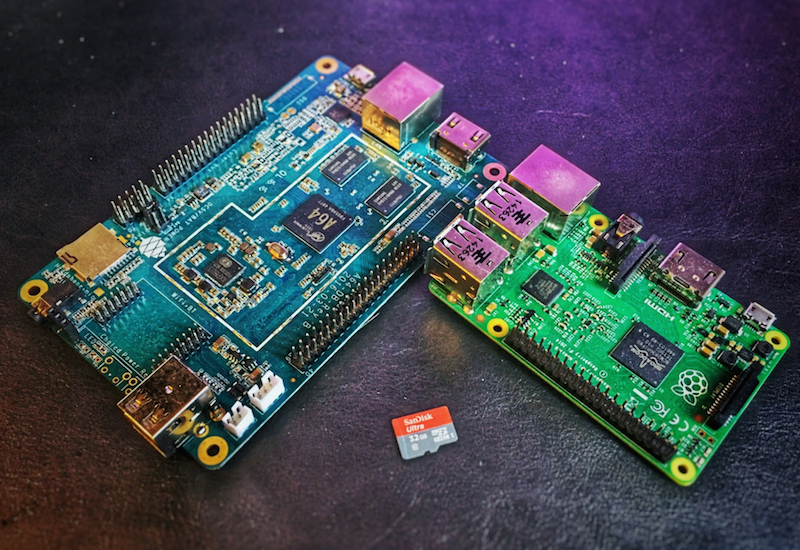
The PINE64 is almost twice as big as the Raspberry Pi 2 (Figure 1), so it’s not as compact as I expected. Still, it’s a good size for a whole range of projects.

Figure 1: Pine 64 (left) next to the Raspberry Pi.

It’s powered by a 1.2Ghz Quad-Core ARM Cortex A53 64-bit processor. This model has only 512MB of RAM but you can get up to 2GB of RAM. It has one microSD card slot that supports up to 256GB of storage.  

The PINE64 has 2 x 2.0 USB ports; 1 full HDMI port that is capable of 4K output, a Gigabit Ethernet port, and two I/O expansion slots (Figure 2).

Figure 2: Pine 64 ports.

I used the charger for my Nexus 5, which outputs 5 volts. You can use any charger with that output. Just keep in mind that you can’t power the device from your PC. I connected the device via HDMI and used a Logitech 400r keyboard that comes with built in trackpad (as the USB ports are limited on the device). It also came with a switch that I soldered to the board for power on and off.  I used an Edimax WiFi dongle for connectivity.

Softer side of the board

There are many Linux-based distributions available for Pine 64 including Debian, Ubuntu, Arch Linux, Android, and Remix OS. Only Arch Linux and Debian, however, are capable of running on the 512MB model. I am currently testing Fedora 24 on my Dell XPS 13 (Skylake), and that’s what I used to create the bootable microSD drive for the PINE64.

Initially, I tried Arch Linux ARM, but it lacked wireless drivers for Edimax out of box. Debian surprised me in that wireless worked out of the box, so I settled down with Debian instead of fiddling with Arch to get drivers for it.

How to install Debian on PINE64

Download the official image from the software download page and then unzip the downloaded file to extract .img image:

$ unzip /home/swapnil/Downloads/debian-mate-jessie-20160701-lenny.raposo-longsleep-pine64-8GB.zip

Then, write the image to a microSD card with the dd command:

$ sudo dd if=/home/swapnil/Documents/debian-mate-jessie-20160701-lenny.raposo-longsleep-pine64-8GB.img of=/dev/sdb bs=1M

Next, I plugged the microSD card into the slot on the PINE board, connected the HDMI cable, plugged the Logitech USB dongle and powered the device. That’s it. It was running Debian with Mate.

The first thing to do after booting the OS is to expand the root partition so that it can use all the space on the microSD card. Run the following script with sudo powers (on Debian, the password is “debian”):

$ sudo resize_rootfs.sh

After doing that, I connected to the Internet and ran system updates.

$ sudo apt-get update

$ sudo apt-get dist-upgrade

The first impression?

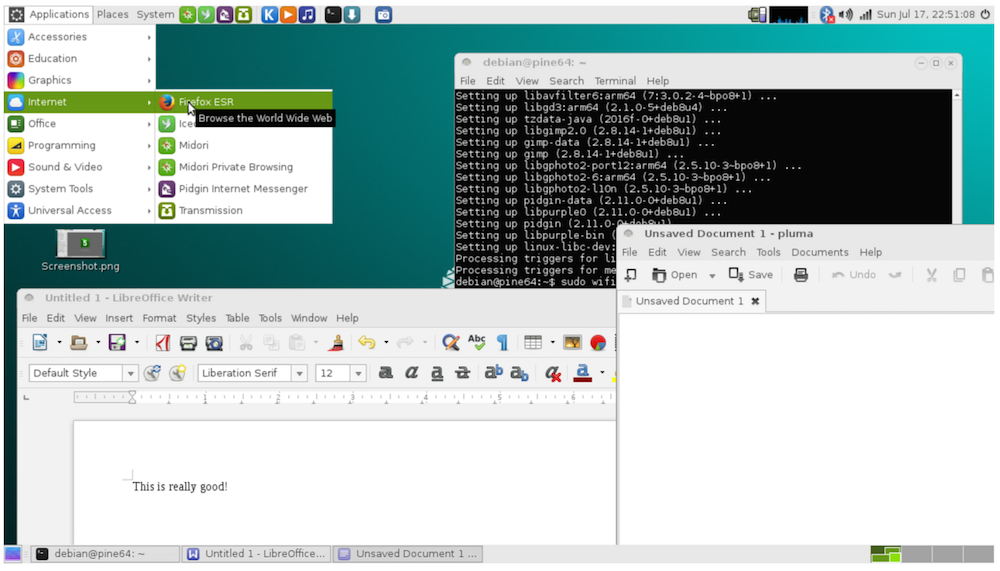
I must say I was genuinely impressed that for $20 I got a complete Linux desktop experience (Figure 3).

Figure 3: The desktop experience.

Once I got the hang of the device, I went ahead and installed applications like Chromium, Firefox, VLC … just for the sake of testing it. And everything that I threw at it worked. Yes, it’s slow, but don’t forget the $20 price tag.

So, it’s not as fast as my latest Skylake system with 32GB of RAM, but for $20, it’s awesome. Kudus to the Mate team who have created a great desktop experience while keeping it lightweight.

This setup may not be suitable for me as a desktop but there are many other  use-cases where it will work just fine. I will certainly be using it for my Traxxas remote-controlled car projects and for automation around the house.

I am so impressed with this board that I have already ordered the 2GB model which is capable of running Android. I am planning to use that unit with my basement TV so that it can be converted into full-fledged Android TV. I had been using ChromeCast on it, but I don’t like that it’s tied to my phone and if I have to go away, the programming goes away, too. A dedicated Android TV would be a better solution. I can’t really comment on the Android or Remix OS performance yet, but once I have that board in hand, I will be doing a detailed review of it.

So, if you want to get your hands on a 64-bit “computer” for DIY fun, PINE64 is the best board around.

The White House Releases Policy to Help Government Agencies Go Open Source

The White House (led by United States Chief Information Officer Tony Scott) has been pretty vocal about using technology to improve how government operates. They want to make sure code helps, not hurts, government agencies, and that the U.S. government can use technology just as effectively as a private company can.

In March the White House issued a blog post detailing their intentions to bring the benefits of open source software to the government, and today they released theFederal Source Code policy, a set of rules that should help government agencies be more efficient with the code they write.

Read more at TechCrunch


SDN Security Researchers State Their Case at Black Hat

Seungsoo Lee and Changhoon Yoon are hoping the industry is ready to start looking at the vulnerabilities that SDN introduces.  Presenting at Black Hat on Thursday, Yoon and Lee introduced SDNSecurity.org, an organization focusing on identifying SDN security issues and their possible solutions. The group has been at work for a little while, finishing eight projects with eight more in the hopper, and a relaunch of the website is due in September.

It’s a joint effort between Kaist and SRI International. Shin once did a summer internship at San Mateo, California-based SRI, where he met security expert Phil Porras, became involved in researching the Conficker worm, and got introduced to security issues in OpenFlow. (Some of that work can be found at OpenFlowSec.org.)

Read more at SDxCentral