The Korora distribution is a desktop oriented operating system built on Fedora. The Korora project has announced the availability of Korora 24 which is based on Fedora 24. The new version of Korora is available in four editions: Cinnamon, GNOME, MATE and Xfce.
“Changes in Korora 24: Images are 64-bit only, 32-bit users can still upgrade. Over the last few versions the demand for 32-bit ISOs has markedly decreased to the point where we feel it’s no-longer necessary to provide install images for the platform. Starting with Korora 24, images will be 64-bit (x86_64) only, however those who have 32-bit systems already are still able to upgrade to Korora 24″…
To start we’ll look at the ‘what’ of Serverless where I try to remain as neutral as I can about the benefits and drawbacks of the approach – we’ll look at those topics later.
Every day, modern society creates more than a billion gigabytes of new data. To store all this data, it is increasingly important that each single bit occupies as little space as possible. A team of scientists at the Kavli Institute of Nanoscience at Delft University managed to bring this reduction to the ultimate limit: they built a memory of 1 kilobyte (8,000 bits), where each bit is represented by the position of one single chlorine atom.
“In theory, this storage density would allow all books ever created by humans to be written on a single post stamp,” says lead-scientist Sander Otte.
Our recent work has focused on delivering a stable API and user interface, marked by version 1.0 of Prometheus. We’re thrilled to announce that we’ve reached this goal, and Prometheus 1.0 is available today. … We’re confident Prometheus 1.0 is a solid monitoring solution. Now that the Prometheus server has reached a stable API state, other modules will follow it to their own stable version 1.0 releases over time.
In today’s market, open source professionals with security expertise are crucial players on an employer roster. The growing use of cloud and big data, as well as the overhaul and expansion of many companies’ tech infrastructures, are driving the demand and need for professionals with this skillset.
According to the 2016 Open Source Jobs Report, 14 percent of hiring managers and recruiters surveyed believe security to be the most important open source skill to date, ranking third just behind cloud technologies (51 percent) and networking (21 percent). Employers aren’t the only ones that see the value in security; 16 percent of open source professionals surveyed cited security as the most important open source skill and the biggest driver for open source growth in 2016.
Open source professionals with security expertise are in demand.
Perhaps, this is the reason why professionals with a background in security are amongst the most difficult for employers to recruit. Recent Dice research shows that landing security talent is one of hiring managers and recruiters’ biggest challenges, finding them only slightly easier to attract than software developers and Java professionals. For companies looking to become more “open,” having team members who can provide infrastructure support as well as oversee and protect its large sets of proprietary data is critical. Thus, demand for professionals with security skills is continuously growing.
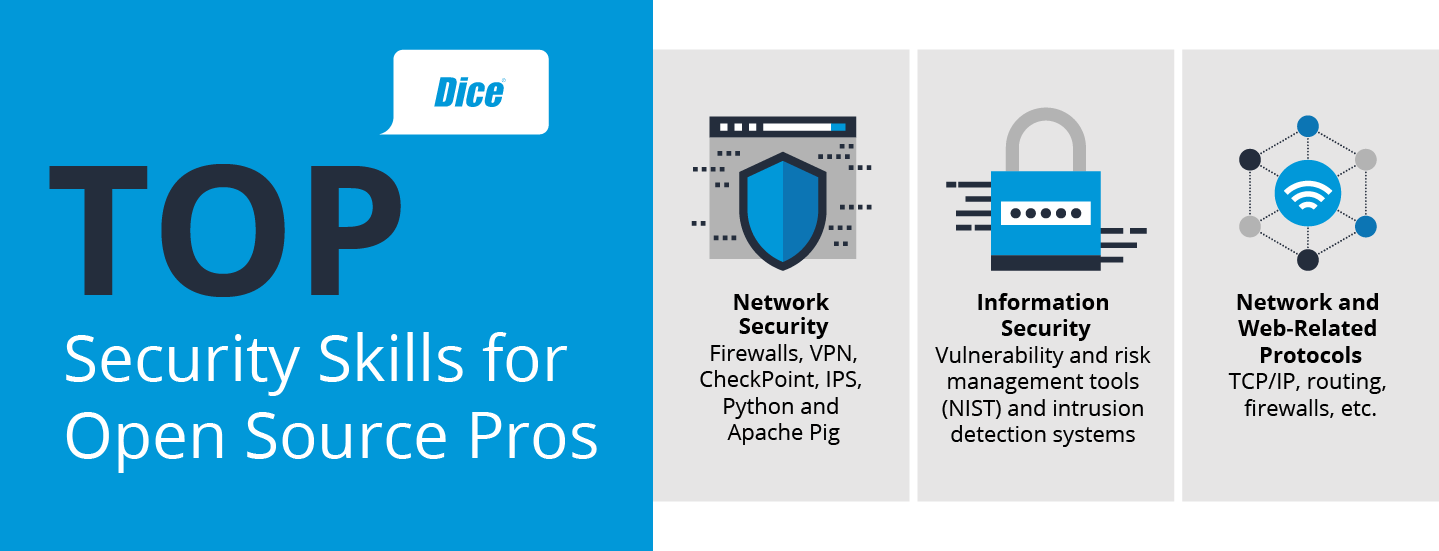
For open source professionals looking to familiarize themselves with security skills, below are just a few that you should pay particular attention to, as they were found to be amongst the most requested security skills on Dice.
Network security: As companies build out their tech infrastructures, they need team members who can monitor and manage their networks. Therefore, it should come as no surprise that job postings requesting network security related skills are up 5 percent year-over-year on Dice. Professionals with network security experience should be familiar with firewalls, VPN, CheckPoint and IPS. In addition, they should be well-versed in skills like Python for scripting purposes and Apache Pig for data analysis purposes.
Information Security: Although companies today are always looking to keep up with the latest trends and be innovative, they are anything but risk takers when it comes to their proprietary information. That is why companies need professionals with information security experience. Professionals who have a wide range of information security experience and have a strong working knowledge of vulnerability and risk management tools (NIST) and intrusion detection systems are crucial hires from an employer and recruiter’s perspective. That is why Dice has approximately 3,000 job postings related to information security on any given day, representing 3-4 percent of total postings on the site.
Network and Web-Related Protocols (e.g. TCP/IP, IPSEC, and routing protocols): As a security professional, you need to be familiar with network and web-related protocols in order to properly do your job. These protocols are the underpinnings of the Internet and are key for security professionals to know. Information security professionals to security engineers alike are asked by employers on Dice to be educated in these protocols.
Having professionals with security acumen are necessary for any employer. These professionals are of particular importance, though, to organizations that rely heavily on big data and cloud services. These companies need professionals who are able to store, manage and process large sets of data and ensure that it is not misused or mishandled. For this reason, the demand and need for professionals with security expertise continues to grow, with both employers and professionals alike recognizing its current and future value. Thus, as an open source professional, brushing up on security-related skills may be an advantageous career move.
There’s no shortage of futurists, industry analysts, entrepreneurs and IT columnists who in the past year have churned out reports, articles and books touting blockchain-based ledgers as the next technology that will run the world.
In the middle of all this hype is a small fire that threatens to put some of those words to ash: The hijacking last month of around US$40 million of dollars worth of a cryptocurrency called ether – named after its blockchain platform, Ethereum — from The DAO, a crowd-sourced investment vehicle that has so far raised over US$100 million in the digital currency. Instead, the DAO has become paralyzed and on the verge of collapse.
Briefly, on June 17 a hacker was able to create a second fund in the DAO, and, leveraging a vulnerability in the software-based smart contracts used to execute transactions, sent just over 3.64 million ether there.
At the Embedded Linux Conference, Grant Likely — who is a Linux kernel engineer, and maintainer of the Linux Device Tree subsystem used by many embedded systems — described his embedded hardware journey in a presentation called “Hardware Design for Linux Engineers” — or as he put it, “explaining stuff I only learned six months ago.”
Sometimes the best tutorials come not from experts, but from proficient newcomers who are up to date on the latest entry-level technologies and can remember what it’s like to be a newbie. It also helps if, like Grant Likely, the teacher is a major figure in embedded Linux who understands how hardware is ignited by software.
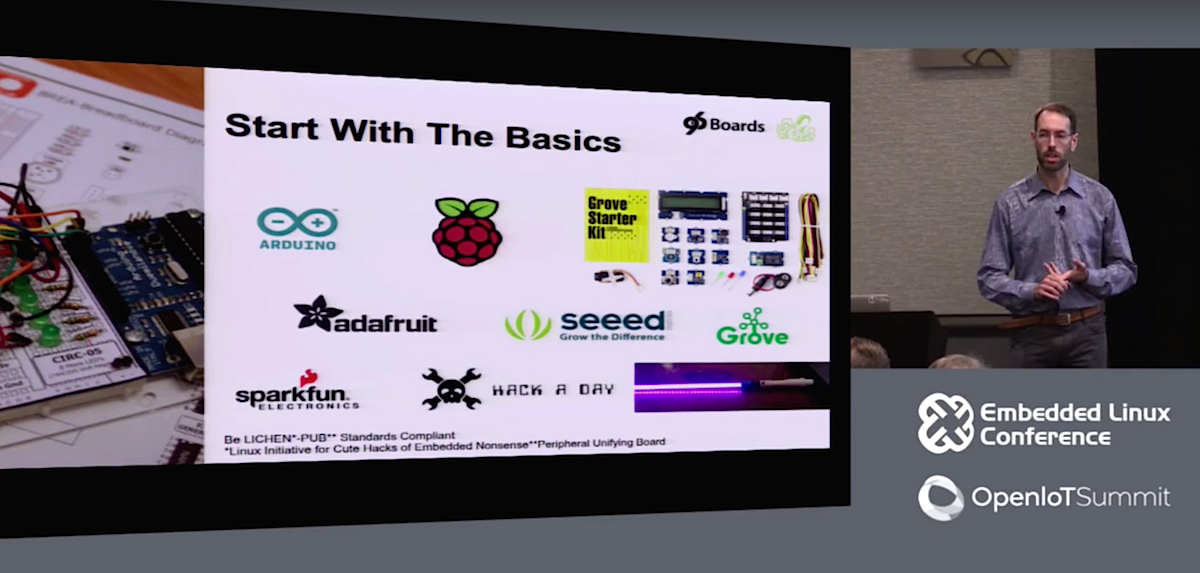
At the Embedded Linux Conference, Likely — who is a Linux kernel engineer, and maintainer of the Linux Device Tree subsystem used by many embedded systems — described his embedded hardware journey in a presentation called “Hardware Design for Linux Engineers” — or as he put it, “explaining stuff I only learned six months ago.”
Likely dove into the embedded deep end when Linaro launched an open source hacker community called 96Boards.org. The 96Boards spec is used by a growing number of 64-bit ARM boards such as the DragonBoard 410c, HiKey, Andromeda Box Edge, and Bubblegum-96.
Linaro, an ARM-backed tools company dedicated to improving Linux and Android code for ARM SoCs, launched 96Boards to provide a consistent test platform. “We built the hardware because it allows us to solve our software goals,” Likely told the ELC audience. “We want Linux on ARM to behave in a consistent way across platforms.”
When Likely saw that 96Boards users craved a USB-to-UART adapter board, and “being foolish and optimistic,” he decided to build one himself. He was inspired by the Alan Kay quote: “People who are really serious about software should make their own hardware.”
Although Likely has an electrical engineering degree, he long ago turned to software, so he was more or less starting out fresh. “It was really intimidating,” he related. “There was a whole bunch of terminology and technology that I found very opaque.”
It’s Never Been Easier
Likely quickly found, however, that a maturing open source hardware ecosystem would make his journey easier. “It’s never been easier to do this,” he said. “We have free software, we have prototype services, and we have manufacturers who will do small runs.” Also helpful are hacker-friendly distribution companies like SparkFun, Adafruit, and SeeedStudio, which “sell a lot of hardware hacker educational materials, ” as well as local hackerspaces, open hardware projects, and hacker how-to sites such as Hackaday said Likely.
Likely recommended starting with one of the many I/O kits with breadboards and solderless components, most of which expand upon Arduino boards. SeeedStudio’s various kits featuring its Grove I/O and sensor modules “make it easy to play with pre-made modules and wire them up without having to know how to build a circuit.”
Likely used one of these kits with his kids to build a lightsaber, but because the USB-to-UART board was heading for production, he needed to dispense with the training wheels. To prep for prototyping a board, he learned how to use tools such as soldering iron, a multimeter, helping hands, and an oscilloscope.
“It took me a long time to figure out how to solder,” said Likely, repeating a complaint voiced by Linus Torvalds at ELC 2016. Said Likely: “I am not responsible for burnt fingers or blown up boards. Proceed at your own risk.”
Because he wanted a run of 10 boards for testing, Likely used an affordable assembly service offered by his prototyping production house, SeeedStudio. “I could have soldered them myself, although I would have had some trouble with the service mounts,” he said.
Likely also began exploring open source embedded design software. “I needed proper design tools to capture a schematic of the circuits, convert that to a layout of where the components are going, and send that off to manufacturing.”
He settled on KiCad, a package for simple two-PCB layer boards that he had tried and abandoned a few years ago. The open source software has now “improved in stability and usability while gaining some high-end features,” said Likely. “KiCad does differential pair routing so the traces are exactly the same length, and it does push/pull of traces so when you draw your traces, it will push the other ones out of the way.”
He also recommended the open source fritzing tool. “What’s cool about fritzing is once your breadboard is sorted out. you can flip over to schematic mode, and all your components and wires are already there,” said Likely. “Once the schematic is done, you flip to the PCB tab and you can lay-out the physical board with the traces and components. You can even submit the design to have a prototype board mastered.”
Deciding on Components
One of the biggest challenges was deciding on components. “You go to DigiKey and you’re confronted with a huge catalog of components with a crazy array of footprints,” said Likely. He suggested the “0603” footprint for two-pin components like resistors and diodes. “It’s big enough to do rework, but small enough so that you’re not taking up much board space.”
Other gnarly issues include choosing the height of connectors and standoffs and whether to use surface or through-hole mounting. “Through-hole has been preferred for hobbyist hardware — it’s easy to solder and replace components, and many people are scared of surface mount,” said Likely. But because manufacturers prefer surface mount, he tried it, and it was “not that bad.”
Likely also described the challenges of level shifting, which he says can usually be avoided by extensive breadboard prototyping. “I didn’t appreciate how difficult IO voltage levels were when I first started,” said Likely. Working with I2C buses and determining “how strong the I2C signals should be pulled up” is very tricky. (For more on debugging I2C, see the video, as well as Likely’s blog post on the subject.)
For PCB printing for prototyping, Likely recommended DirtyPCBs and OSHPark, in addition to the Seeed Fusion PCB service he chose. “They source the components, and build and assemble the boards,” said Likely. “With Seeed, you can submit your entire order online, including Gerber files and BOM, and they’ll give you an online quote.”
When looking for a manufacturing partner, choose one that can review your design before starting and that offers a testing service, recommended Likely. “Once you’re into production, you will want to document everything,” he said. “I spent as much time figuring out the manufacturing details as I did doing the design itself.”
Prometheus 1.0 is part of the Cloud Native Computing Foundation’s effort to assemble a product portfolio for a container-based, open source cloud.
Prometheus, an open source system for monitoring and alerting a wide spectrum of enterprise IT events, including containers, released its 1.0 revision this week.
It’s also the second product in what amounts to a portfolio assembled by the CNCF (Cloud Native Computing Foundation) for realizing the promise of a container-powered cloud built entirely on open source and open standards.
AT&T this week unveiled a new powerful security platform, using big data analysis based on a Hadoop architecture which allows the company to ingest and analyze 5 billion security events in less than ten minutes.
Developed over the last three-and-a-half years as part of the Domain 2.0 push to SDN, the new threat intelligence platform collects data from every router, switch and server in AT&T’s network and uses machine learning to constantly analyze and correlate data to detect threats faster. (See AT&T Intros New Security Service Suite.)
All of this is underlying the AT&T Threat Intellect, the name the company has given the people, processes, products and tools that are part of its security operation.

 ,
,