In this tutorial, I will show you how to implement a virtual private network using OpenVPNvpn under the Linux operating system OpenSUSE Leap 42.1. VPN or Virtual Private Network is a secure private network over a public network like the internet. A VPN is a secure tunnel trough the internet which protects your data traffic and increases internet privacy and security. Access to the VPN is restricted by secure authentication methods.
Read the complete article: https://www.howtoforge.com/tutorial/how-to-install-and-configure-open-vpn-on-opensuse-leap-42.1/
File management is so important on a computer that users always want to have a simple and easy to use file manager or file browser. But sometimes having a feature rich and highly configurable…
[[ This is a content summary only. Visit my website for full links, other content, and more! ]]
Trying to maximize business efficiencies while staying within a budget is something that keeps CTOs and CIOs up at night. How to do senior IT leaders manage for change with a flexible infrastructure, especially one that is built on open-source?
Recently, IBM had the opportunity to interview Mike Woster the Chief Revenue Officer and Chief Operating Officer for the Linux Foundation about these exact challenges. As Linux adoption continues to steadily increase, Mr. Woster has helped build the Linux Foundation to a $65M organization and the home of Linux – and increasingly industry-changing open-source projects such as Cloud Foundry and Blockchain. Mr. Woster is at the forefront of the Linux and open-source movement. He frequently advises senior IT leaders on how best to leverage this burgeoning technology base.
According to Mr. Woster, “Linux is becoming a fundamental building block in any modern IT strategy and the basis for DevOps and Agile development”. But, how do senior IT leaders join this crowd sourced technology movement in such a tumultuous environment? They are facing the perfect storm of trends that are not only changing the model of how IT is delivered, but how the applications that run on that infrastructure are developed.
These trends are also emerging at a time when the senior IT leaders are under increasing pressure from the Line of Business (LOB) owner. That LOB owner is more tech savvy than ever due to the plethora of complex apps available via a smartphone and the widespread use of personal cloud services.
A slew of big-name customers suggests that the application platform is finally getting traction. Cloud Foundry Foundation CEO Sam Ramji explains why.
Practically no developers in their right mind want to write an application from scratch and run it on single server anymore. Instead, they want to tap existing services, keep the original coding to a minimum, and test/deploy the finished application in as automated a fashion as possible on scalable infrastructure.
Bitcoin is able to integrate and have endpoints (in Bitcoin terminology ‘wallets’ and ‘miners’) seamlessly talk to each other in a large and dynamic network. Devices and their protocols do not have the ability to seamlessly communicate with other devices. This presentation will try to show where Bitcoin and the underlying Blockchain and Consenus Technology can offer an innovative approach to integrating members of a large and dynamic network.
Stephen Salinas discusses some of the benefits of their Mesos-based dynamic load-balancer system: “We condensed I think it was about 225 was the highest limit of that down to less than 10 servers, saving us about 24 grand a month in server costs, which was a pretty cool thing. …”
In his MesosCon presentation, Kamalakannan Muralidharan discusses the flexibility and agility that is possible with Mesos: “Even though Mesos is good at handling a cluster, somebody has to provision and make it available for Mesos to use the cluster. …”
Twitter’s compute platform manages thousands of containers across thousands of hosts. But they had no way of knowing if containers were sized properly and using hardware efficiently, couldn’t tell who owned which containers and services, and couldn’t track resource use by container. Micheal Benedict and Jeyappragash Jeyakeerthi (JJ for short) built their Chargeback system on Mesos to answer these questions.
Dr. Abhishek Verma, first author of the Google Borg Paper, describes using the Apache Cassandra database and Apache Mesos to build a fluid, efficient cluster of geographically diverse datacenters.
Today, open source development is an integral part of the tech industry, as more and more companies are looking for greater collaboration, flexibility and efficiency within their organizations. With what’s trending in tech constantly changing, the open source model provides companies with the ability to accommodate new technologies and at a rapid speed.
Continuing to gain popularity and value, open source development has led to large-scale change and innovation across different areas of the tech industry. Networking, in particular, is one knowledge area that has evolved due to growing mainstream adoption of the open source model.
Hiring managers seek applicants with networking knowledge.
A leading emergent technology, open source networking separates hardware from software, allowing for rapid innovation, scalability, and cost cutting. With open source networking, businesses are more in control of their networks and have the ability to collaborate more freely, bring products and services to market more quickly and adjust to changing market trends.
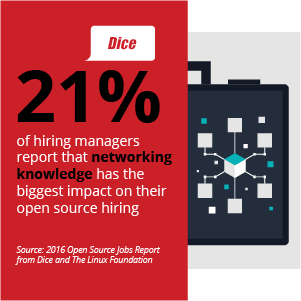
For open source professionals, especially those in the market for a new job, familiarizing yourself with networking skills is extremely valuable. According to the 2016 Open Source Jobs Report, open source networking is the second most in-demand knowledge area, trailing only slightly behind cloud technologies like OpenStack and Cloud Stack for the number one slot. Twenty-one percent of hiring managers surveyed cited networking as having the biggest impact on open source hiring.
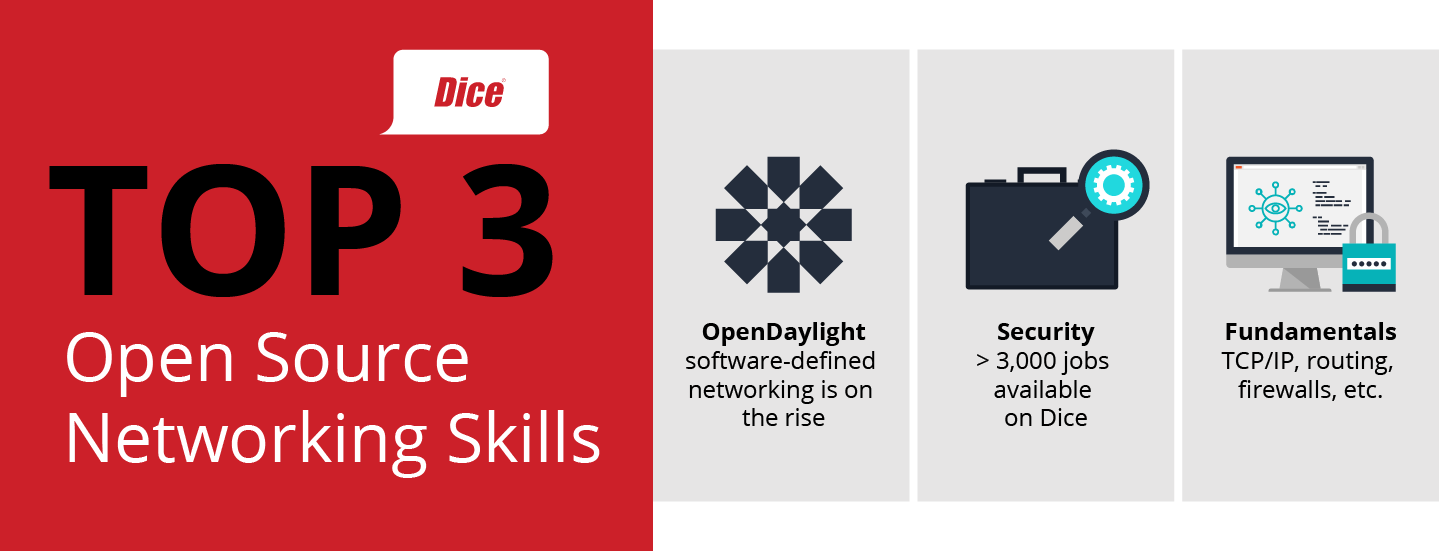
With that in mind, brushing up on some of the most popular networking skills is a good idea. Below are just a few networking skills that are trending in the open source community and are what employers are looking for on Dice:
OpenDaylight:With the rise of cloud computing and the expansion of data centers, software-defined solutions, like this Linux-based platform, are gaining greater traction in the tech industry. OpenDaylight works to help drive network success, reduce business costs and provide employees with greater flexibility.
Network Security: As companies build out their tech capabilities, one thing that they need to ensure is that their data is protected. For that reason, professionals with network security expertise are in high demand, with more than 3,000 job postings available on Dice on any given day, reflecting a 16 percent year-over-year increase.
Strong working knowledge of fundamental networking technologies:You can’t get anywhere without a basic understanding of core networking technologies like TCP/IP, routing and firewalls. These skills are the bread-and-butter of networking.
As the need for open source technologies continues to expand, more employers will look to networking solutions as a means to accommodate this growth. For this reason, open source networking will continue to weigh heavy on hiring managers’ minds when looking for new open source talent. As an open source professional, remaining up-to-date on the latest networking trends and adding new skills to your knowledge base are key in order to build and grow your career.