
Home Blog Page 781

IBM Launches Cloud-Based Development Environment for Apache Spark

IBM recently announced the Data Science Experience on its Bluemix cloud platform to help developers build intelligent applications and make data analytics more accessible to the enterprise.

Applying Bitcoin to the IoT Interoperability Conundrum
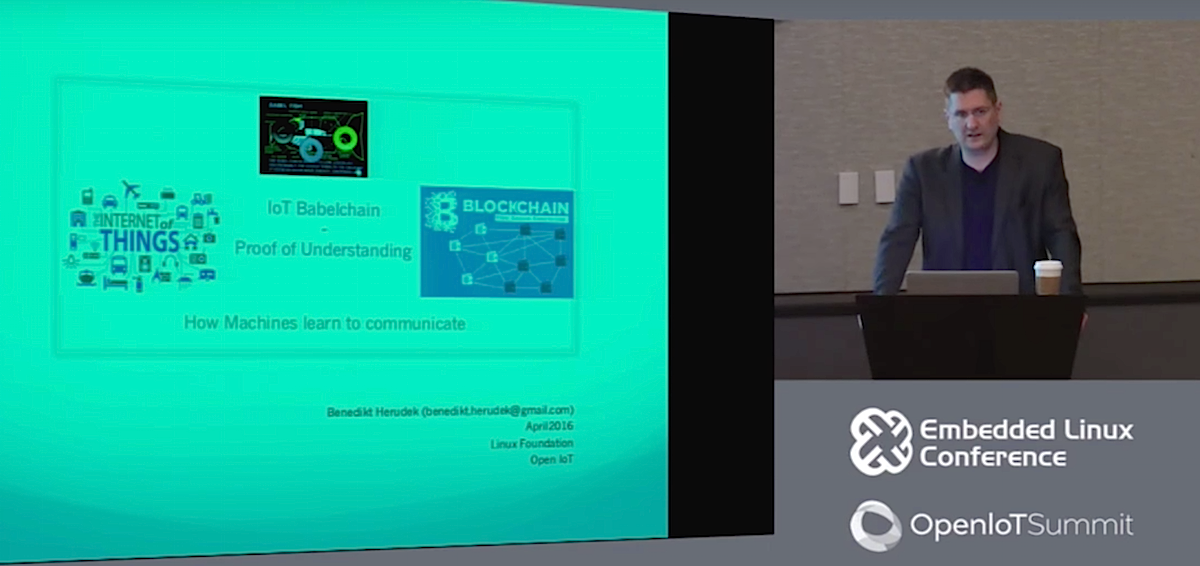
One of the main themes of this year’s Embedded Linux Conference and OpenIoT Summit was the challenge of bridging the growing number of Internet of Things (IoT) standards. Many speakers were hopeful about the potential for achieving functional interoperability, if not a unifying standard, and there were even calls for a possible merger between two of the largest open source efforts: AllSeen and IoTivity.

Others, however, like Dutch IT consultant Benedikt Herudek, were more skeptical. “Forget about standards,” Herudek told attendees to his presentation “IoT Consensus — A Solution Suggestion to the ‘Baskets of Remote’ Problem.”

“Sometimes it works, but in my experience getting everybody to use the same standard is usually wishful thinking,” he said.

Herudek is not content with an IoT world separated into silos, however. He has a potential solution based on a proven technology: Bitcoin. In Herudek’s view, the same qualities of universality and security that mark Bitcoin and its blockchain technology for financial transactions could be applied to the IoT messaging protocol problem. Specifically, Herudek outlines a version of the Bitcoin’s “proof of work” consensus mechanism that would translate messages between any application without requiring a trusted middleman or resorting to industry or vendor protocol standards.

The scheme is inspired in part from IBM’s ADEPT proof-of-concept draft, developed with Samsung, which similarly uses Bitcoin and blockchain for IoT. According to Herudek, his proposal is an improvement over ADEPT. Both solutions are based on the peer-to-peer Bitcoin cryptocurrency protocol for financial transactions, which offers the equivalents of IoT endpoints with its “wallets” and “miners.” The blockchain, meanwhile, acts as a public distributed ledger.

“Bitcoin and blockchain can create consensus between a lot of different parties on the state of transactions,” said Herudek. “Blockchain has some economic advantages over a centralized cloud, which maybe after the next big upgrade won’t support your device anymore. A distributed blockchain system, which is kind of self-organizing and not dependent on one vendor, could give you the advantage of having something long lasting. Bitcoin lets you achieve security in a distributed system without identity and access management. Typically, if people misbehave, the identity management system will kick you out, but Bitcoin doesn’t do that because it says: ‘I have such a convincing algorithm, nobody can cheat.’”

Instead of using Bitcoin’s “proof of work,” in which miners compete to be the first to place transactions into blocks, Herudek proposes using a “proof of useful work.” He uses an IoT example of a smartphone telling a smart fridge to open the door.

“This occurs at the very highest layer, not the transportation layer,” says Herudek. “You have to get an agreement on the message format and the semantics — which value can you put into which slot — and you need to achieve a certain action. So, instead we can take a model similar to Bitcoin in which you have a translator, something like a miner, which is responsible for delivering message formats. You would have a three-step process: a format handshake, content handshake, and an action handshake.”

Replacing Hashing with Smart Learning Algorithms

The challenges of using Bitcoin for IoT include using miner hashing sessions for very well-defined use cases, like transferring money between two parties. “I don’t think that is something you can transfer to the number of use cases in IoT,” said Herudek.

“Instead of using hashing, you could instead use something like a machine-learning algorithm to translate, and then give rewards for translating,” continued Herudek. “The algorithm would essentially use blockchain as a training set. You would not only record the transactions between entities, but also the whole history of how they tried to do the handshakes. You could give them features like which vendor is participating and which technology is used, or apply inputs like noticing if someone is standing in front of the fridge. You can facilitate this by adding a training set to the blockchain.”

From there, Herudek discussed issues such as immutability, security, and how to measure “effort.” Much of the proposal requires a solid understanding of both Bitcoin and the latest IoT message interchange methods. The idea is intriguing, however, as it might emerge as a ready-made alternative to a standards development process that could take many years to achieve on both the technological and political/business levels.

“In the world of IT, it can take years to integrate apps,” said Herudek. “Yet, if you open your Bitcoin wallet on your iPhone, you can communicate within minutes to any other wallet in the world.”

More information is available in Herudek’s Service Technology Magazine article on using Bitcoin and Blockchain for IoT messaging, as well as this slide set from his presentation.

Watch the complete presentation below:

https://www.youtube.com/watch?v=qbzUxuFOYJk?list=PLGeM09tlguZRbcUfg4rmRZ1TjpcQQFfyr

linux-com_ctas_may2016_v2_elc.png?itok=QQNwiljU

Mesa 12.0 Release Candidate 2 Hits The Web

Ahead of the official Mesa 12.0 debut later this month, Mesa release manager Emil Velikov of Collabora has announced 12.0 Release Candidate 2…

Read more at Phoronix

What is Operations?

Hi, I’m grouchy and I work with operations and data and backend stuff.  I spent 3.5 years helping Parse grow from a handful of apps to over a million.  Literally building serverless before it was cool TYVM.

So when I see kids saying “the future is serverless!” and “#NoOps!” I’m like okay, that’s cute.  I’ve lived the other side of this fairytale.  I’ve seen what happens when application developers think they don’t have to care about the skills associated with operations engineering.  When they forget that no matter how pretty the abstractions are, you’re still dealing with dusty old concepts like “persistent state” and “queries” and “unavailability” and so forth, or when they literally just think they can throw money at a service to make it go faster because that’s totally how services work.

I’m going to split this up into two posts.  I’ll write up a recap of my talk in a sec, but first let’s get some things straight.  Like words.  Like operations.

WHAT IS OPERATIONS?
Let’s talk about what “operations” actually means, in the year 2016, assuming a reasonably high-functioning engineering environment.

Read more at Charity.wtf blog.

How The Xen Project Streamlined Code Review By Analyzing Mailing List Data

The Xen Project’s code contributions have grown more than 10 percent each year. Although growth is extremely healthy to the project as a whole, it has its growing pains. For the Xen Project, it led to issues with its code review process: maintainers believed that their review workload increased and a number of vendors claimed that it took significantly longer for contributions to be upstreamed, compared to the past.

The project developed some basic scripts that correlated development list traffic with Git commits, which showed indeed that it took longer for patches to be committed. In order to identify possible root causes, the project initially ran a number of surveys to identify possible causes for the slow down. Unfortunately, many of the observations made by community members contradicted each other, and were thus not actionable. To solve this problem, the Xen Project worked with Bitergia, a company that focuses on analyzing community software development processes, to better understand and address the issues at hand.

We recently sat down with Lars Kurth, who is the chairperson for the Xen Project, to discuss the overall growth of the Xen Project community as well as how the community was able to improve its code review process through software development analytics.

Like many FOSS projects, the Xen project code review process uses a mailing list-based review process, and this could be a good blueprint for projects that are finding themselves in the same predicament.

Linux.com: Why has there been so much growth in the Xen Project Community?

Lars Kurth: The Xen Project hypervisor powers some of the biggest cloud computing companies in the world, including Alibaba’s Aliyun Cloud Services, Amazon Web Services, IBM Softlayer, Tencent, Rackspace and Oracle (to name a few).

It is also being increasingly used in new market segments such as the automotive industry, embedded and mobile as well as IoT. It is a platform of innovation that is consistently being updated to fit the new needs of computing with commits coming from developers across the world. We’ve experienced incredible community growth of 100 percent in the last five years. A lot of this growth has come from new geographic locations — most of the growth is from China and Ukraine.

Linux.com: How did the project notice that there might be an issue and how did people respond to this?

Lars Kurth: In mid 2014, maintainers started to notice that their review workload increased. At the same time, some contributors noticed that it took longer to get their changes upstreamed. We first developed some basic scripts to prove that the total elapsed time from first code review to commit had indeed increased. I then ran a number of surveys, to be able to form a working thesis on the root causes.

In terms of response, there were a lot of differing opinions on what exactly was causing the process to slow down. Some thought that we did not have enough maintainers, some thought we did not have enough committers, others felt that the maintainers were not coordinating reviews well enough, while others felt that newcomers wrote lower quality code or there could be cultural and language issues.

Community members made a lot of assumptions based on their own worst experiences, without facts to support them. There were so many contradictions among the group that we couldn’t identify a clear root cause for what we saw.

Linux.com: What were some of your initial ideas on how to improve this and why did you eventually choose to work with Bitergia for open analytics of the review process?

Lars Kurth: We first took a step back and looked at some things we could do that made sense without a ton of data. For example, I developed a training course for new contributors. I then did a road tour (primarily to Asia) to build personal relationships with new contributors and to deliver the new training.

In the year before, we started experimenting with design and architecture reviews for complex features. We decided to encourage these more without being overly prescriptive. We highlighted positive examples in the training material.

I also kicked off a number of surveys around our governance, to see whether maybe we have scalability issues. Unfortunately, we didn’t have any data to support this, and as expected different community members had different views. We did change our release cadence from 9-12 months to 6 months, to make it less painful for contributors if a feature missed a release.

It became increasingly clear that to make true progress, we would need reliable data. And to get that we needed to work with a software development analytics specialist. I had watched Bitergia for a while and made a proposal to the Xen Project Advisory Board to fund development of metrics collection tools for our code review process.  

Linux.com: How did you collect the data (including what tools you used) to get what you needed from the mailing list and Git repositories?

Lars Kurth: We used existing tools such as MLStats and CVSAnalY to collect mailing list and Git data. The challenge was to identify the different stages of a code review in the database that was generated by MLStats and to link it to the Git activity database generated by CVSAnalY. After that step we ended up with a combined code review database and ran statistical analysis over the combined database. Quite a bit of plumbing and filtering had to be developed from scratch for that to take place.

Linux.com: Were there any challenges that you experienced along the way?

Lars Kurth: First we had to develop a reasonably accurate model of the code review process. This was rather challenging, as e-mail is essentially unstructured. Also, I had to act as bridge between Bitergia, which implemented the tools and the community. This took a significant portion of time. However, without spending that time, it would have been quite likely that the project would fail.

To de-risk the project, we designed it in two phases: the first phase focused on statistical analysis that allowed us to test some theories; the second phase focused on improving accuracy of the tools and making the data accessible to community stakeholders.

Linux.com: What were your initial results from the analysis?

Lars Kurth: There were three key areas that we found were causing the slow down:

  • Huge growth in comment activity from 2013 to 2015

  • The time it took to merge patches (=time to merge) increased significantly from 2012 to the first half of 2014. However, from the second half of 2014  time to merge moved back to its long-term average. This was a strong indicator that the measures we took actually had an effect.

  • Complex patches were taking significantly longer to merge than small patches. As it turns out, a significant number of new features were actually rather complex. At the same time, the demands on the project to deliver better quality and security had also raised the bar for what could be accepted.  

Linux.com: How did the community respond to your data? How did you use it to help you make decisions about what was best to improve the process?

Lars Kurth: Most people were receptive to the data, but some were concerned that we were only able to match 60 percent of the code reviews to Git commits. For the statistical analysis, this was a big enough sample.

Further investigation showed that the main factor for this low match rate was caused by cross-posting of patches across FOSS communities. For example, some QEMU and Linux patches cross-posted for review on the Xen Project mailing lists, but the code did not end up in Xen. Once this was understood, a few key people in the community started to see the potential value of the new tools.

This is where stage two of the project came in. We defined a set of use cases and supporting data that broadly covered three areas:

  • Community use cases to encourage desired behavior: this would be metrics such as real review contributions (not justed  ACKed-by and Reviewed-by flags), comparing review activity against contributions.

  • Performance use cases that would allow us to spot issues early: these would allow us to filter time-related metrics by a number of different criteria such as complexity of a patch series

  • Backlog use cases to optimize process and focus: the intention here was to give contributors and maintainers tools to see what reviews are active, nearly complete, complete or stale.

Linux.com: How have you made improvements based on your findings and what have been the end results for you?

Lars Kurth: We had to iterate the use cases, the data supporting them and how the data is shown. I expect that that process will continue, as more community members use the tools. For example, we realized that the code review process dashboard that was developed as part of the project is also useful for vendors to estimate how long it will take to get something upstreamed based on past performance.

Overall, I am very excited about this project, and although the initial contract with Bitergia has ended, we have an Outreachy intern working with Bitergia and me on the tools over the summer.

Linux.com: How can this analysis support other projects with the similar code review processes?

Lars Kurth: I believe that projects like the Linux kernel and others that use e-mail based code review processes and Git should be able to use and build on our work. Hopefully, we will be able to create a basis for collaboration that helps different projects become more efficient and ultimately improve what we build.

Resources:

​Red Hat Open Sources How It Makes Decisions

Five core open source principles–open exchange, participation, meritocracy, community, and release early and often–are outlined in Red Hat’s framework.

Read more at ZDNet.

Support Builds for P4 to Boost NFV

In a world where network processors are viewed as a commodity, the assumption is that most innovation will be driven by software. But support is building for the P4 language to boost NFV, as chip specialists point to hardware improvements that will be key for more demanding applications in a virtualized environment.

To make it easier for organizations to take advantage of a broad range of custom processors that can be optimized for specific use cases, hardware vendors have been rallying behind the open source P4 programming language being developed by the P4 Language Consortium. The Consortium is developing the specifications for the P4 programming language as well as associated compilers.

P4 is a declarative language for expressing how packets are processed in network forwarding elements such as a switches, NICs, routers, or other network function appliances. It is based upon an abstract forwarding model consisting of a parser and a set of match+action table resources, divided between ingress and egress. P4 chips compatible with the language can be reprogrammed in the field, after they are installed in hardware, to help them assimilate the intelligence of software-defined networking (SDN). This could lead the P4 language to boost NFV performance.

Read more at SDxCentral.

SDN is Coming. Is Your Workforce Ready?

SDN is moving into the data center at a rapid clip, but while deploying a new technology is one thing, getting people to use it properly is quite another.

According to market analyst IHS Inc., SDN revenues grew more than 80 percent in 2015 compared to the year earlier, topping $1.4 billion. The bulk of that came in the form of new Ethernet switches and controllers, although newer use cases like SD-WAN are on the rise as well and will likely contribute substantially to the overall market by the end of the decade.

This means that, ready or not, the enterprise network is quickly becoming virtualized, severing the last link between data architectures and underlying hardware. This will do wonders for network flexibility and scalability, but it also produces a radically new environment for network managers, few of whom have gotten the appropriate levels of training, if anecdotal evidence is any indication.

Read more at Enterprise Networking Planet.

AT&T: Domain 2.0 has upset vendors’ business models, says Prabhu

AT&T’s creation of the Domain 2.0 program, which is driven by the implementation of software-defined networks (SDN) and network functions virtualization (NFV), is causing the telecom equipment industry to rethink how they deliver products and services.

The telco’s initiative has driven all of its vendor partners to be on their toes, meaning they have to be able to quickly innovate and respond to any emerging issue. If they don’t these vendors run the risk of being ousted by another new supplier.

Read more at Fierce Telecom.

3 Emerging Open Source Data Analytics Tools Beyond Apache Spark

On the data analytics front, profound change is in the air, and open source tools are leading many of the changes. Sure, you are probably familiar with some of the open source stars in this space, such as Hadoop and Apache Spark, but there is now a strong need for new tools that can holistically round out the data analytics ecosystem. Notably, many of these tools are customized to process streaming data.

The Internet of Things (IoT), which is giving rise to sensors and other devices that produce continuous streams of data, is just one of the big trends driving the need for new analytics tools. Streaming data analytics are needed for improved drug discovery, and NASA and the SETI Institute are even collaborating to analyze terabytes of complex, streaming deep space radio signals.

While Apache Spark grabs many of the headlines in the data analytics space, given billions of development dollars thrown at it by IBM and other companies, several unsung open source projects are also on the rise. Here are three emerging data analytics tools worth exploring:

Grappa

Big organizations and small ones are working on new ways to cull meaningful insights from streaming data, and many of them are working with data generated on clusters and, increasingly, on commodity hardware. That puts a premium on affordable data-centric approaches that can improve on the performance and functionality of tools such as MapReduce and even Spark. Enter the open source Grappa project, which scales data-intensive applications on commodity clusters and offers a new type of abstraction that can beat classic distributed shared memory (DSM) systems.

You can get the source code for Grappa and find more about it here. Grappa began when a group of engineers with experience running Big Data jobs on Cray systems wondered if they could challenge the analytics that Cray systems were capable of on off-the-shelf commodity hardware.

As the developers note: “Grappa provides abstraction at a level high enough to subsume many performance optimizations common to data-intensive platforms. However, its relatively low-level interface provides a convenient abstraction for building data-intensive frameworks on top of. Prototype implementations of (simplified) MapReduce, GraphLab, and a relational query engine have been built on Grappa that out-perform the original systems.”

Grappa is freely available on GitHub under a BSD license. If you are interested in seeing Grappa at work, you can follow easy quick-start directions in the application’s README file to build and run it on a cluster. To learn how to write your own Grappa applications, check out the tutorial.

Apache Drill

The Apache Drill project is making such a difference in the Big Data space that companies such as MapR have even wrapped it into their Hadoop distributions. It is a Top-Level project at Apache and is being leveraged along with Apache Spark in many streaming data scenarios.

For example, at the New York Apache Drill meeting back in January of this year, MapR system engineers showed how Apache Spark and Drill could be used in tandem in a use case involving packet capture and near-real-time query and search.

Drill is notable in streaming data applications because it is a distributed, schema-free SQL engine. DevOps and IT staff can use Drill to interactively explore data in Hadoop and other NoSQL databases, such as HBase and MongoDB. There is no need to explicitly define and maintain schemas, as Drill can automatically leverage the structure that’s embedded in the data. It is able to stream data in memory between operators, and minimizes the use of disks unless needed to complete a query.

Apache Kafka

The Apache Kafka project has emerged as a star for real-time data tracking capabilities. It provides unified, high-throughput, low-latency processing for real-time data. Confluent and other organizations have also produced custom tools for using Kafka with data streams.

Apache Kafka was originally developed by LinkedIn, and was subsequently open sourced in early 2011. It is a hardened, tested tool and many organizations require workers with Kafka knowledge. Cisco, Netflix, PayPal, Uber, and Spotify are among well-known companies using Kafka.

The engineers who created Kafka at LinkedIn also created Confluent, which focuses on Kafka. Confluent University offers training courses for Kafka developers, and for operators/administrators. Both onsite and public courses are available.

Are you interested in more unsung open source data analytics projects on the rise? If so, you can find more in my recent post on the topic.