Home Blog Page 794

Users Cite Management Challenges With Network Virtualization

Any IT professional looking at software-defined networking (SDN) implementation will need to have a long and in-depth discussion about network virtualization (NV) with management tool vendors. Enterprise Management Associates (EMA) research has found that the majority of early adopters have management challenges with NV and SDN, as their standing network management tools do not fully support a virtualized environment.

Many of the IT professionals surveyed are modifying the tools they have to work in a virtualized environment, while many others are acquiring new tools. Based on a survey of early SDN adopters (150 enterprise IT professionals and 76 communication service provider infrastructure professionals), EMA’s report “Managing Tomorrow’s Networks: The Impacts of SDN and Network Virtualization on Network Management” reveals the challenges and benefits of SDN adoption.

Challenges With Both Overlays and Underlays

In the data center, users see a more significant challenge for NV overlays (VMware NSXNuage Networks, etc.) than for NV underlays like  Cisco ACI or  OpenFlow-based solutions from the likes of Big Switch Networks or NEC. For instance, 37 percent of early enterprise adopters said their network planning and engineering tools fully support underlays.

Read more at SDx Central

Big IT Rising: An Overview of Lean, Agile and DevOps

The lunch of big corporate IT is being stolen by smaller, nimbler companies. Big IT, with its greater resources, should have crushed the competition. Rather it is playing catch-up. But things are changing. There is a quiet revolution in corporate IT. Big organisations are learning from small companies and are beginning to use it at scale. Goliath is back but acting like David.

All this change leaves the corporate manager at a loss as to what tools to use. Big IT, especially banks, is stuck in a world of waterfall development where plans are rather rigid, risk management is paramount and new functionality to the customer is few and far between. The aim of this article is to provide a toolbox of different methodologies that can be used to transform Big IT. For the sake of simplicity, let’s refer to our toolbox of methodologies as the “New Ways of Working”.

Our starting point is an exploration of the different elements of the New Ways of Working (Figure 1). This was adapted from Gartner’s framework for DevOps.

Read more at Josef Langerman Blog

OpenSUSE Administration with Zypper

This tutorial shows the steps to install and update OpenSUSE packages with Zypper. Zypper is the command line package manager for openSUSE, introduced in openSUSE 10.2 which uses the libzypp library. Zypper provides a command line interface to manage repositories, the software installation, packages, patches, verifying dependencies etc.

Tibbo LTPS Native C Development How To

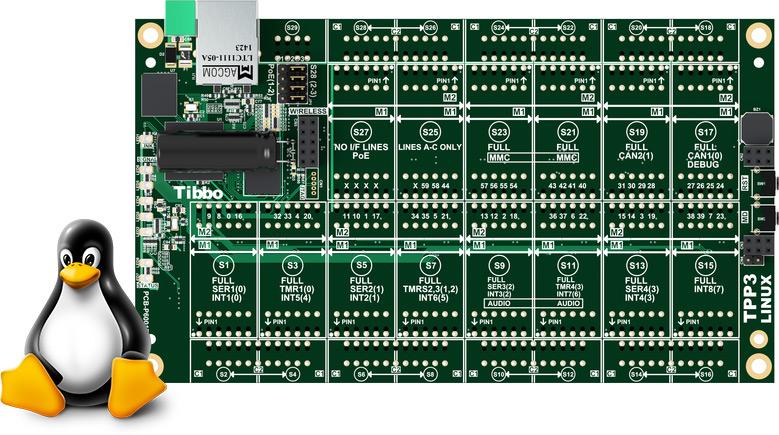
Tibbo Technology Inc. has recently announced a Linux version of its popular Tibbo Project System (TPS).

LTPP is a Linux-based Tibbo Project PCB (TPS mainboard) based on the powerful 1GHz Cortex-A8 Sitara CPU from Texas Instruments. Carrying 512MB of RAM and 512MB of flash memory, the new LTPP3 board runs Tibbo’s own, highly polished distribution of Linux that is updated with the latest and greatest kernel and drivers.

LTPP may be programmed and managed in several different ways: the Tibbo-supplied Embedded AggreGate (purchased separately), NodeJS (comes pre-installed), TiOS (not yet fully ported). Tibbo also says that LTPP may be used and programmed as any other generic Linux board. For developers who have at least some Linux coding experience, the company supplies the LTPS SDK.

Is it hard to develop native C applications for LTPS? We don’t think so! If you have ever written a Linux program, it will be easy for you to figure out how to do this for the LTPP board.

Doubtful? OK, let’s see how to write a simple C application for the LTPP. Here is the list of steps: get the cross-compiler, install the SDK, build a program, and load it into the board.

Please note that root (supervisor) credentials are NOT required for installing the SDK and building programs.

We will assume that you are using a Linux PC or that you have previously created a Linux virtual machine on your computer. If you don’t have a Linux PC yet, please install any popular Linux distribution under Oracle VM VirtualBox, QUEMU or Vmware.

1. Getting the Cross-compiler for LTPS from Tibbo Website

*Note: the download location may change in the future. Please, search our website (tibbo.com) for updates.

Open the terminal emulator on your Linux host, make sure you are connected to the Internet, and download the LTPS SDK from http://tibbo.com/downloads/TPSL_tmp/SDK/


[dv@dvh hello_world]$ wget http://tibbo.com/downloads/TPSL_tmp/SDK/tps-systemd-glibc-i686-TPS-agent-cortexa8hf-neon-toolchain-1.8+snapshot.sh
--2016-05-16 22:02:01--  http://tibbo.com/downloads/TPSL_tmp/SDK/tps-systemd-glibc-i686-TPS-agent-cortexa8hf-neon-toolchain-1.8+snapshot.sh
Resolving tibbo.com (tibbo.com)... 93.174.104.89
Connecting to tibbo.com (tibbo.com)|93.174.104.89|:80... connected.
HTTP request sent, awaiting response... 200 OK
Length: 443644550 (423M) [text/plain]
Saving to: 'tps-systemd-glibc-i686-TPS-agent-cortexa8hf-neon-toolchain-1.8+snapshot.sh'

100%[======================================>] 443,644,550 4.61MB/s   in 99s    

2016-05-16 22:03:40 (4.28 MB/s) - 'tps-systemd-glibc-i686-TPS-agent-cortexa8hf-neon-toolchain-1.8+snapshot.sh' saved [443644550/443644550]

[dv@dvh hello_world]$ ls -l
total 433256
drwxrwxr-x 2 dv dv      4096 May 16 22:00 html/
-rw-r--r-- 1 dv dv 443644550 Apr  4 14:07 tps-systemd-glibc-i686-TPS-agent-cortexa8hf-neon-toolchain-1.8+snapshot.sh


2. LTPS SDK Installation

Full SDK image weighs around 0.5 Gb. It is not just a binary file; it is an installation script with an archive inside. Make it executable and run it to install the SDK.

[dv@dvh hello_world]$ chmod 0755 ./tps-systemd-glibc-i686-TPS-agent-cortexa8hf-neon-toolchain-1.8+snapshot.sh 
[dv@dvh hello_world]$ ./tps-systemd-glibc-i686-TPS-agent-cortexa8hf-neon-toolchain-1.8+snapshot.sh 
TPS (Tibbo Project System) SDK installer version 1.8+snapshot
=============================================================
Enter target directory for SDK (default: /opt/tps-systemd/1.8+snapshot): ~/tpsC/
You are about to install the SDK to "/home/dv/tpsC". Proceed[Y/n]? Y
Extracting SDK................................................................................done
Setting it up...done
SDK has been successfully set up and is ready to be used.
Each time you wish to use the SDK in a new shell session, you need to source the environment setup script e.g.
 $ . /home/dv/tpsC/environment-setup-cortexa8hf-neon-tps-linux-gnueabi


3. Setting up the Environment

Run the environment setup script as advised by the installer.

[dv@dvh hello_world]$ . /home/dv/tpsC/environment-setup-cortexa8hf-neon-tps-linux-gnueabi


4. Testing the Installation

In the same terminal emulator window, try to run the GCC compiler.

dv@dvh hello_world]$ gcc --version
gcc (GCC) 4.8.2
Copyright (C) 2013 Free Software Foundation, Inc.
This is free software; see the source for copying conditions.  There is NO
warranty; not even for MERCHANTABILITY or FITNESS FOR A PARTICULAR PURPOSE.

Oops, this looks like the default compiler, not the compiler we want. This compiler is the GCC from your Linux distribution, and it can only build for the x86 CPU.
Our cross-compiler is in the environment variables $CC, $CXX, $CPP.

[dv@dvh hello_world]$ echo $CC 
arm-tps-linux-gnueabi-gcc -march=armv7-a -mfpu=neon -mfloat-abi=hard -mcpu=cortex-a8 --sysroot=/home/dv/tpsC/sysroots/cortexa8hf-neon-tps-linux-gnueabi
[dv@dvh hello_world]$ $CC --version
arm-tps-linux-gnueabi-gcc (GCC) 5.3.0
Copyright (C) 2015 Free Software Foundation, Inc.
This is free software; see the source for copying conditions.  There is NO
warranty; not even for MERCHANTABILITY or FITNESS FOR A PARTICULAR PURPOSE.

That is what we needed! Ok, let’s write our first LTPS “Hello World!” program and build it.


5. Write a Simple Program

[dv@dvh hello_world]$ mkdir test_0
[dv@dvh hello_world]$ cd test_0/

Create the “Hello World” program using any editor you like. We prefer MC (Midnight Commander) editor, but here I will use VI, just as an example.

[dv@dvh test_0]$ touch ./test_0.c

test_0.c contents:

#include 

int main( int argc, char *argv[]) {
 printf( "Hello world from LTPS!n");
 return( 0);  }

Now create Makefile for our program. This is an old, traditional way of building anything in UNIX.

[dv@dvh test_0]$ touch ./Makefile
[dv@dvh test_0]$ vi ./Makefile

Makefile contents:

all:
        $(CC) -o test_0 test_0.c

clean:
        rm -f test_0
        rm -f *.o

* Lead whitespaces are not the whitespaces, they are 2 (two) tabs.
Here is the Makefile syntax.


6. Building your Program with Cross-compiler

Run ‘make’ command in the same terminal emulator window where you previously ran LTPS SDK environment setup script.

[dv@dvh test_0]$ make
arm-tps-linux-gnueabi-gcc  -march=armv7-a -mfpu=neon  -mfloat-abi=hard -mcpu=cortex-a8 --sysroot=/home/dv/tpsC/sysroots/cortexa8hf-neon-tps-linux-gnueabi -o test_0 test_0.c
[dv@dvh test_0]$ ls -l
total 20
-rw-r--r-- 1 dv dv   64 May 16 22:28 Makefile
-rwxr-xr-x 1 dv dv 9144 May 16 22:28 test_0*
-rw-r--r-- 1 dv dv  110 May 16 22:27 test_0.c
[dv@dvh test_0]$ ./test_0 
bash: ./test_0: cannot execute binary file

Program build starts from “test_0.c” to “test_0”. It is an executable binary. I tried to run it but it failed with the “cannot execute binary file” message. Why? Because it was built for a non-Intel CPU. 

[dv@dvh test_0]$ objdump -f ./test_0

./test_0:     file format elf32-little
architecture: UNKNOWN!, flags 0x00000112:
EXEC_P, HAS_SYMS, D_PAGED
start address 0x000102f4

[dv@dvh test_0]$ $OBJDUMP -f ./test_0

./test_0:     file format elf32-littlearm
architecture: arm, flags 0x00000112:
EXEC_P, HAS_SYMS, D_PAGED
start address 0x000102f4

Yes, you understand this correctly: we have TWO ‘objdump’ executables: our traditional x86 ‘objdump’ program that can be found in the default $PATH and ‘cross-objdump’ from LTPS SDK that can be found in the $OBJDUMP environment variable.

First (intel) objdump says it can’t detect the architecture.
The second one (cross-objdump) says it
is an ARM 32bit little-endian executable.
Everything looks correct. Let’s copy the program into LTPS and try to run it…

[dv@dvh test_0]$ scp ./test_0 root@192.168.75.217:~/
root@192.168.75.217's password: 
test_0                                        100% 9144     8.9KB/s   00:00    
[dv@dvh test_0]$ ssh root@192.168.75.217
root@192.168.75.217's password: 
X11 forwarding request failed on channel 0
root@tpp:~# ./test_0 
Hello world from LTPS!
root@tpp:~# uname -a
Linux tpp 4.4.3-tpp #1 Sat May 14 14:28:50 MSK 2016 armv7l GNU/Linux
root@tpp:~# 

Success!

AT&T on Track to Virtualize 30 Percent of its Network Functions by End of 2016

AT&T continues to move down the virtualization path by transforming more of its hardware-based network functions into software by leveraging a mix of SDN and NFV.

AT&T is on track to virtualize 200 functions in its network, which allows the telco to create a new set of services like its Network On Demand Ethernet service and NetBond, for example.

By using SDN, AT&T will be able provide a better customer experience, while also helping to drive costs out of the business.

Read more at Fierce Telecom.

AllJoyn Momentum Accelerates Under the AllSeen Alliance

The future is bright and, if the industry is right, it’s going to be really, really connected. Gartner predicts that by 2020, 30 billion things will be connected and that every product selling for $100 or more will be smart. The IoT industry continues to grow and rapidly evolve, and as varying protocols and differing standards arise, we’ve observed a corresponding rise in confusion. That’s understandable; with so many groups trying to do similar things, it’s understandable why the text on the various groups’ website can be largely indistinguishable.

Not surprisingly, many of the IoT groups share a similar mission – enabling a world where billions and billions of things interact together, securely, easily, and safely. It’s the approach they take to get there that is the fundamental difference to understand between the various organizations and their work.

Traditional standards organizations work (often in private) to create their view of how something should work – that is they create a standard specification against which a particular real-world implementation may be compared. Historically this has often led to a nightmare of competing implementations, each satisfying the specification but via each implementers interpretation yielding a morass of non-interoperable products and services. To attempt to address this, some standards organizations go a step further and offer a reference implementation that shows how you might take the standard to implementation, but even then the reference implementation is often incomplete. Those dependent on that code find their products left out in the cold while the drivers of the specification ponder theories and prioritize their own requirements. It’s the rare standards organization that goes the final mile to provide open, free, and production-ready code that companies can build products with.

There is a place and time for standards, but in an emerging space where everything is evolving rapidly and simultaneously, it’s unreasonable to say, “this is the one and only way to the IoT.” IoT is an ecosystem being built from the contributions of the many, evolving over time, and shifting as the market matures. There are billions of connected devices that exist today and billions more to come and any IoT platform must embrace looking backward and forward rather than asking history, and the industry, to come to them.

The AllSeen Alliance and its AllJoyn project exist to allow anyone seeking to build connected devices and services the opportunity to access, use, and modify to suit their needs a shared protocol that is fully unencumbered by patents, licenses, or proprietary lock-in from any company. Our nearly 200 members back and invest in AllJoyn, celebrating many advantages beyond unencumbered access to the code. Our five Working Groups are open to the world; this means anyone can join the calls, attend the face to face meetings, access the Wiki, listen to the recordings, join the mailing lists and contribute to the code base. We don’t discriminate against who and how you participate because we are open.

Read more at Allseen Alliance

The (R)Evolution of Network Operations

Since the mid-1990s, the costs of compute, storage, and memory have been steadily plummeting. The commoditization revolution in compute (“x86 everywhere”), combined with the commercialization of distributed systems programming models, has taken huge advantage of this economic situation.

At the same time, we are processing more data, from more sources, for more purposes than ever before. Although multi-core and multi-socket compute platforms are commonplace – leveraging parallelism at the processor to try to handle the hockey-stick growth of data processing needs – even these approaches are insufficient to deliver the processing power needed to accomplish enterprise data mining efforts. Hence the scramble to build distributed systems solutions for our applications.

Read more at SDxCentral.

Building a Next Generation Mobile Network Using Open Networking Technologies

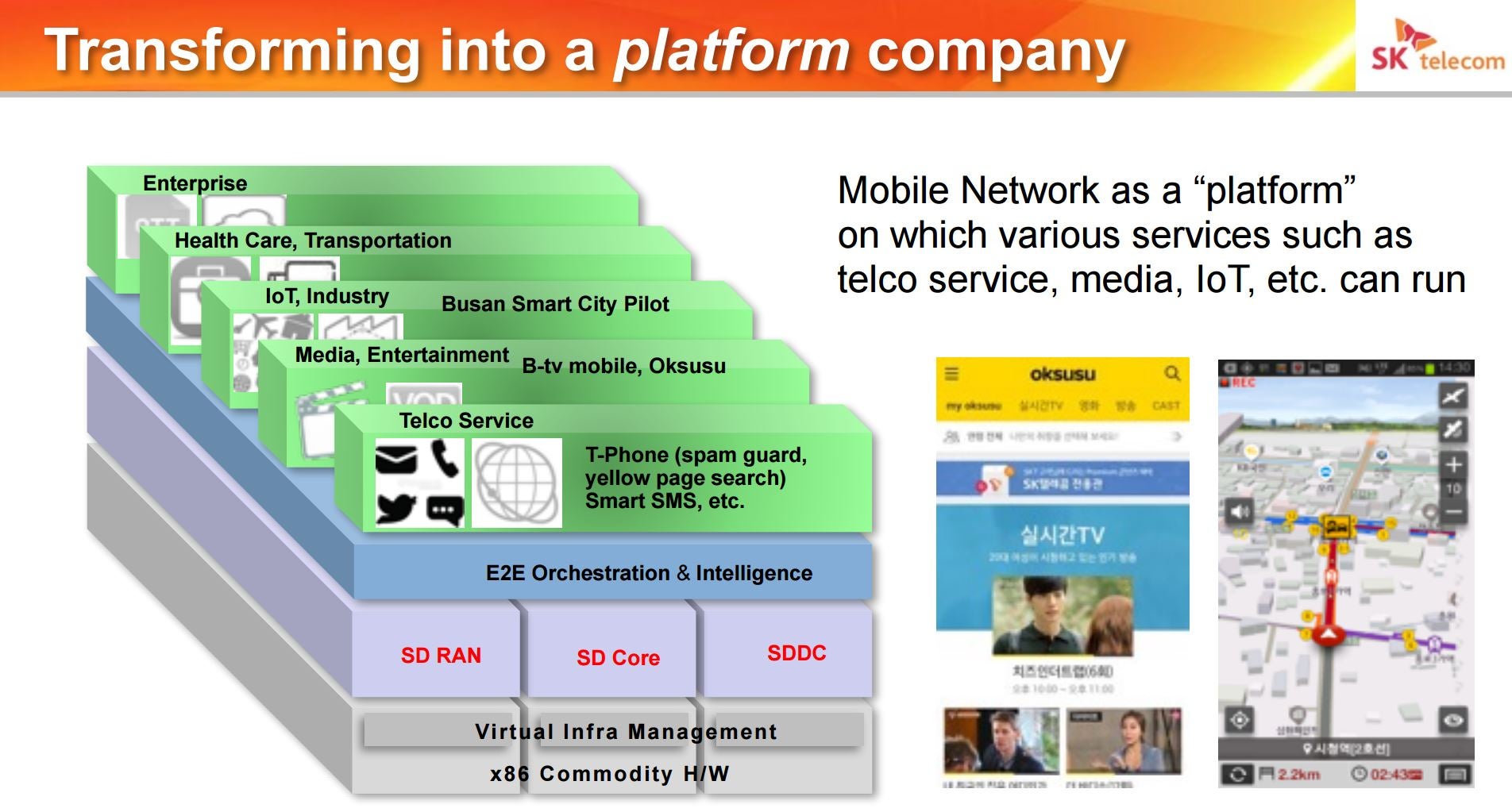
SK Telecom envisions transforming itself into a platform company, making the mobile network as a platform where new services can be created and supported including traditional telco applications, media apps, streaming and IoT applications.

“We need to transition the current telco infrastructure into more of a datacenter infrastructure with wireless connectivity at the end so introduction of new services becomes more agile and faster with new services” said Kang-Won Lee, Senior Vice President of R&D, SK Telecom at the Open Networking Summit 2016. “Average LTE data usage per user per month is expected to increase by 5 times over the next 4 years which presents a significant challenge for a network operator like us.”

Lee predicted the next generation change to a 5G network would happen in 2020 and leading mobile operators need to prepare now. The consensus amongst most service providers and vendors is that this transition will see traffic growth by over 2 orders of magnitude, latency to be 10 times lower and the network will need to support many different devices. SK Telecom wants to bring new opportunity and provide new customer experience with it.

To accomplish this, he emphasized the need for reducing total cost of ownership leveraging open hardware and software; simplifying network design, management; enabling automation and moving fast through prototypes, trials and failures. He also shared SK Telecom’s collaboration across the ecosystem ranging from open source projects, vendors and other service providers; highlighting its contributions to ONOS, virtual network management solution for CORD (CORD-VTN), Mobile CORD (M-CORD) and hardware development.

Watch the full talk ‘Building a Next Generation Mobile Network Using Open Technologies’ below.

linux-com_cta_ons.png?itok=2Fnu27xm


https://www.youtube.com/watch?v=ialUO5NyD1w


U.S. Lab Considers SDN for Growing ESnet Research Network

Inder Monga of the Lawrence Berkeley National Laboratory is responsible for a U.S. Department of Energy network that’s doubling in capacity each year. By 2020, the research network that connects scientists in the U.S. and Europe is projected to carry an exabyte of data each month.

Monga, CTO at Energy Sciences Network (ESnet), can’t satisfy such a high demand for capacity by building a larger network each year. “We cannot keep growing our network cost at an exponential rate,” he said. “Otherwise, our taxes will go up exponentially.”

ESnet is an unclassified network that connects more than 40 Department of Energy research sites, including the National Laboratory system and its supercomputing facilities. ESnet also connects to 140 research and commercial networks globally.

Read more at SearchSDN.

Building a Next Generation Mobile Network Using Open Technologies

https://www.youtube.com/watch?v=ialUO5NyD1w

“We need to transition the current telco infrastructure into more of a datacenter infrastructure with wireless connectivity at the end so introduction of new services becomes more agile and faster with new services” said Kang-Won Lee, Senior Vice President of R&D, SK Telecom at the Open Networking Summit 2016