Inder Monga of the Lawrence Berkeley National Laboratory is responsible for a U.S. Department of Energy network that’s doubling in capacity each year. By 2020, the research network that connects scientists in the U.S. and Europe is projected to carry an exabyte of data each month.
Monga, CTO at Energy Sciences Network (ESnet), can’t satisfy such a high demand for capacity by building a larger network each year. “We cannot keep growing our network cost at an exponential rate,” he said. “Otherwise, our taxes will go up exponentially.”
ESnet is an unclassified network that connects more than 40 Department of Energy research sites, including the National Laboratory system and its supercomputing facilities. ESnet also connects to 140 research and commercial networks globally.
“We need to transition the current telco infrastructure into more of a datacenter infrastructure with wireless connectivity at the end so introduction of new services becomes more agile and faster with new services” said Kang-Won Lee, Senior Vice President of R&D, SK Telecom at the Open Networking Summit 2016.
When it comes to software-defined networking (SDN) automation, certain benefits frequently get more attention than others. Take, for instance, the simultaneous provisioning of network functions and servers, which allows applications to become available in minutes instead of days or weeks.
Often overlooked, however, is how SDN automation strengthens your network security posture, particularly through quarantine and monitoring.
When people talk about cloud native applications you almost inevitably hear a reference to a success story using Apache Mesos as an application delivery framework at tremendous scale. With adoption at Twitter, Uber, Netflix, and other companies looking for scale and flexibility — Mesos provides a way to abstract resources (CPU, memory, storage, etc.) in a way that enables distributed applications to be run in fault-tolerant and elastic environments. The Mesos kernel provides access to these abstractions via APIs and scheduling capabilities in much the same way that the Linux kernel does but geared towards consumption at the application layer rather than the systems layer.
Benjamin Hindman (@benh), the co-creator of Apache Mesos, developed the open source powerhouse as a Ph.D. student at UC Berkeley before bringing it to Twitter. The software now runs on tens of thousands of machines powering Twitter’s data centers and is often credited for killing the fail whale and providing the scale Twitter needed to serve its growing base of over 300 million users. It’s also causing a huge ground swell in companies developing cloud native applications.
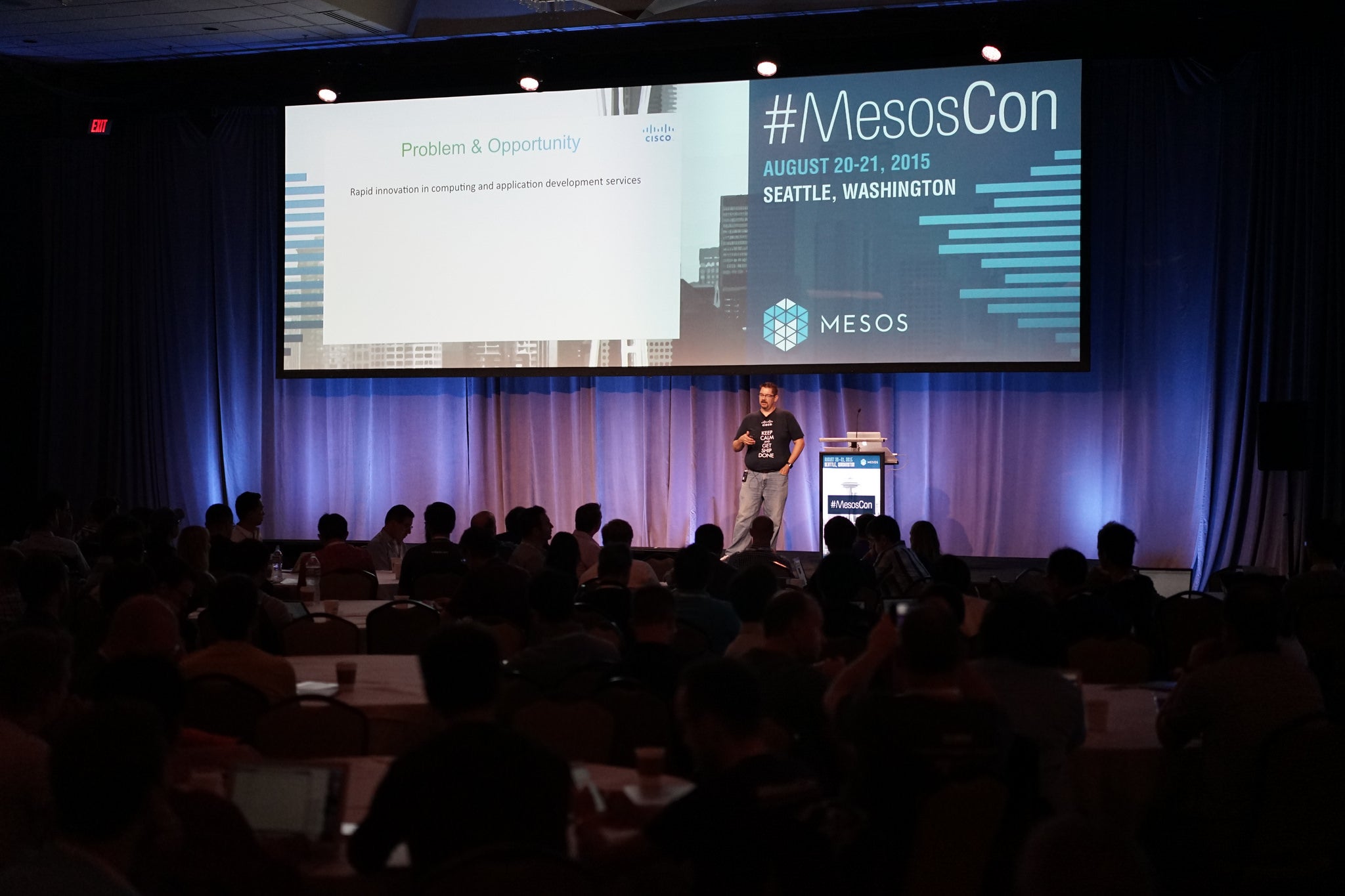
Ben, now founder of Mesosphere, will give the welcome address atMesosCon North America, the Apache Mesos conference going on in Denver on June 1-2. This event is a veritable who’s who from across the industry of those using Mesos as a framework to develop cloud native applications.
MesosCon is a great place to learn about how to design application clusters running on Apache Mesos from engineers who have done it like Craig Neth (@cneth), distinguished member of the technical staff at Verizon, who will walk attendees through how they got a 600 node Mesos cluster powered up and running tasks in 14 days.
Your Uber has arrived, thanks to Open Source Software
Traditionally, machines were statically partitioned across the different services at Uber. In an effort to increase the machine utilization, Uber has recently started transitioning most of its services, including the storage services, to run on top of Apache Mesos.
At MesosCon, Uber engineers will describe the initial experience building and operating a framework for running Cassandra on top of Mesos across multiple data centers at Uber. This framework automates several Cassandra operations such as node repairs, the addition of new nodes, and backup/restore. It improves efficiency by co-locating CPU-intensive services as well as multiple Cassandra nodes on the same Mesos agent. And it handles failure and restart of Mesos agents by using persistent volumes and dynamic reservations.
Microservices, Allowing us to binge watch House of Cards on Netflix
Netflix customers worldwide streamed more than forty-two billion hours of content last year. Service-style applications, batch jobs, and stream processing alike, from a variety of use cases across Netflix, rely on executing container-based applications in multi-tenant clusters powered by Apache Mesos and Fenzo, a scheduler Java library for Apache Mesos frameworks. These applications are consuming microservices that allows Netflix to build composable applications at massive scale.
Based on the experiences from Netflix projects Mantis and Titus, Netflix Software Engineer Sharma Podila (@podila) will share his experiences running Docker and Cgroups based containers in a cloud native environment.
Dragos Sccalita Haut is a solutions architect at Adobe’s API Platform, adobe.io, building a high scale distributed API Gateway running in the cloud. He realized that as the number of microservices increase and the communication between them becomes more complicated. This brings new questions to light:
How do microservices authenticate? How do we monitor who’s using the APIs they expose? How do we protect them from attacks? How do we set throttling and rate limiting rules across a cluster of microservices? How do we control which services allow public access and which ones we want to keep private? How about Mesos APIs and frameworks, can they benefit from these features as well?
The answer to these questions was using the Mesos API management layer to expose microservices in a secure, managed and highly available way.
If you are interested in hearing how Apache Mesos is being developed and deployed by the world’s most interesting and progressive companies the place to see this is MesosCon on June 1-2, in Denver. The conference will feature two days of sessions to learn more about the Apache Mesos core, an ecosystem developed around the project, and related technologies. The program will include workshops to get started with Apache Mesos, keynote speakers from industry leaders, and sessions led by adopters and contributors.
People are already tired of the over-promise of IoT – the slew of marginally useful products, the overly confusing and crowded developer space, and endless examples of how to turn an LED on and off. Take a break, step back from the crowd, and come learn how to solve real human problems with that old phone that’s collecting dust on your shelf.
With so many technologies, tools, and techniques to keep track of, it can be hard to know where to start learning new skills. This series on next-gen cloud technologies aims to help you get up to speed on the important projects and products in emerging and rapidly changing areas such as containers, container orchestration, software-defined networking, and more.
This article takes a brief look at five next-generation cloud technologies and some of the key open source projects in each space to help you get up to speed with the rapidly changing cloud landscape.
Container orchestration tools aim to simplify container management and provide a framework for defining and maintaining container deployments for improved availability, scaling, and networking.
Container as a Service environments like Kubernetes and Google Container Engine sit between the IaaS and PaaS environments. CaaS tools provide a framework to manage container and application deployment.
Innovations in networking allow containers to connect with each other across hosts, and container networking tools can help accomplish the necessary scalability. This article looks at some of the tools available in this emerging area.
You can learn more about container management, software-defined networking, and other next-gen cloud technologies through The Linux Foundation’s free “Cloud Infrastructure Technologies” course — a massively open online course being offered through edX. Registration for this course is open now, and course content will be available in June.
The tech landscape has evolved significantly in recent decades. Constant innovation in the space has forced these companies to rethink and reinvent how they compete in the market. And the more I learn about these changes, the more I’ve become entranced with movements like DevOps.
DevOps as a cultural shift within the tech community calls into question the fundamental bedrocks of how work used to be done in order to remain competitive in today’s rapidly evolving business environment.
In order to conduct a deeper exploration into the topic and help provide some additional perspective, I was fortunate to spend some time with members of the leadership team at Sumo Logic, a cloud-based platform from the Bay Area that provides machine data analytics for modern web applications.
Microservices-based architecture is an emerging trend in software development. It is the result of efforts to make enterprise application code more flexible and easily deployable. Current applications are typically layered based on technology. Teams that are structured around this model also end up having segregated domain expertise. Any change requires coordination between different teams, increasing the time to ship a feature. The final deliverable becomes a monolithic application which bundles all these layers together.
This article attempts to highlight the issues with a monolithic application development model and the benefits of moving to a microservices-based architecture. It then describes a possible approach to transform a monolithic application into a more nimble service-based application. The article concludes by proposing how a production model could look in the new architecture.
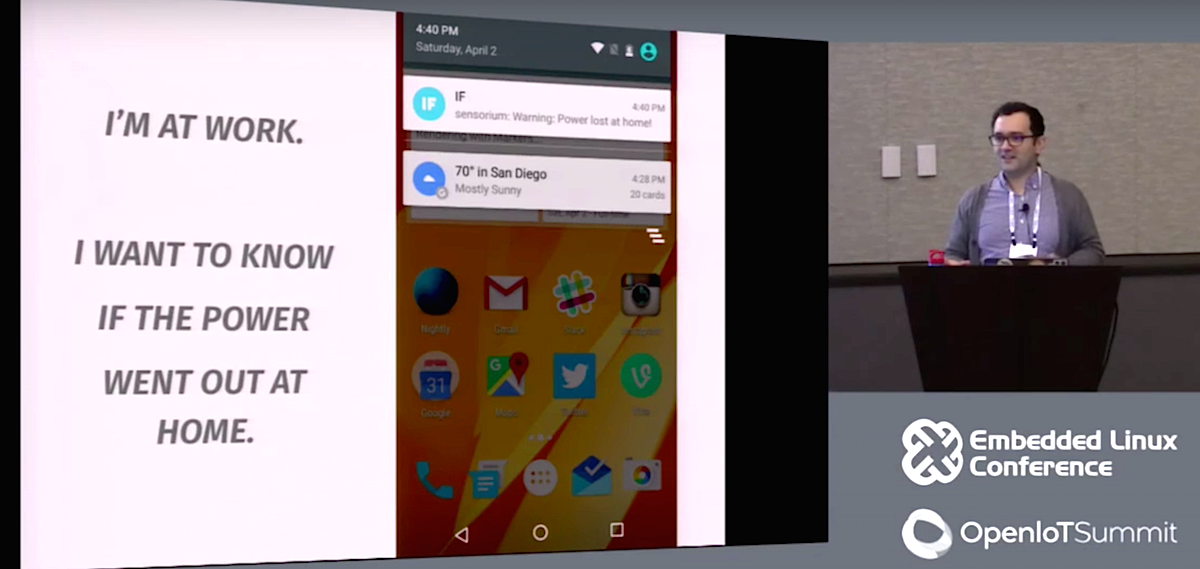
At the recent Embedded Linux Conference and OpenIoT Summit, Mozilla Technical Evangelist Dietrich Ayala proposed a simple and affordable solution to home automation: A discarded smartphone can handle some of the most useful home automation tasks without requiring expensive hubs and sensors — or risking data security in the cloud.
“With a smartphone you can detect motion, sound, presence, and the absence of radio services,” said Ayala in his presentation, “Turning Sensors into Signals: Humanizing IoT with Old Smartphones and the Web.”
“Many phones have proximity or ambient light sensors, orientation, and battery,” continued Ayala. “Consumer devices have almost none of these. My phone knows if it’s being moved around, but my Nest doesn’t.”
Ayala introduced his “Context” JavaScript program for turning an old Firefox OS smartphone into a combination hub and sensor array for remote home monitoring. After Mozilla pivoted the Firefox OS team from phones to IoT, Ayala wondered how he might repurpose all the Firefox OS phones he had sitting around.
Ayala had also been contemplating the shortcomings of the first generation of home automation. “Devices aren’t actually connected today,” said Ayala. “You have to buy into a particular network of devices, and they’re not cheap. Then there are end of life issues, as with Revolv.”
Most commercial IoT products include cloud services for remote connectivity, storage, and in some cases, processing. “How much of your personal life is being exposed to a black box where you have no guarantee or visibility?” said Ayala. “There are no standards, legislation, or case law around what people can do with this data.”
Many hacker-oriented automation products avoid using the cloud, but at the price of greater complexity. You get more privacy and open source personalization, “but at a high cost in experimentation in time and learning,” said Ayala.
IoT’s Killer App: Presence or Absence
A greater challenge affecting commercial and DIY IoT systems alike is the lack of a compelling purpose. “You have to ask yourself, what problems am I addressing?” said Ayala. “Do I really need to have the light reflect my mood or do automated shopping? To me these aren’t solving day to day problems. People have problems like not having enough money or time, or worrying about sick relatives. Maybe they need to know if someone is in their house or whether basic services are working. What you need is physical awareness put in context — the presence or absence of things like noise, motion, or services.”
Most of these capabilities, Ayala realized, are already available on a smartphone even without hooking up additional sensors. You could even repurpose several old phones in a WiFi- or Bluetooth-based sensor network.
Ayala started by writing some JavaScript code to gain access to low level sensors. With Firefox OS, he found he could even avoid building a downloadable app. “With progressive web apps, you can distribute a web page, so users can load it and then receive push notifications forever without loading the page again,” said Ayala. “You don’t even need a UI. You can just reply to the body of channels and configure how much you want to know about a given topic.”
Notifications are currently sent to IFTTT’s maker channel. “From there, I can hook it up to wherever I want,” said Ayala.
Much of the functionality of Ayala’s Firefox OS script can work on other platforms. It would be fairly straightforward to do something similar in a mobile framework, or for more experienced developers, even a native app, Ayala said.
Ayala spent a lot of time studying the readouts from sensors, as well as from the phone’s microphone, camera, and, radios, that would enable a remote user to draw conclusions about what was happening at home. This contextual information could then be codified into more useful notifications.
With ambient light, for example, if it suddenly goes dark in the daytime, maybe someone is standing over a device, explained Ayala. Feedback from the accelerometer can be analyzed to determine the difference between footsteps, an earthquake, or someone picking up the device. Scripts can use radio APIs to determine if a person moving around is carrying a phone with a potentially revealing Bluetooth signature.
With the battery API, you can usually tell if the power went out. If the phone has some battery life and an SMS plan, you can have it send a text message alert.
When sensors hit certain levels, you can have the script use a media API to turn on a camera or mic to see what’s up. In one experiment, Ayala used the getUserMedia API to turn on the mic and record the average volume of ambient sound. “There are some signatures you can get from sound that might yield useful information around presence or absence,” he said.
Future enhancements might tap a mobile platform’s connectivity and discovery interfaces to hook up with other devices. On Firefox OS, these include TCP and UDP sockets, DLNA, and others. Ayala also sees possibilities using local speech recognition APIs.
“In the end, it’s about using the phone as an awareness tool,” said Ayala. “About learning about the environment and yourself.”
Cloud Foundry has quickly risen as one of the de-facto solutions to developing applications at scale. As companies continue to approach development with a multi-platform approach, Cloud Foundry offers developers a platform upon which to build apps without having to recreate the wheel when deploying an application across Google Cloud Platform, Microsoft Azure, or Amazon AWS.
In this episode of The New Stack Makers podcast, you’ll hear about some of Cloud Foundry’s core values in its approach to multi-cloud application development, containers, and how Cloud Foundry hopes to help improve the OpenStack and open source communities.