A new Artik IDE development environment and the Artik Cloud give developers new capabilities with Artik modules.
Samsung has given Internet of things developers several new tools to create and grow their ideas for new devices and concepts, including the Samsung Artik IDE (integrated development environment) and an IoT-focused Samsung Artik Cloud where developers can collect, store and access their data from any device or other cloud. The new tools for developers who use Samsung’s tiny Artik System-on-Module (SOM) platform were unveiled April 27 at the company’s third annual Samsung Developer Conference, …
Next week, FOSS4G North America is coming to Raleigh, NC. FOSS4G is a conference celebrating all of the ways that free and open source software are changing the world of geographic and geospatial information science (GIS).
These days, with ever-expanding technologies for collecting geographic data, sensor networks and the Internet of Things are driving larger and larger quantities of data that must be stored, processed, visualized, and interpreted. Practically every type of industry imaginable is increasing the types and quantities of geographic data they utilize. And the traditional closed source tools of the olden days can no longer keep up.
Many of the applications of geographic tools are scientific in nature, from biology to oceanography to geology to climatology. Here are seven applications for geographic science that I’m excited about hearing talks on next week.
This tutorial will guide you on how you can configure OpenStack networking service in order to allow access from external networks to OpenStack instances.
Requirements: Install OpenStack in RHEL and CentOS 7
Zemlin’s career spans three of the largest technology trends to rise over the last decade: mobile computing, cloud computing and open source software. Today, as executive director of The Linux Foundation, he uses this experience to accelerate the adoption of Linux and support the future of computing.
Zemlin works with the world’s largest technology companies, including IBM, Intel, Google, Samsung, Qualcomm, and others to help define the future of computing on the server, in the cloud and on a variety of new mobile computing devices. His work at the vendor-neutral Linux Foundation gives him a unique and aggregate perspective on the global technology industry.
Red Hat is out with a slew of cloud-related announcements at this week’s OpenStack Summit event in Austin, Texas, and one of them calls for the company to literally reach beyond the cloud — for the stars. NASA’s Jet Propulsion Laboratory (JPL) has built a private cloud based on Red Hat OpenStack Platform aimed to help it reach new frontiers in planetary exploration. That was just one of the major cloud computing updates from Red Hat this week.
According to JPL’s announcement: “Deploying Red Hat OpenStack Platform offers JPL enterprise-scale computing capacity that would enable researchers to tap into their own private cloud and use external cloud resources, such as Amazon Web Services (AWS), when necessary for peak demand.”
The company also announced that leading organizations across Europe, including Fastweb, Paddy Power Betfair, and Produban, have deployed Red Hat OpenStack Platform as the backbone of their cloud initiatives. In addition, Cambridge University has selected Red Hat for its OpenStack deployments.
Red Hat is not the only beneficiary of the interest from Europe. There are also going to be a lot of OpenStack-related jobs created, by their customers and others, as deployments increase. Regarding the rapid adoption of OpenStack in Europe, research firm IDC noted in early 2015: “As European enterprises enter the most critical phase in the 3rd Platform era – the innovation phase, they want new, yet cost-effective technologies to bring their ideas to fruition. Their desire to avoid vendor lock-ins, and reduce software licensing fees are steering them to evaluate OpenStack for building their cloud infrastructures.”
Telecoms are on Board
Red Hat has remained very focused on bringing OpenStack and NFV (Network Function Virtualization) technology to companies in the telecom arena. Telecoms have had notorious problems with vendor lock-in when deploying infrastructure technology, and tools such as OpenStack can offer more openness and more choice.
At the OpenStack Summit, Red Hat and Verizon announced that Verizon has completed the industry’s largest known Network Function Virtualization OpenStack cloud deployment across five of its U.S. data centers. Verizon said it worked with Red Hat to develop an OpenStack pod-based design that leverages open source Cepth storage and went from concept to deployment of more than 50 racks in five production data centers in less than nine months.
“With its open NFV architecture, Verizon is building a next-generation, automated, software-defined network based on open source solutions, including OpenStack, giving them the ability to build a network that changes at the pace of software, not at the pace of hardware,” said Darrell Jordan-Smith, Vice President of Worldwide Information and Communications Technology at Red Hat.
The Transformative Cloud
Red Hat is continuing down a transformative path focused on OpenStack and cloud computing that, despite a few hiccups, is succeeding. The company, of course, made its name offering hardened and dependable support for its enterprise-focused Linux platform. In recent quarterly reports, though, Red Hat officials have pointed to cloud initiatives contributing strongly to company growth. Indeed, the company recently crossed the $2 billion annual revenue threshold, and CEO Jim Whitehurst has maintained that the company sees much promise in offering support for enterprises running OpenStack.
There were a few bumps in the road for Red Hat. All the way back in 2013, Gartner Research Director Allessandro Perilli came out with an essay that painted a very gloomy picture of actual OpenStack deployments, including deployments of Red Hat’s OpenStack platform. Red Hat’s Bryan Che responded by noting that many enterprises were in the consideration stage and would be pursuing OpenStack deployments.
With this week’s OpenStack Summit announcements from Red Hat, it is clear that enterprises have moved beyond just consideration and large deployments are underway. In fact, according to survey results from The OpenStack Foundation, 65 percent of OpenStack deployments are now in production, which is 33 percent more than a year ago.
Meanwhile, countless reports from analysts are still calling out the fact that there are not enough skilled OpenStack administrators. The Linux Foundation, The OpenStack Foundation and others are offering training to help rectify that situation. As major deployments spread out, we are going to see many more jobs emerging around the world for administrators armed with strong OpenStack skills.
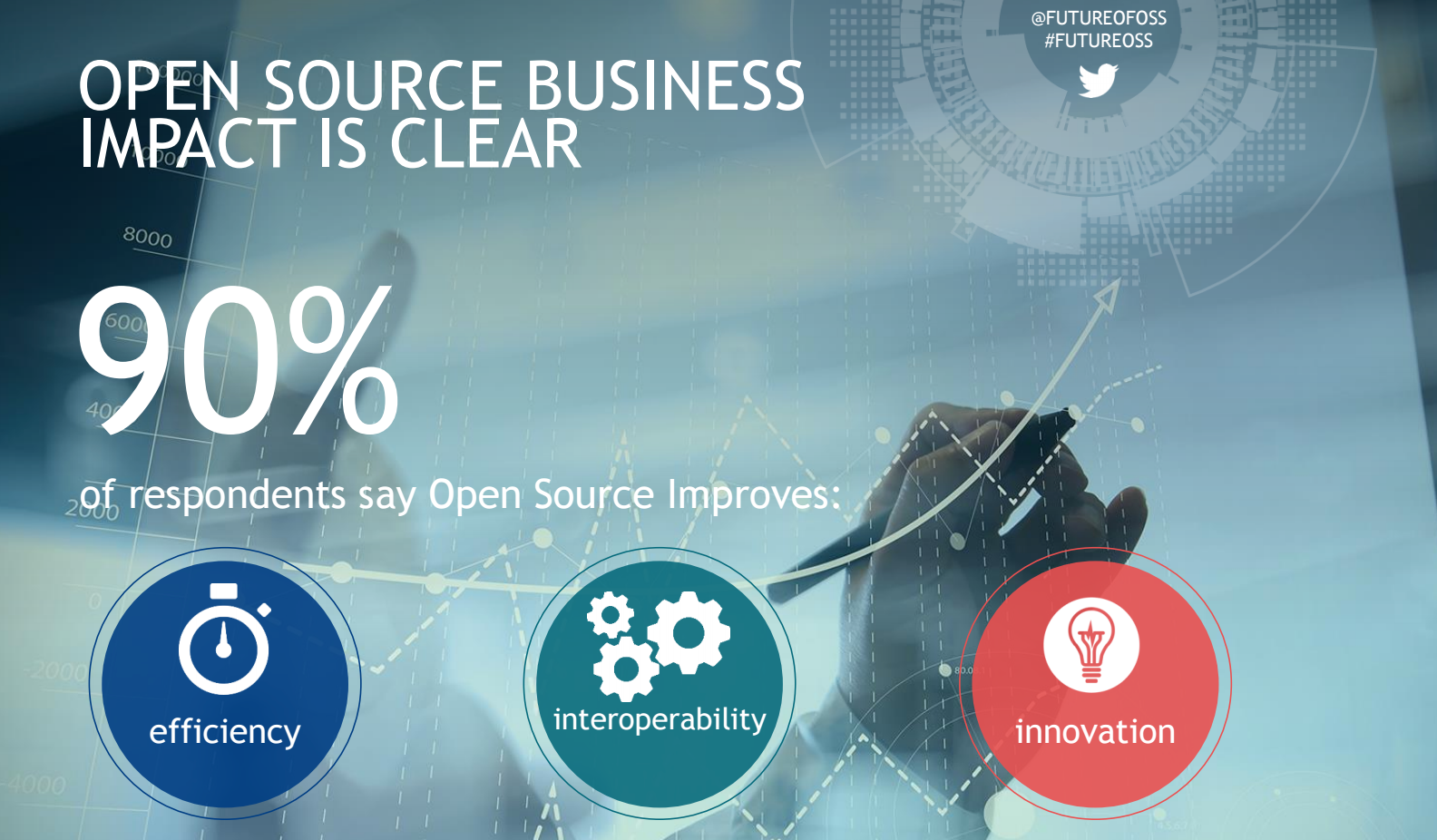
Open source improves efficiency, interoperability, and innovation according to the latest open source survey from North Bridge and Black Duck.
The companies today released results of their annual “Future of Open Source” study, which examines open source software trends. These results show open source as “today’s preeminent architecture, the foundation for nearly all applications, operating systems, cloud computing, databases, and big data,” according to the announcement.
Overall, the use of open source software (OSS) increased in 65 percent of companies surveyed. The reasons given for using OSS include: quality of solutions, competitive features, and the ability to customize and fix the software. Additionally, 90 percent of this year’s respondents say that open source improves efficiency, interoperability, and innovation.
Specifically:
More than 65 percent leverage open source software (OSS) to speed application development
More than 55 percent leverage OSS for production infrastructure
65 percent of companies also contribute to open source projects, mainly in order to fix bugs or add functionality to a project
67 percent actively encourage developers to engage in and contribute to open source projects
Challenges remain, however:
50 percent of companies surveyed have no formal policy for choosing open source code
47 percent have no formal process in place to track open source code
And, nearly one-third of companies have no process for identifying, tracking or remediating known open source vulnerabilities
Looking ahead, respondents say that, in the next 2-3 years, the main revenue-generating business models for open source vendors will be: software-as-a-service (46 percent); custom development (42 percent), and services/support (41 percent).
These results come from 1,313 respondents in 64 countries. You can see the full results here.
In a previous article on next-generation cloud technologies, I mentioned Containers as a Service (CaaS), which provides a framework to manage container and application deployment.
Brendan Burns, Google’s lead engineer for Kubernetes, introduced CaaS as a term for container platforms in his talk at the Defrag conference last year. An article on The New Stack describing the talk says CaaS environments like Kubernetes and Google Container Engine sit between the IaaS and PaaS environments. In Burns’s view, the article says, “CaaS falls into this middle ground as a way to connect to the machine but also offers the ability to make use of concepts that will impact how we think about application development on distributed architectures.”
Tools in the CaaS space are aimed at easing tension between development teams and operation staff when it comes to pushing application content and monitoring and managing applications and infrastructure, according to a recent Docker blog.
As Sam Ramji, CEO of Cloud Foundry, said in his keynote at OSCON last year, “we live in an age of open source datacenters, so we can stack all these things together and we have open source from the ground to ceiling.” For all of these things, Ramji maintains, the underlying goal is continuous innovation. But, he says, there can’t be continuous innovation if developers and operations staff spend their time trying to figure out how open source code components will work together.
Here are five projects and tools in the CaaS space aimed at making that open source stack easier to manage:
Amazon ECS — The Amazon EC2 Container Service (ECS) supports Docker containers and lets you run applications on a managed cluster of Amazon EC2 instances.
CoreOS Tectonic — Tectonic combines the Kubernetes and CoreOS stack into a commercial distribution. It packages the components required to build a “Google-style infrastructure” and add commercial features such as a management console.
Docker Universal Control Plane — Docker Universal Control Plane is a container management solution for deploying and managing Docker applications in production environments.
Google Container Engine — Google Container Engine, which is built on Kubernetes, lets you run Docker containers on the Google Cloud platform. It schedules containers into the cluster and manages them based on user-defined requirements.
Project Magnum — Magnum is an OpenStack API service that makes container orchestration engines, such as Docker and Kubernetes, available as resources in OpenStack.
You can learn more about Containers as a Service and other next-gen cloud technologies in The Linux Foundation’s free “Cloud Infrastructure Technologies” course — a massively open online course now being offered through edX. Registration for this course is open now, and course content will be available in June.
The OpenStack Foundation is calling on enterprises to step up their involvement with the open source community to ensure its work keeps pace with the rate of innovation occurring in the Internet of things (IoT) and big data era.
Speaking at the OpenStack Summit in Austin, Texas, Mark Collier, the foundation’s chief operating officer, said the proliferation of connected devices in the coming years will require a rethink of how to manage the infrastructure underpinning them all. Citing Cisco’s oft-quoted Internet of Everythingprojections, Collier said there is expected to be around 50 billion devices connected to the internet by 2020. Analyst Mark Field predicts this will require underlying support from around 400 million servers.
Many HPC applications began as single processor (single core) programs. If these applications take too long on a single core or need more memory than is available, they need to be modified so they can run on scalable systems. Fortunately, many of the important (and most used) HPC applications are already available for scalable systems. Not all applications require large numbers of cores for effective performance, while others are highly scalable.
One of the best ways to understand application behavior is to benchmark on a scale-up and scale-out system. Indeed, if the applications are used throughout a specific market sector, there should be published data on application performance across a variety of hardware.
Here is how to better understand your HPC application needs.
Node.js, the server-side JavaScript runtime engine, has just gotten a lot faster.
The Node.js Foundation has released version 6 of Node.js today, bringing with it security updates, performance improvements, and increased stability. The most significant boon to developers with this update is to performance. Node.js v6 loads modules four times faster than its LTS (long term support) predecessor, Node.js v4. As most Node deployments rely on multiple external modules, this improvement could dramatically cut the time it takes to start complex Node-based deployments.
Node v6 also buddies up to the new ECMAScript 2015 (ES6) standard, through the inclusion of the recently updated v8 JavaScript engine, vesrion 5.0. As a result, 93 percent of ES6 features are also now supported in the Node.js v6 release…