New research into the “Rowhammer” bug that resides in certain types of DDR memory chips raises a troubling new prospect: attacks that use Web applications or booby-trapped videos and documents to trigger so-called bitflipping exploits that allow hackers to take control of vulnerable computers.
The scenario is based on a finding that the Rowhammer vulnerability can be triggered by what’s known as non-temporal code instructions. That opens vulnerable machines to several types of exploits that haven’t been discussed in previous research papers. For instance, malicious Web applications could use non-temporal code to cause code to break out of browser security sandboxes and access sensitive parts of an operating system.
The highly diplomatic letter begins: We write to express our deep concerns about well-intentioned but ultimately unworkable policies around encryption that would weaken the very defenses we need to protect us from people who want to cause economic and physical harm.
All the Operating Systems that we use now-a-days, either Windows or an Open Source platform like Linux, comprise of various sets of programs and events that keeps running in the background to carry out the tasks to maintain efficient and reliable use of system resources. These events may happen in system software, for example the init process, or user applications such as Apache, FTP and others.
Now the question that arises in everyone’s mind is – how to keep an eye on working state of the system and different applications that are running in the background? One of the general solutions is that the system administrator himself keeps a review on the Log-files on a daily basis from the Production Environment.
But is this really a productive and easy factor to check each Log file on a daily basis which involves reviewing each log file from several system areas and applications. Still it is possible but making a user available at daily basis is not always a possible task. Here come the Log software management tools into action. They help to monitor, review, analyse and even generate reports from different log files as configured by a System Administrator.
Whether it’s a brand new car or just a Chipotle burrito, free stuff makes you happy. The same goes here with these Log management software as all of these are free to download and easy to manage. We have put together a list of the best free Log management software solutions out there for you to compare and contrast accordingly to you needs.
1. Graylog 2.
Being a fully integrated Open Source Log management software Graylog 2 enables a user to collect, index, and analyse both framed, systematic and disorganized data from any available source systems. Apart from this, the tool helps in running analytics, alerting, monitoring and powerful searches over your whole log base.
Its web interface is designed in Ruby on Rails while the server is programmed in Java. All of the source code can be accessed through Github.
When it comes to Features. Graylog 2 consist of following features
1. More Reliable due to its Features
2. Enabled with dashboard and a notification system
3. Can work from any log source
4. Real time log processing
5. Parsing of unstructured data can be easily carried out
2. Logcheck
Logcheck is a full platform to monitor and control your system. It helps a system administrator to Identify unknown problems that occurs automatically in Log-files. During configuration the system administrator provides with an email address such that all of the analysis report is automatically forwarded to this email ID on a periodic basis.
All of the Log system rebooting is done on an hourly basis that occur by default. Log-check enables with different layer of filtering done depending on the system. These are:
1. Paranoid: is maintain for high-security systems where the services that runs are very less in number.
2. Server: this is the default filtering level for log-check and its rules are defined accordingly to different systems.
3. Workstation: it is for sheltered systems and helps to filter most of the messages. It also includes rules defined under paranoid and server levels.
3. ClearOS Log Viewer
The powerful Log Viewer by ClearOS serves something more than just log management – it keeps your system safe and also checks system status and health. Need to manage huge log files, no issue. ClearOS Log Viewer is capable of handling and reviewing large databases with great precision. It shows a tabular display of all log files in your system, making the search process easy for you.
4. Logwatch
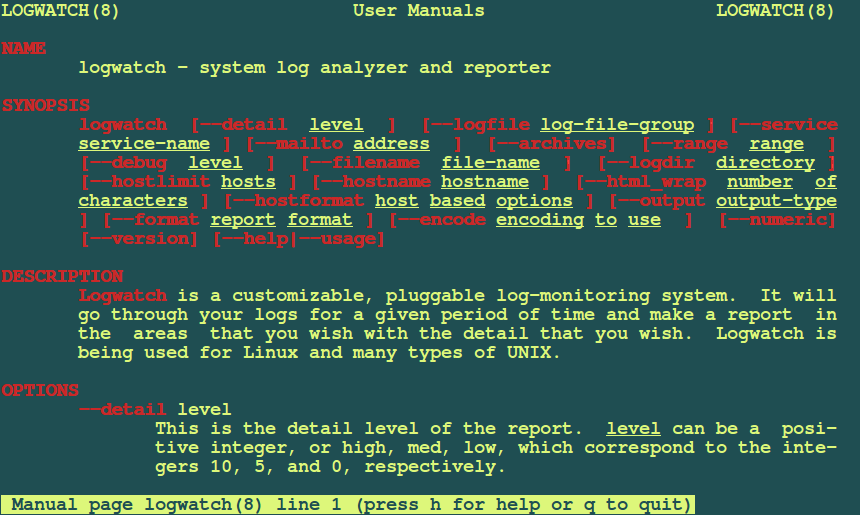
Logwatch is an easily customizable Open Source Log management tool that carries out features such as reviewing Log files for a given period of time and then generating report for the same based on the areas set by the administrator itself. That is one only need to set up his own information area.
One of the most essential features of this logging system is that it is easy to use for new System Administrator and it also works on most Linux distributions available and many Unix systems.
It enables a system administrator to add additional plug-ins, create custom scripts that serve specific logging needs.
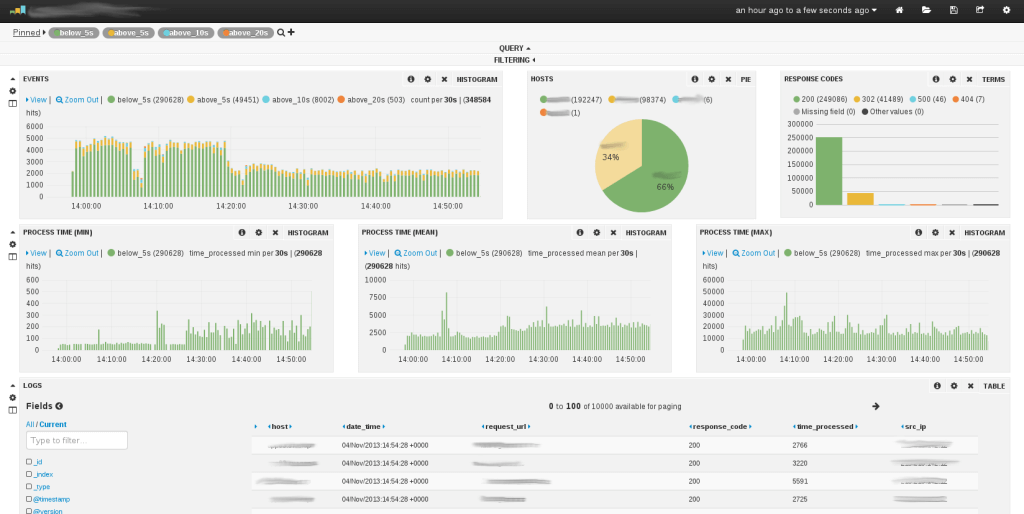
Just like the other open source Log management tools available on Linux defined above, Logstash resembles its own functionality of Real-time pipelining. As it was originally intended to maintain data collection but if we told about the new updated version integrated with several other features that collects a wide range of input data formats, works as an Open Source Filter and also output plug-ins and formats.
Logstash also allows System Administrators to cleanse, compare and standardize all their logging data for distinct advanced analytics and also create visualization use cases as well.
As the world of application development has evolved, so too have the infrastructures used to support the storage and networks demands of todays enterprises. So it is not surprising that there is increasing buzz around programmable infrastructure, an emerging method in which the automated practices and tools of DevOps are being extended into managing system operations as well.
At the Intel Cloud Day 2016 event, last month, The New Stack founder Alex Williams and TNS reporter Scott M. Fulton III met with a variety of executives of companies engaging in the programmable infrastructure space, to learn more about the role the practice could play in the data center. The interviews have been captured as a series of podcasts, embedded below.
“The infrastructure of the future is going to be software defined.” — Paul Turner, Cloudian
Devops is one of those volatile topics that mixes human behavior patterns with technology, often yielding dramatic increases in productive output — that is, more high-quality software at a much faster pace. It’s a fascinating area. But is devops fascinating enough for a novel?
Gene Kim guessed that it was. His book, “The Phoenix Project: A Novel about IT, DevOps, and Helping Your Business Win,” written with Kevin Behr, actually became a best-seller… Before his novel, Kim was best known as the founder and CTO of Tripwire, a creator of security and compliance automation software that was sold to Belden early last year. Over the past five years, he’s built himself into one of the industry’s foremost experts on devops, working with Jez Humble, Dr. Nicole Forsgren, and the team at Puppet Labs to produce the annual, influential State of DevOps Report.
This tutorial shows the installation of a Ubuntu 16.04 minimal server in detail with many screenshots. The purpose of the guide is to show the basic installation of Ubuntu 16.04 that can be used as basis for our other Ubuntu tutorials here at howtoforge like our perfect server guides.
You may already know that “deleting” a file does nothing of the sort. Securely erasing drives before you sell a computer keeps your personal information from falling into the wrong hands. Good news: it’s easier than ever to fully erase data.
SSDs – now the standard in Ultrabooks and Macs – are a little different. Thanks to the Flash Translation Layer (FTL) your OS doesn’t know where the data is physically. As a result, the Mac’s “Secure Empty Trash” command has been removed because it can’t be sure that the data is actually gone. But there’s an easy workaround for SSDs: encrypt, reformat, and re-encrypt, which is described below.
OpenStack is a free and open-source software platform which provides IAAS (infrastructure-as-a-service) for public and private clouds. OpenStack platform consists of several inter-related projects that control hardware, storage, networking resources of a datacenter, such…
This is a content summary only. Visit my website for full links, other content, and more! Read more at Tecmint
Jim Zemlin, executive director of The Linux Foundation, will take centre stage at ITS America 2016 San Jose on Tuesday, 14 June as the keynote speaker for day two of the event, The Infrastructure of Things.
Before taking the helm at the Linux Foundation, Zemlin worked at startups in Silicon Valley, including Covalent and Corio. His career started in telecom at Western Wireless. Zemlin advises a variety of startups, including Splashtop, and sits on the boards of the Global Economic Symposium, Open Source for America and the Chinese Open Source Promotion Union….
CoSoSys develops data-loss prevention products for computers and mobile devices that access and store sensitive data. The company’s Endpoint Protector 4 features device control to manage Windows, Mac OS X, and Linux machines.
Recently, CoSoSys joined The Linux Foundation and released a private beta version of Data Loss Prevention for Linux, which is available upon request for Ubuntu, openSUSE, CentOS, and Red Hat. The company is also investigating the possibility of expanding its technology to help manage wearable devices.
Roman Foeckl, founder and CEO of CoSoSys
To find out more, we spoke with Roman Foeckl, founder and CEO of CoSoSys, who explains how and why the company uses Linux and talks about trends that are shaping the industry.
What does CoSoSys do?
CoSoSys specializes in Data Loss Prevention (DLP) for Windows, Mac OS X and Linux, Mobile Device Management (MDM), and Mobile Application Management for iOS and Android, and applications for portable storage device encryption and enhancement. The application portfolio includes functions, such as device control, content filtering, mobile device security, file tracing and shadowing, password security, data synchronization and network security. Our flagship product, Endpoint Protector 4, was named Data Loss Prevention solution of the Year in the 2014 and 2015 Computing Security Awards, and it is certified with Common Criteria EAL2.
How and why do you use Linux and open source?
Endpoint Protector, our DLP and MDM solution, is based on Linux. Our server console runs on the operating system, which allows us to customize the solution as much as we want and to deliver our software as a virtual machine (VM). We chose Linux because it is extremely versatile and secure, which are essential characteristics for any data security product.
The ability to deliver our software as a VM is one of our main differentiators. By combining this with open source solutions, we are able to make more frequent releases of our product to address constantly evolving security threats.
Why did you join The Linux Foundation?
For us, it was a natural next step since we support Linux with our DLP software, and our solutions are Linux-based. We feel passionately about supporting the Linux community because it shares a lot of our same values, especially with its emphasis on, and reputation for, being secure. In the new open source world, it is incredibly important to give back and support the technologies that so many of today’s most influential products are built on.
What interesting or innovative trends in your industry are you witnessing and what role do Linux and open source play in them?
The Internet of Things (IoT) is one of the top innovative trends that is shaping DLP and MDM, and changing data security as we know it.
Interconnected devices, systems, and other items collecting and exchanging data are enhancing the world we live in. Homes, cars, offices, and even cities, are becoming smarter and adapting to and anticipating our needs. While this is enhancing our lives and sparking a new wave of innovation, it also comes with increased risk. These technologies use and store a huge amount of behavioral and other personal data. In light of IoT evolution – the number of Internet-connected devices is expected to reach 50 billion by 2020 – new threats to data security are starting to emerge. DDoS attacks, hijacking or backdoors could pose serious problems for healthcare, banking, and other highly sensitive industries. Therefore, information security vendors have already started to contemplate the development of solutions to secure IoT.
Open source solutions and Linux play an essential part in IoT and in keeping it secure. To date, they are considered the most viable options to allow the development of operating systems that support IoT devices. Open source software allows vendors of diverse infrastructure to adapt it according to the specific use of an IoT device — for example, a heart monitor that connects to a doctor’s smartphone through an app or a smart heating system that starts automatically right before you arrive home from work.
How is your company participating in that innovation?
We are investigating the possibility of managing wearable devices with our MDM solution to provide IT departments a solution to control them, just as they control iOS and Android mobile devices. Wearables are currently very popular, and they continue to make their way into enterprise environments. They are the closest thing to what IoT represents now, so we are determined to take a closer look at how they need to be secured by the IT departments.
How has participating in the Linux and open source communities changed your company?
Open source software is at the base of the creation of Endpoint Protector. Open source solutions and communities, like Linux, provide developers with a rich set of resources that are attainable, making their development easier and in turn speeding up the pace of innovation. Without Linux, and other open source solutions, creating Endpoint Protector would have been much more costly and challenging, and may not have even made it to market.
Is there anything else important or upcoming that you’d like to share?
While Linux is one of the most secure operating systems, users and developers alike need to keep in mind that it, or any technology, is by no means impenetrable. Human error and insider threats are some of the top causes for data losses and data thefts, which can and do still occur even in a highly secure environment. Confidential data can end up in the wrong hands if users upload it or copy it to unauthorized cloud apps and services, or send it to recipients who cannot be trusted.
To address these kinds of scenarios, we recently launched Content-Aware Data Loss Prevention for Linux. The solution provides detailed content inspection before it is uploaded or copied to online applications and blocks the content, in case it is flagged as sensitive, ensuring sensitive data doesn’t end up in the wrong hands.
Roman Foeckl is the founder and CEO of CoSoSys, and co-founder of Onyx Beacon. Roman’s vision is to offer a Data Loss Prevention solution that is easy to use and implement, and covers all popular platforms — from Mac OS to Windows to Linux. He believes organizations of all sizes should be able to protect their data against accidental loss or intentional theft. He’s been a regular contributor to the IT Security community, with articles featured in various outlets, including VentureBeat, SC Magazine, CSO, and many others.