 Why are all the internet companies based on the West Coast of the U.S.? Google, Yahoo, eBay, Facebook, Amazon, Twitter – all the world’s top internet innovators are based in California or Seattle. Or not. Three of the biggest internet companies in the world are actually based in China – Baidu, Alibaba and Tencent – collectively known as “BAT.”
They are often explained in the U.S. as China’s Google, eBay and Facebook, but that is really selling them short. These aren’t just copies but aggressive competitors who have shown an uncanny ability to deeply understand consumer trends in their market and have delivered some very interesting innovations. One key enabler of this innovation is their growing embrace of open source platforms. The innovation coming from the highly admired BAT companies is also having a ripple effect across the Chinese market – inspiring Chinese telcos, enterprises, and equipment manufacturers to also look to open technologies to gain agility and cost savings.
I recently had a chance to spend time with a cross section of Chinese technology leaders and was surprised and impressed by what I saw. I’ve been to China a few times and am always surprised by the juxtapositions and contrasts you immediately encounter while in China. The pace at which they’ve gone from an agrarian third-world nation to an industrialized advanced powerhouse is breathtaking. This time, though, I saw something new I hadn’t seen before: not just catch-up innovation, but also brand new innovation coupled with some impressive advancements.
This really struck home to me during a site visit to Tencent’s headquarters. If you’re not familiar with Tencent, they are one of the world’s largest and most successful internet companies. Valued at an astonishing $167 billion with year-over-year quarterly earnings growth of 32 percent and a profit margin of 30 percent, this is not some overhyped unicorn. They started as a platform for online gaming but have almost completely re-invented themselves with two of the world’s largest messaging apps: WeChat and QQ. I’ve heard people say “yeah but that’s not innovation – they just copied what others have done in a captive market.” That’s a complete misunderstanding of what Tencent is.
Once Tencent had the vast bulk of Chinese consumers on their WeChat platform they quickly saw the potential for extending the platform – they added mobile payments and basically became a micro PaaS – enabling a broad set of applications to benefit from and add to the platform. You can walk into a store and print a picture from your feed and pay for it all with a QR code, create and edit ecards, send money, play games, log into events, find friends, get notified of accidents, etc. etc. etc. Abductors have even been caught based on an app built on their platform.
Four Factors Driving Innovation in China
So what is the leading force behind all of this rapid innovation? I see four main factors that have enabled Tencent, and to some extent all of China, to innovate so fast:
-
Willingness to take inspiration from others.
-
Solid execution to quickly replicate what’s been done and iterate.
-
Ability to adapt what’s been done already to the needs of the local market (market insights).
-
Extend technology to capture new market needs.
It’s actually these same four points that also describe why I believe Chinese companies may be particularly well prepared for the world of open source. More specifically:
-
Often brilliant people and companies take a NIH (“Not Invented Here”) approach, viewing their own inventions as amazing and poo-pooing others. What I saw at Tencent and in China in general is a willingness to leverage others’ work and experience. While many might dismiss that as copying, I believe this is a key to innovation and the key to open source – reinventing the wheel is highly wasteful. An attitude of “first see what I can borrow” vs. “first invent” is one key tenet of open source-based development.
-
Often in open source we chose to rewrite something to be able to extend it (e.g. Yahoo with MapReduce/Hadoop). Tencent has clearly done more than just reproduce Snapchat – they created a whole new extended platform. I believe this same skill will serve them well once they begin to be more active as contributors in open source projects.
-
In any rewrite or refactor, great developers don’t just stupidly recreate but continually seek to improve and adapt based on a broader understanding of the market needs, technology innovations and their own requirements.
-
The key to the Open + [Value] framework (I am presenting on this at the Open Network Summit) is the recognition that the key to making money on open source is the ability to find a way to attach differentiated value to the common leveraged idea, code, platform etc. What I saw with Tencent was an ability to take an existing idea and extend far beyond it. I believe as they begin to leverage open source more and more this will lead to both exciting innovations but also contributions back to the community.
The analogy isn’t perfect but I think it does hold. I’ve already seen the early signs of leadership from BAT, especially from Tencent.
Tencent’s Open Source Leadership
Like many companies, Tencent is already leveraging Linux heavily. Tencent was actually one of the first companies to leverage the OpenDaylight Project’s Software Defined Networking (SDN) controller at scale in production to manage the massive amounts of data that must flow between their data centers.
Tencent has realized that leveraging open source SDN is critical to supporting their extreme scalability demands (with over 1.2 billion users across both of their platforms). OpenDaylight specifically has solved several problems that originally threatened to slow the company’s growth, including low bandwidth usage in expensive Wide Area Network (WAN) connections and inefficient redundancy scheduling.
A more complete history on why Tencent chose OpenDaylight is available here, but what’s important to note is that originally the company contemplated developing a distributed cluster SDN controller internally. Leveraging open source has turned out to be a much better option for dealing with an ever-increasing variety of applications, distributed controller models and emerging protocols – including OpenFlow, PCEP and NETCONF – and extensibility to support more southbound protocols. At this point, Tencent has been using the OpenDaylight platform for more than one year. And last year the company requested that its partners make the SDN controllers they were building compatible with OpenDaylight by the end of 2015. Tencent has recently joined as a member of the OpenDaylight foundation – joining at the Silver level to begin with.
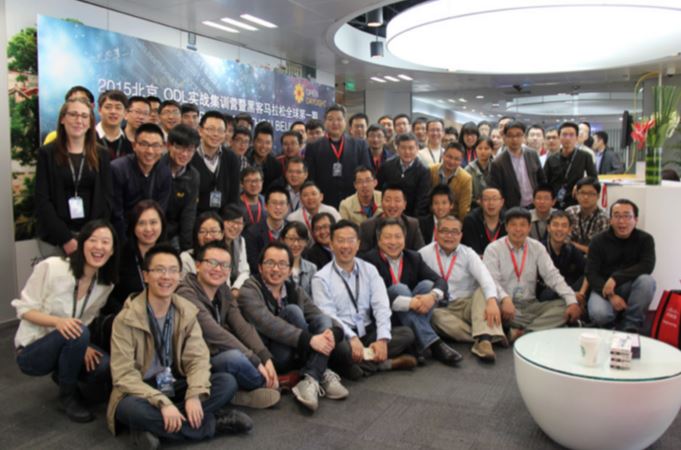
My enthusiasm about Tencent and China doesn’t just come from their use of open source but from the early signs of leadership I am seeing from BAT. They took the initiative with a local startup to create the China Open SDN (COS) committee. The committee includes leaders from major Chinese internet companies, service providers and networking equipment vendors that meet together to oversee the expansion of the community in China. With sponsorship from Cisco and companies in the COS, they put together an impressive community day in China in January 2016 that was full of valuable sessions. There were so many impressive things. They leveraged the Tencent WeChat platform for registration, event information, live polling, feedback etc. Because it wasn’t a separate app, connections made at the event can be easily maintained. Attendees were also immediately connected to the 1,600+ person OpenDaylight QQ group that has already grown organically.
Open Source in China
One of the pioneers of the internet in China gave a highly provocative talk – asking the audience why China had yet to birth a major open source project. The consensus in the audience (polled via WeChat platform) was that China’s culture inhibited open source. I heard this in my travels throughout China.
Frankly I can see this both ways. While I see the cultural challenges everyone was telling me about, their awareness of the challenge is so tangible that it is driving leaders in the community like Tencent’s Marty Ma and TethrNet’s Kevin Yin to try just a little harder. Even if the majority of Chinese tech workers don’t quite fully get open source now, we’re seeing leaders emerge in the country willing to invest of their time and energy to change things. I wouldn’t bet against them.
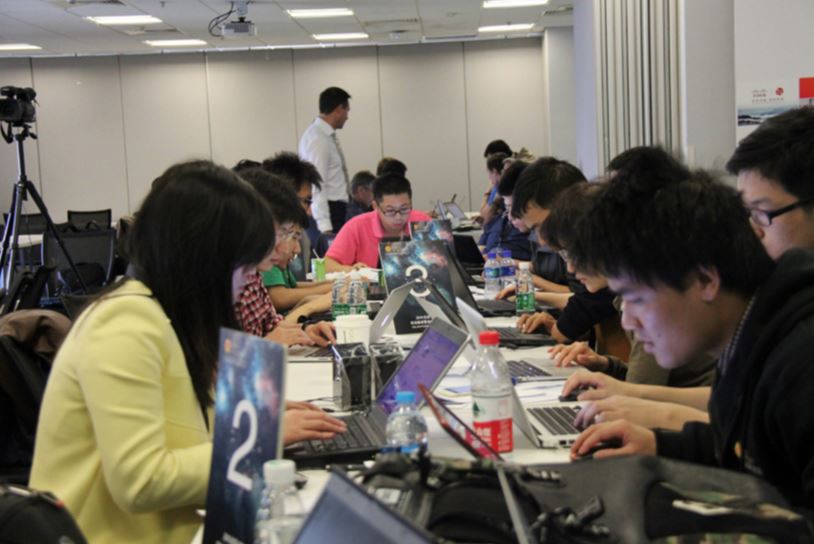 The COS also drove the creation of an OpenDaylight Bootcamp – sponsored by Cisco – over five days in Shenzhen. The event was heavily oversubscribed but only 40 slots were available. Every single person stayed for the full five days, staying up most of the night the final day to impress the judges with their progress on code and app development.
Meeting executives at ZTE, H3C, Huawei, China Mobile Communications Corporation, China Unicom and China Telecom, as well as students and professors at two of China’s leading technical universities (Shenzhen and Beijing University of Posts and Telecommunications) have all convinced me that we are at the cusp of something very special in China. Awareness of open source is growing, code bases such as OpenDaylight are being increasingly leveraged, and leadership is emerging. As in the rest of the world the siren call of proprietary and associated desire to control it certainly a major impediment. Much hard work will have to be done to help promulgate the ideas of open source.
A major question remains. It is clear that companies like Tencent, Alibaba, Baidu and the Chinese telcos will leverage OpenDaylight for their networks, but will they truly contribute significantly to the project, and even more importantly will true leaders emerge to drive open source contributions in China and globally? What I experienced in China last month is very encouraging, yet the real hard work is still to come. I know many in the U.S. and Europe question whether Chinese companies can and will truly emerge as open source leaders the way Red Hat, IBM, Google, Facebook and AT&T have done. Only time will tell, but signs are pointing in the right direction.

 Scientists from the University of Southampton in the UK have created a new data format that encodes information in tiny nanostructures in glass. A standard-sized disc can store around 360 terabytes of data, with an estimated lifespan of up to 13.8 billion years even at temperatures of 190°C. That’s as old as the Universe, and more than three times the age of the Earth.
 Elementary OS has a Mac-like feel with a sleek, elegant appearance, subtle highlighting cues, minimal clicks to get from one place to another, and lots of useful super key shortcuts. I expect that even inexperienced Linux users could start using Elementary OS and be productive with just a little bit of poking around. One feature that sets Elementary OS apart from other distros is the
  LXLE is not an amazing new revolutionary technology, but rather an excellently crafted and refined enhancement of Lubuntu 12.04 and 14.04 optimized for older, less powerful PCs. (The newest release is 14.04.3.) The last 5 percent of any project is the hardest, and LXLE goes all the way and finishes that last 5 percent. Installation is fast and simple, and it boots up very quickly — in under a minute. LXLE has five desktop looks to choose from: Unity, Windows XP, GNOME 2, Mac OS X, and Netbook. Its most fun feature for me is the 100+ included beautiful wallpapers, and the Random Wallpaper button to cycle them automatically. Windows refugees, or any casual user, will find their way around easily. It also includes the full capabilities of Linux for power users. That is why I love Linux: we can have it all. (32- and 64-bit x86)
 Arch supports x86 and also has an excellent
 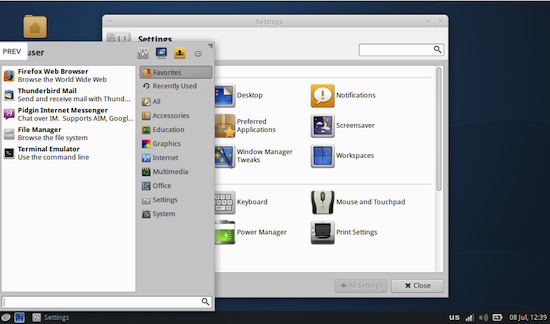 It runs well on old feeble hardware and now offers multiple download options: 32- or 64-bit x86, and full or minimal core versions. Point Linux is based in Russia and has good comprehensive localization. If you miss the Ubuntu of old, when it had the best GNOME 2 implementation of any distro, then you might like Point Linux.
 Android-x86 is 100 percent open source. If you’re looking for an active, important project to contribute to, consider this one.