
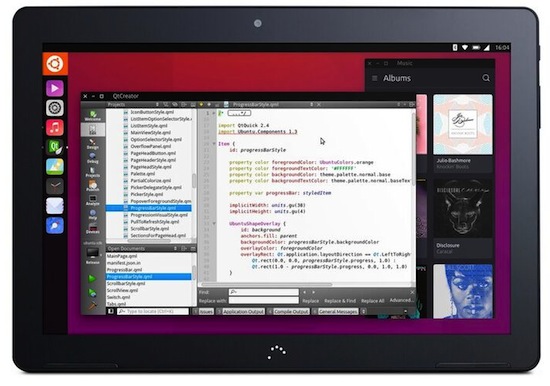
 Three years after Canonical unveiled its Ubuntu for Tablets platform, shortly after announcing the related Ubuntu Touch stack for phones, the company announced the first tablet to ship with Ubuntu Linux. The Ubuntu version of BQ’s 10.1-inch Aquaris M10 will go on sale in March at an unstated price (see below for tech details). The 64-bit, ARMv8 Aquaris M10 Ubuntu Edition will be the first product to ship with the long-promised “convergence” version of Ubuntu, enabling a PC-like experience with a mobile device.
In the press call for the announcement, which had partially leaked in recent weeks, Canonical CEO Jane Silber almost apologized for hyping the release of a tablet, a form-factor that has seen reduced popularity. Yet, the convergence capability makes the tablet especially notable, she argued.
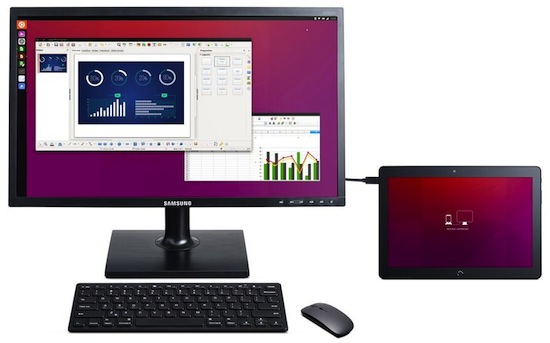
If you plug in a Bluetooth dongle for a keyboard and mouse, Ubuntu immediately recognizes the new input methods, and if you connect the tablet to a larger display, Ubuntu immediately scales to the larger screen. With a larger display, a “side stage” feature kicks in that presents multiple open windows for different applications, as well as multi-column text options.
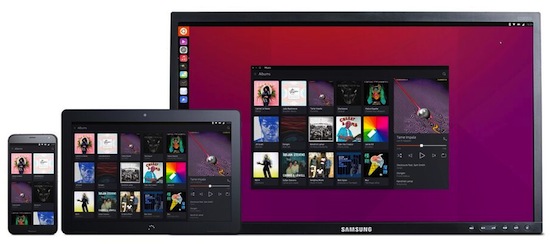
 According to Silber, a convergence version for phones is also being released for Ubuntu Touch phones. These include the BQ Aquaris E4.5 Ubuntu Edition, Meizu MX4, and BQ Aquaris E5 HD phones, all of which shipped last year and sold out, according to Silber. Convergence-ready phones will ship “later this year,” she added. The converged phone stack will offer at least one more convergence trick: the ability to use a desktop interface to control the phone’s telephony and messaging applications.
A Spanish-language Xataka report on the new tablet, cited by PC World in its January 25th story about the tablet rumor, claims that BQ is prepping a new Ubuntu phone called the Aquaris X5 Plus. Xataka did not say whether the phone would offer convergence.
It appears that the upcoming Ubuntu 16.04 “Xenial Xerus” LTS release due in April will be the first true convergence release. According to PC World, it will still be optional, however, with a traditional Unity 7 build with X.org available alongside the newly converged Unity 8 with the new Mir display server. The new tablet, and Unity 8, will feature Ubuntu Touch’s Scopes interface, which presents frequently used content and services as an alternative to traditional apps.
In addition to automatically changing the interface in response to new screens and input devices, Ubuntu is also providing convergence on the application development level. Developers are already developing single apps that can automatically morph into desktop, phone, and tablet formats.
 The impact of Ubuntu convergence has been somewhat muted by Microsoft’s recent release of a similar Continuum feature on recent Windows 10 phones. Continuum lets you plug in a phone to a monitor, and use a keyboard and mouse in a PC-like interface. Continuum has some performance issues, however, and only works with core apps.
In the press call, Silber noted that “Microsoft hasn’t converged the underlying platform like we have.” The announcement, meanwhile, refers to the converged Ubuntu as “the only platform that runs both a mobile-based full touch interface and a true PC experience from a single smart device.”
Also in the announcement. Silber appears to be alluding to Continuum when she is quoted as saying: “This isn’t a phone interface stretched to desktop size — it’s the right user experience and interaction model for the given situation.” Silber also claims that Ubuntu is alone in providing “a single, visual framework and set of tools for applications to run on any type of Ubuntu smart device.”
Enterprises will be particularly drawn to Ubuntu convergence devices like the new tablet, said Silber. She noted that there’s limited UI diversity in Android, especially if vendors want an officially sanctioned device with Google Apps. By comparison, Ubuntu is far more customizable and open to third-party branding, she claimed. The announcement also notes enterprise friendly features like Ubuntu’s support for Virtual Desktop Infrastructure (VDI) and thin client services, as well as advanced security.
The tablet announcement continues a string of good news for Canonical in 2016, most of it on the cloud enterprise front. Among other wins, Microsoft announced a technical preview of the Microsoft Azure Stack with Ubuntu, increasing the integration of Ubuntu with the Azure cloud platform. More importantly, AT&T chose Ubuntu and Canonical as its cloud, enterprise, and application solution provider, beating out IBM and Microsoft. Should the relationship prove fruitful, it’s possible Canonical could find its first U.S. carrier for Ubuntu Touch products.
Before that happens, AT&T, as well as other carriers and hardware vendors, will want to see more progress in app availability. According to Canonical, “hundreds of apps and scopes are already available in the Ubuntu App Store.” That’s a drop in the bucket, however, compared to the millions of apps available for Android and iOS. Silber cited research claiming that most mobile device consumers install only about 64 apps. However, “the challenge is that only 30 of those are common,” she added.
Inside the Aquaris M10 Tablet
For years, vendors have loaded Ubuntu onto tablets, and last year, a Chinese company called Cube showed off an Ubuntu- or Windows-based i7-CM 2-and-1 tablet running on an Intel Core CPU. However, without an integrated, homegrown touch interface, none of these products have been very successful. It’s not a stretch, then, to say the Aquaris M10 is the first real Ubuntu tablet.
The Aquaris M10 is equipped with a 64-bit, quad-core, Cortex-A53 MediaTek MT8163A system-on-chip clocked to 1.5GHz, along with a high-powered ARM Mali-T720 MP2 GPU. The tablet ships with 2GB of RAM, 16GB flash, and a microSD slot.
No resolution was listed for the 10.1-inch touchscreen, but considering the 1.5GHz clock rate, this would appear to be the “Full HD,” 1920×1200-pixel, 240ppi version of the tablet featuring an MT8163A SoC. Spanish vendor BQ also sells a version with a 1.3GHz MT8163B SoC that tops out at 1280×800 pixels and 160ppi.
The BQ Aquaris M10 is further equipped with an 8-megapixel camera with HD recording, plus a micro-HDMI port, speakers, and a 7280mAh battery, says Canonical. The 24 x171x8.2mm tablet weighs 470 grams. BQ lists some additional specs for the existing Android-ready device, including a micro-USB OTG port, a 3.5mm audio jack, 802.11b/g/n WiFi, Bluetooth 4.0, and GPS.
 OpenMP is basically fine-grained, in that parallel parts of the application are created and destroyed multiple times throughout a run. …
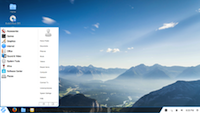 Zorin OS is a Linux distribution that uses Ubuntu as its base and tries to provide a user interface which will be familiar to former Windows users. The latest release of Zorin OS, version 11, is based on Ubuntu 15.10 and features a number of tweaks to the to the desktop environment. “We’re excited to finally announce the release of Zorin OS 11 with the availability of the Zorin OS 11 Core and Ultimate editions. With Zorin OS 11, we’ve focused on improving the overall desktop user experience,…
 All good things must come to an end, and so SUSE and the openSUSE Linux community today, February 3, 2016, announced that they will no longer support the openSUSE 13.1 operating system.
 Are you a Windows power-user? You can get and install Linux Mint running on your PC — either to try it out, or as a replacement for Windows.