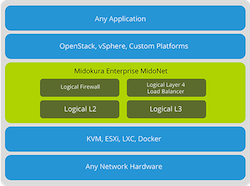
 Midokura has released Midokura Enterprise MidoNet (MEM) 5.0, a network virtualization product designed for Infrastructure as a Service (IaaS) clouds. MEM 5.0 builds on Midokura’s open source, highly scalable, network virtualization system — MidoNet — to support network virtualization deployments with enhanced tools for OpenStack operators.
According to the announcement, “MEM 5.0 offers an intelligent, software-based network abstraction layer between the hosts and the physical network, allowing operators to build isolated networks in software overlaying pre-existing, hardware-based network infrastructure.”
This type of network function virtualization (NFV), which lets companies move network services traditionally carried out by proprietary, dedicated hardware into the cloud, has seen huge growth over the past few years. And, a fivefold increase in revenue, to $11.6 billion, is projected for the NFV and Software-Defined Networking (SDN) market by 2019.
Pino de Candia, CTO of Midokura, explains the technology explosion this way: “The value proposition for SDN was initially for disaggregation of the silicon-based networking equipment and decoupling it from the network operating systems. This strategy was certainly attractive to web-scale companies like Facebook, Google, and Amazon, who need the flexibility and cost efficiency of commodity “white box” switches. Those companies essentially want to replicate the formula from Open Compute to Open Networking.”
However, he says that a more compelling use case for SDN/NFV in the enterprise is security. “Virtualizing network nodes and implementing fine-grain security at the virtual machine and container level is driving the use case for NFV-enabled security.” (For more details, see Pino de Candia’s recent Huffington Post article, “Why the Cloud Has a Security Problem.”)
Open source also plays a role in this infrastructure change. De Candia says, “Foundational technologies like OpenStack and Docker are becoming the standard for building infrastructure clouds and platform as a service (PaaS), respectively.” MidoNet itself is built on open source elements including Apache Zookeeper, Cassandra, and ELK stack. “Building on open source helps our developers bring innovations far more quickly into MidoNet,” he says.
 MEM 5.0 specifically offers more security and simplicity, along with more support for Docker. Additionally, OpenStack users benefit from advanced data visualizations that provide up-to-date details about the state of the virtual network. “Operational tools are generally geared towards configurations, monitoring in OpenStack, but they offer no visibility into encapsulated traffic…. MEM 5.0 builds upon our popular technology to meet this need, making OpenStack far simpler to manage, operate, and also troubleshoot,” de Candia says.
MEM 5.0 emphasizes the simplification of OpenStack management, which is often viewed as complex. A recent report commissioned by openSUSE, for example, cited difficulties associated with deploying OpenStack as a factor in slowing OpenStack adoption.
De Candia, however, says, “From our vantage point, getting started and running OpenStack can be done with a lean and agile team. Gone are the days when you needed a dedicated systems admin for Linux and Windows, another certified network admin or storage admin. A single cross-functional operations team with Linux competency is all you need. Companies are choosing OpenStack for consistency of operations, centralized policies, and management — IT silos have been shown to be inefficient and costly to manage.”
Learn more:
Check out these new courses from the Linux Foundation to improve your OpenStack skills:
Essentials of OpenStack Administration is a classroom-based training course aimed primarily at those who are deploying applications and infrastructure on OpenStack.
OpenStack Administration Fundamentals is a self-paced course that provides everything you need to know to administer public and private clouds with OpenStack.


 Canonical, the company behind the world’s most popular free operating system, Ubuntu Linux, has published multiple Ubuntu Security Notices to inform users about major kernel updates for all of its supported Ubuntu OSes.
 One of the benefits of the
  It’s been more than five years since the launch of Illumos as the concerted, community-based effort around the OpenSolaris code-base. This truly-open Solaris stack continues to be at the heart of OpenIndiana, SmartOS, Dyson, and other operating systems.