 CES is arguably the biggest tech unveiling of the year and I always look forward to attending to get a feel for where the industry thinks the market is heading. As an attendee, if you look through the glitz, hype and products, you can see into the Matrix and spot the trends that flow through it. My focus this year was 100 percent on the Internet of Things. Specifically, I was on the hunt for evidence that the mainstream of companies building connected products are moving beyond Nikola Tesla’s 1898 model of “teleautomaton” (aka the remote control) to something bigger, better and far more powerful…
To cut to the chase, most of what I saw at CES were me-too teleautomations, connected gewgaws, the technical equivalent of Coelacanths, following a device-cloud-app architecture of days-gone-by to deliver islands of connectivity. That really disappointed me because I, no we, all want more.
We want an ‘Open IOT’ where billions of smart connected products, devices and applications all speak the same language, enabling simple and secure connection and communication, and where everybody – not just the Technorati – can combine those smart connected products into solutions that improve our lives, workplaces and communities.
So how, you ask, do we get to this utopian world where users combine connected products in ways that transform their lives, where the “created creates creators”? To paraphrase Newton, we stand on the shoulders of giants.
Lucky for us, we can do that easily because a history of success is all around us. Versions of this story have already played out, over and over again. Proprietary gives way to open, communities form, competing models converge, interoperability becomes the norm and the world is transformed. Email, the Web and Linux are all shining examples of the power of open.
We need an open IoT. Because as history has taught us, once we have billions of interoperating devices, the IoT will no longer be an idea or a story, it will be part of the fabric of our lives. Consumers won’t need manuals, user forums, 800 numbers or IT skills to make everything around them connect and meet their needs. New products, services, companies, markets and industries will be born. Users will become creators of the experiences they want, using everything in the environment around them. We will know we succeeded when it’s no longer “IoT technology,” but when everything is simply interactive and responsive, as expected.

So off my soap box and back to CES…
There were two bright shiny areas in the CES 2016 Matrix. The first was the emergence of the user in the IoT story. This was evident in products that have adopted the open model to deliver experiences to users that reach beyond a single company or ecosystem. These products – Lowe’s Iris, iControl’s Piper and Technicolor’s Ize – are all amazing examples of wide integration through open protocols to help users solve real problems by being in control of the experience and its embodiment. In short, these companies have opened their thinking and their products to become part of the emerging open IoT.
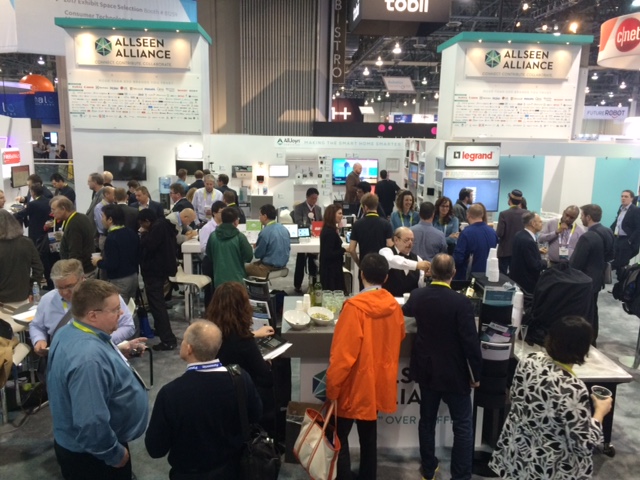
The second was the continued momentum of the AllSeen Alliance, a Collaborative Project managed by the Linux Foundation, on behalf of the Alliance’s 200-plus member companies. This open community is collaborating on a common technology framework and shared standards to deliver the common language needed for an open IoT. Members of the Alliance pool their knowledge and technical resources to advance the open source AllJoyn® framework and deliver interoperable IoT products to market. At CES 2016, the AllSeen booth was filled with tons of real products that consumers can buy today, garnering heavy traffic, happy members and engaging conversations. Nearly two dozen products are now AllJoyn Certified, ensuring consumers that AllJoyn products will work seamlessly together to enable more than just a remote control.
Mike Krell of Moor Insights & Strategy summed it up well in Forbes:
“[At the AllSeen Alliance] they understand it’s all about the consumer and delivering integrated solutions that change the way people live. The products in their booth were all about getting solutions to market that make people’s lives easier, and their membership represents home automation brands that people care about. The framework they provide is designed to make it simpler and easier for vendors to integrate their solutions, providing a simpler way to make lifestyle scenes happen.”
I firmly believe that an open IoT will enable the IoT ecosystem the world wants and needs. I’m delighted that the AllSeen Alliance continues to build on that vision, and even more so by the fact that we are starting to see products come to market, embodying that vision. In 2016, I see the IoT ecosystem rapidly converging towards a common, open model that delivers solutions, not things, to people everywhere so they can solve problems, live better lives, save money and have more fun. With an open, common ecosystem, the possibilities are endless.
Philip DesAutels is the Senior Director of IoT at the AllSeen Alliance, a Linux Foundation Collaborative Project. To learn how to get your company’s products or services AllJoyn Certified, visit allseenalliance.org/certification.

 First round of devices to get the official IPv6 Ready CE Router Logo debut as challenges remain for broader IPv6 adoption.
 This visualization from CSCS in Switzerland shows the world’s smallest integrated switch. “Researchers working under Juerg Leuthold, Professor of Photonics and Communications at ETH Zurich, have created the world’s smallest integrated optical switch. Applying a small voltage causes an atom to relocate, turning the switch on or off. ETH Professor Mathieu Luisier, who participated in this study, simulated the system using Piz Daint Supercomputer. The component operates at the level of individual atoms. “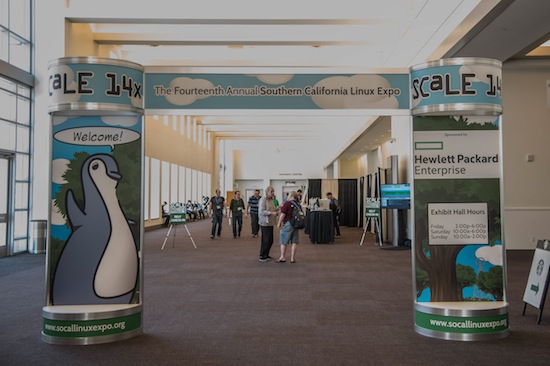
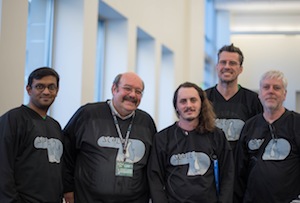 The 14th edition of this event was held at the Pasadena Convention Center in warm and sunny Pasadena, California on Jan. 21-24, 2016. What impressed me the most about the event was the “scale” of organization. SCaLE is similar to European FOSDEM in the sense that it’s fully organized by volunteers and managed by a committee including Hriday Balachandran, Larry Cafiero, Ilan Rabinovitch, Gareth J. Greenaway, and Ron Golan, who, along with about 100 other volunteers, make SCALE happen.
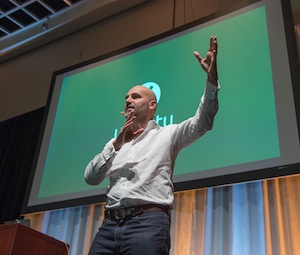 Shuttleworth talked about celebrating the diversity in the open source world and mentioned how Ubuntu is growing to address different needs from different markets — from IBM mainframes to drones to smart cars.