 Companies see a real business advantage to using an open source private cloud, but a shortage of IT professionals and business managers skilled in OpenStack may be preventing them from moving to the open source cloud platform, says a new report commissioned by SUSE, which offers a private cloud product based on OpenStack.
In addition to building organizational skills and business processes around a private cloud, companies have a technical challenge “which is less about how to get cloud installed and running and more about how to take advantage of cloud to really improve application scalability,” says Pete Chadwick, Senior Product Manager, Cloud Infrastructure Company at SUSE.
The report, released today, looked at how large companies around the world are using cloud services, particularly OpenStack. This research polled 813 senior IT professionals in seven countries from companies with 250 or more employees. According to the report, 90 percent of large companies have implemented at least one private cloud solution to date.
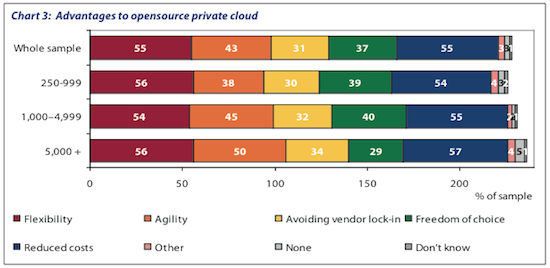
What’s behind this move to the cloud? The report states that 67 percent adopted cloud solutions for financial reasons and 77 percent did so for agility/innovation purposes. Specifically, 96 percent of respondents see business advantages to implementing an open source private cloud. Topping the list of advantages are flexibility and reduced costs (both 55%), followed by agility (43%) and freedom of choice (37%).
 The report also says that 66 percent of respondents are considering moving to OpenStack at some point, and 15 percent have already done so. Those planning to move to OpenStack appear evenly divided over the best approach:
“We believe the overall findings speak very positively about the level of trust and confidence that enterprises have in OpenStack,” said Ralf Flaxa, SUSE vice president of engineering in the report announcement. “Understandably, there are clear concerns among customers about how their cloud infrastructure should be integrated and managed.”
One stated concern is a growing skills shortage in the industry:
-
86 percent of these senior IT professionals say that a lack of available skillset is making their company reluctant to pursue private cloud.
-
78 percent of those companies that have not yet adopted private cloud are put off by the skills shortage.
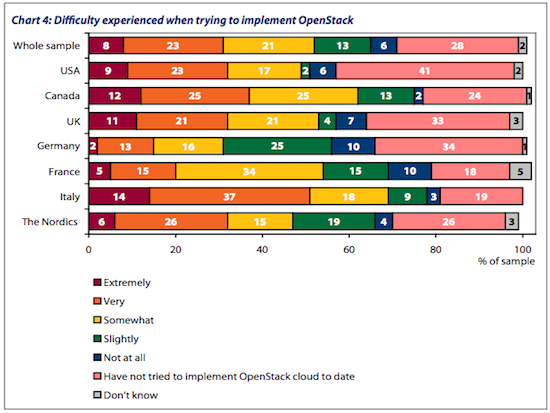
Only 28 percent of companies say they have not yet tried to implement OpenStack cloud at all. However, 65 percent of companies who have tried found the experience difficult, and 31 percent described it as very or extremely difficult. Nonetheless, the report says “the more difficult companies have found their attempts to move to OpenStack, the more determined they seem to be to make it a success in the future.”
SUSE’s Chadwick says that success in private cloud deployment depends on organizational considerations as well as technical skills. In his view, building an OpenStack implementation from scratch is a relatively complex task and using commercial software can help companies deal with the skills shortage. Such companies, he says, “are focused on providing training on how to use the cloud or training existing systems administrators on using installation and management tools that simplify deployment and operation of OpenStack.” Additionally, Chadwick sees “an increased interest in understanding the higher level capabilities in OpenStack that enable more dynamic control and configuration of workloads.”
Chadwick believes that companies seeking OpenStack training should focus on what is truly important for their business. “Most companies do not need to have their staff drill down on all the technical details of how OpenStack works and should instead be focused on how to derive value from the cloud. Getting trained on how to build applications for developers and how to optimize cloud operation for administrators are the most critical to long term cloud success,” he says.
To help address the skills shortage, the Linux Foundation recently launched Essentials of OpenStack Administration, a classroom-based training course aimed primarily at those who are deploying applications and infrastructure on OpenStack. A self-paced training course, called OpenStack Administration Fundamentals, will be available later this month.

 Solomon Hykes, Docker founder, explains how Unikernel and the concept of purpose-built microkernels will improve the future of computing.
  The former CEO of Mozilla and creator of JavaScript, Brendan Eich, has announced the launch of a new browser named Brave that’s going to treat ads in a very different way.
 Fracturing a site’s contents into a plurality of arbitrary domains to improve performance is