Home Blog Page 909

Snappy Ubuntu 16.04 LTS Will Let You Build Kernel Snaps via Snapcraft, Says Mark Shuttleworth

snappy-ubuntu-16-04Ubuntu on the phone, tablet or desktop is not the only thing Canonical is working on in 2016, as Mark Shuttleworth and his team of skilled IoT engineers over Canonical are planning great new features for the Snappy Ubuntu Core operating system for embedded and Internet of Things devices.

We reported last week that Canonical announced the release of new Snappy Ubuntu 16.04 LTS (Xenial Xerus) images with the all-snap architecture for Raspberry Pi 2 and 64-bit devices, powered by Snappy 2.0. At the moment, all these technologies are in development, but they will get a final release on April 21, 2016.

How to block an IP address with ufw on Ubuntu Linux server

I am using UFW to manage firewall on my Ubuntu Linux 12.04/14.04 LTS server. I need to block a specific IP address from accessing my server. How do I block an IP address using ufw?

Read more…

How To Patch and Protect Linux Kernel Zero Day Vulnerability CVE-2016-0728 [ 19/Jan/2016 ]

A very serious security problem has been found in the Linux kernel. A 0-day local privilege escalation vulnerability has existed since 2012. This bug affects millions of Android or Linux applications to escalate privileges. Any server or desktop (32 or 64 bit) with Linux Kernel version 3.8+ is vulnerable. How do I fix this problem?


Read more…

Deepin Takes Linux to New Depths

deepinThe latest release of the Linux distro now called “Depth OS” deserves serious consideration. It is fast, reliable and innovative, with an impressive homegrown desktop design dubbed “Deepin Desktop Environment.” Depth OS has a bit of an identity problem. It’s not well known outside Asia and Europe, but that’s not the major cause of confusion. The problem is that the open source community that developed the distro seems to have a difficult time deciding what to call it. It has had several names, including “Hiweed GNU/Linux,” “Linux Deepin,” “Deepin” and now “Depth OS.”…
Read more at LinuxInsider

Why Sustainable Software Needs a Change in the Culture of Science

“Scientific research is dependent on maintaining and advancing a wide variety of software. However, software development, production, and maintenance are people-intensive; software lifetimes are long compared to hardware; and the value of software is often underappreciated. Because software is not a one-time effort, it must be sustained, meaning that it must be continually updated to work in environments that are changing and to solve changing problems. Software that is not maintained will either simply stop working, or will stop being useful.”…

The goal is to encourage software developers, whatever the type of software they are developing, to do the extra work needed to make their own software sustainable and to build or join communities whose members work together on shared code. The task is how to achieve this. 

Read more at insideHPC

New Prime Number Discovery Breaks Record at 22 Million Digits

A new highest known prime number has been calculated, clocking in at nearly 5 million digits more than the previous record holder.

Prime numbers, which can only be divisible by themselves, are presumably infinite. However, the higher you count, the fewer and farther between prime numbers are. The previous highest known prime number held the record for nearly three years. On January 25, 2013, 2 to the power of 57,885,161 minus 1, a figure 17,425,170 digits long, was announced by Great Internet Mersenne Prime Search… GIMPS has just announced a new record.

Read more at The Open Road

$65 Hacker Board Runs 64-Bit Linux on Quad-Core Atom

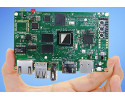
jaguarboard hand-thmThe Linux- and Android-friendly “JaguarBoard” SBC, based on a 64-bit quad core Atom processor, has achieved 600 percent of its Kickstarter funding goal.

Hong Kong-based Jaguar Electronic HK’s successful Kickstarter campaign for a $65 “JaguarBoard” SBC based on the quad-core Intel Atom Z3735G processor will end on Jan 22, having conjured up more than six times its modest $3,000 funding goal. Manufacturing of the first batch of boards is in process, with first shipments expected to go out within a few weeks, says the company. Once the Kickstarter project closes, the retail price is expected to rise to $79.

Read more at LinuxGizmos

Canonical and BQ to Unveil the First Ubuntu Tablet That Runs X11 Apps at MWC 2016

canonical-and-bq copyThere you have it. Canonical promised this for a long time now, and it would appear that the London-based company behind the world’s most popular free operating system, Ubuntu Linux, will finally unveil the first ever, real Ubuntu tablet device this year, during the upcoming MWC (Mobile World Congress) 2016 event.

MWC 2016 will take place at the end of next month, between February 22 and 25, and Canonical will be there, as usual, to present its latest work. The first Ubuntu tablet to run the Ubuntu Touch operating system, which is currently used in several Ubuntu Phone devices, will be unveiled…

openSUSE Makes the Leap to the Public Cloud

openSUSE Leap 42.1 is now available on Amazon EC2, Google Compute Engine, and Microsoft Azure. Leap has been available on EC2 & GCE since shortly after it release; the Azure release was delayed due to a qemu bug resulting in incorrectly formatted images. These images are maintained by SUSE’s Public Cloud Engineering Team. If you’d like to peek inside, they’re developed on Open Build Service (OBS), in the Cloud:Images project.

Amazon Web Services

For Amazon EC2, openSUSE Leap 42.1 is published for HVM, 64-bit, SSD-Backed instances. If you’re using the web portal, search for ‘leap’ in the openSUSE Community AMIs. If you’re using command line or automated tools, here are the AMI IDs:

Read more at openSUSE News

How to setup a intermediate compatible SSL website with LetsEncrypt certificate

Many people have decided to implement Let’s Encrypt into their production sites. I find this still a very bad idea to be done without being very (but really very) careful. Let’s Encrypt brings you freedom but also limits you in using the certificate with SHA-256 RSA Encryption. Support for SHA-2 has improved over the last few years. Most browsers, platforms, mail clients and mobile devices already support SHA-2. However, some older operating systems such as Windows XP pre-SP3 do not support SHA-2 encryption. Many organizations will be able to convert to SHA-2 without running into user experience issues, and many may want to encourage users running older, less secure systems to upgrade. In this tutorial, we are going to deal with this incompatibility in a simple, but still nasty way.

Read more at HowtoForge